Author Archive
Fake Art Can Be Detected Because of Nuclear Bombs Detonated in 1945
By Chad Upton | Editor
Art forgers have become experts at creating the types of paints and canvases used during popular and valuable art periods, to the point that art experts may not be able to distinguish a fake from the real thing.
But, Dr Elena Basner, a long time art curator, worked with scientists to create a much better way to detect forged oil paintings.
Prior to the first nuclear bomb detonation in July of 1945, isotopes such as strontium-90 and cesium-137 simply did not exist in nature. They were created by the massive neutron bombardments that occur during a thermonuclear explosion.
Since those isotopes didn’t exist in nature prior to 1945, paintings created prior to 1945 could not contain them originally.
550 nuclear bombs were detonated from 1945 to 1963, when most nations agreed not to test nuclear weapons any longer. The isotopes created during this period bind with the types of crops that are used to produce oil based paints. Therefore, oil paintings created after 1945 will contain trace amounts of these new isotopes.
If someone is trying to pass a work that is dated prior to 1945, but it contains these isotopes, it is almost certainly a fake.
Broken Secrets | Facebook | Twitter | Email | Kindle
Sources: TheArtNewspaper.com, Wikipedia (Nuclear Weapon)
How to Maximize a Window in Mac OS
By Chad Upton | Editor
One of the most annoying Mac OS traits is the inconsistent behavior of the maximize (aka “zoom”) button.
Some native apps, such as iCal, Mail, iPhoto, behave as you might expect and completely fill the screen when the maximize button is clicked. But, many other applications do not fill the screen, instead they the button maximizes the height of the window, but not the width.

But, there is another trick that maximizes some other applications, such as Chrome. Holding down shift while clicking the green maximize button, will maximize the window to fill the screen.
Magazine Subscription Expiry Date is on Address Label
By Chad Upton | Editor
I love books and magazines and I mean real books and real magazines, printed on paper.
Sure, I love their digital counterparts too. They have snazzy interactive layouts, rich multimedia and they’re always in your pocket. But, sometimes less is more.
There is something powerful and irreplaceable about ink and paper. The experience is linear and there are few distractions along the way. Most importantly, there are no instant notifications, no batteries and you have to actually see one of your real friends to “share” it with them. On paper, you’re alone with your thoughts. Ten percent of that is because the medium consumes you, the remaining ninety percent is because there are no stupid comments at the bottom of each page.
That’s not to say all comments are stupid, there are plenty of useful and thought provoking comments on the internet. But when there are no comments at all, there can’t be any stupid ones either. Comments should be consumed for dessert; people should think for themselves before eating honey from the hive.
That’s where pages beat pixels.
It is why I have books and magazine subscriptions. But, it’s not all rainbows and unicorns. First of all, there are at least three subscription cards in each magazine. They should do a print run for subscribers that is exempt from the inserts. That would be a significant incentive for readers to actually subscribe! In the meantime, I’ll keep shaking them over the recycling bin.
Publishers also suggest renewing your annual subscription on what seems like a bimonthly basis. So, it’s helpful to know when your subscription really expires.
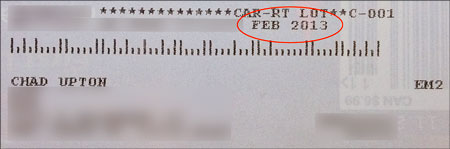
Thankfully, they put the expiration date right on the address label.
Halloween Secrets
By Chad Upton | Editor
Trick or treating can be traced back to European “guising” traditions where children would travel from home to home, reciting songs, jokes or poems. They didn’t say “trick or treat” back then, it was “please help the guisers” — a reference to the groups who performed plays to ward off evil spirits during Samhain, the Celtic celebration we now know as Halloween.
The children were often given fruit, nuts, sweets or even money. Trick or treating started to take hold in North America during the middle of the 19th century, although it was put on hold for sugar rationing during World War II.
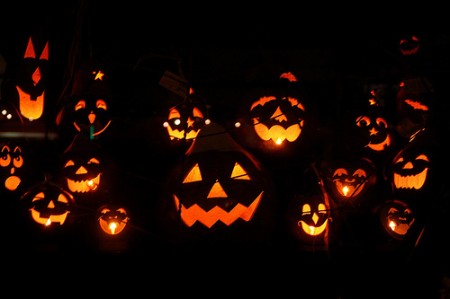
The Celts believed spirits of the dead would walk the earth on Halloween. Costumes were worn to help blend in with and hide from the real spirits who were thought to be walking among them.
The traditional colors of halloween, Black and orange, have meaning too. Black is the typical color of death in many cultures and orange symbolizes strength in Celtic legend, which was important for weathering a harsh winter. They burned large bonfires, believing this would bring the heat of the sun back after winter. Animal bones were often thrown into the fires and some believe these “bone fires” spawned the term bonfire.
Broken Secrets | Facebook | Twitter | Email | Kindle
Photo: José Luis Murillo (cc)
Sources: History.com, IrishCentral.com, Answers.com,
Arcade Claw Games are Rigged
By Chad Upton | Editor
The claw game (aka “crane games” or “fairground grabbers”) are pretty straight forward in appearance: put in your money, position the crane over a prize, drop the claw and hope your aim was good enough to bring home the prize.
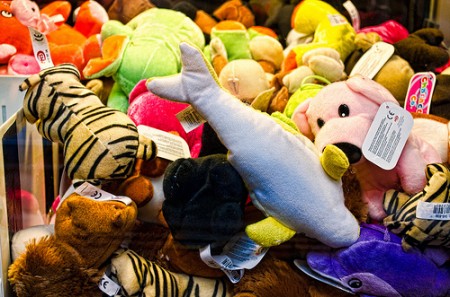
But, winning a prize requires a lot more than skill. These machines are like slot machines, except children are allowed to play. Just like a slot machine, the operator can dial in how often the machine should pay out.
The crane game machine reduces the claw strength when the player is supposed to lose and increases its grip strength when the player is allowed to win. In that sense, they’re worse than slots because the player still requires some skill when the odds are in their favor.
The odds of the machine giving the claw enough strength to win a prize is regulated by some states and therefore varies. In California, the claw must have enough strength to win during an average of 1 in 12 games. In Nevada, it’s 1 in 15 games. In other words, during 1 in 15 games the claw will be strong enough to pickup a prize, but you still have to aim it well. (more…)
Point Blank Range Can Be Over 100 Yards
By Chad Upton | Editor
The phrase, “point blank range” is frequently used in tv shows and news reports to indicate a shot was fired within an short range (usually a few yards or meters).

While that usage is accurate, the phrase is rarely used to describe shots from further away that are still point blank range.
You see, Point Blank Range simply means: a distance at which the shooter does not need to compensate for gravity by adjusting the elevation of their weapon.
Due to the velocity of the projectiles, some weapons and ammunition have a point blank range of over 100 yards (91m). Due to recoil, some cannons can shoot over 1000 yards without elevation compensation; therefore they have a point blank range of over 1000 yards (914m).
Broken Secrets | Facebook | Twitter | Email | Kindle
Photo: calflier001 (cc)
Source: point blank range
Party Cup Ridges are Measurement Markings
By Chad Upton | Editor
Now that college is back in session, it’s time to learn something really useful. Party cups aren’t just for playing beer pong and flippy cups; some people use them exclusively for serving drinks. They’re great for cash bars and beer pong for the same reason: the ridges can be used to measure servings.
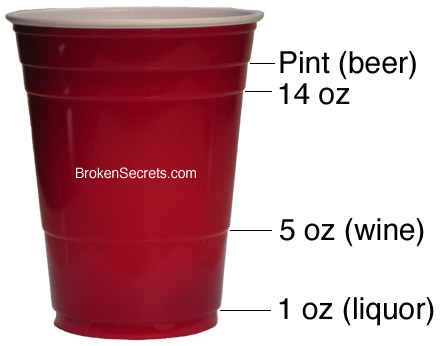
Starting at the top, the lines are as follows:
- First Line: 16 oz / Pint (beer)
- Second Line: 14 ounces (mixed drink fill line)
- Third Line: 5 ounces (wine / ice fill line for soda / beer pong fill line)
- Fourth Line: 1 ounce (liquor)
Most of these measurements are pretty common serving sizes for various types of alcohol. For example, 1 oz of 100 proof liquor has about the same alcohol as 5 oz of wine and each are considered “1 drink”. For beer, 10 – 12 ounces is considered 1 drink, but a pint is a typical serving size no less. (more…)
2012 Olympic Gold Medals are Mostly Silver
By Chad Upton | Editor
A gold medal has been awarded to the top Olympic athlete in an event since the 1904 St. Louis Summer Olympics. Although this tradition has stuck, many things have changed since the St. Louis games.
I hadn’t planned on writing much about the St. Louis Olympics, but some of the research proved too bizarre to hold back. For starters, the games were supposed to be in Chicago; but, the World Fair organizers in St. Louis promised to hold their own sporting event that would eclipse the Olympic games, unless they were awarded the games. So, the games were awarded to St. Louis.
 During the marathon, Frederick Lorz dropped out of the race after nine miles and rode a car back to the start/finish to collect his clothes. But, the car broke down so he had to run the rest of the way. Officials thought he was the first to finish and he went along with it, but was later caught and banned for a year. The following year, he did win the Boston Marathon fair and square.
The actual winner of the marathon, Thomas Hicks, had a bit of help from his trainers who gave him a mix of brandy and strychnine sulfate — a poison which isn’t lethal in small doses and “stimulates” the nervous system. A postman from Cuba, Felix Carbajal, also ran in the marathon. He he snacked on rotten apples in an orchard, took a nap and then finished in fourth place. (more…)
UPS Co-Founder Wanted Yellow Trucks
By Chad Upton | Editor
In 1915, Merchants Parcel Delivery (now UPS) decided they needed a consistent color scheme across all of their vehicles — four cars and five motorcycles. Co-founder James Casey consulted a local adman, who suggested yellow. Charlie Soderstrom, another partner, argued that yellow would be too difficult to keep clean.
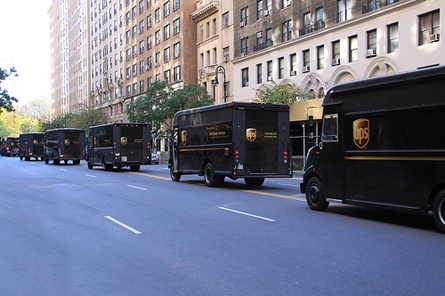
Another company had already considered this. Railroad cars manufactured by Pullman Company were brown because they hid dirt better than other colors which meant they required less washing. That settled the argument, Casey conceded and brown has been UPS’s color ever since.

Half a century later, competing package delivery service DHL forms and chooses yellow.
Broken Secrets | Facebook | Twitter | Email | Kindle
Photos: Jeremy Vandel (cc), wolfgang (cc)
Sources: cnn, wikipedia (ups, pullman company)
You Can Print Your Own Passport Photo (in the US)
By Chad Upton | Editor
If you’ve ever had a really embarrassing driver’s license photo, you have to live with it. But, Americans have the luxury of shooting and printing their own passport photo.
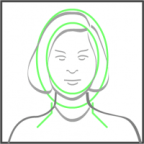
Drugstores charge about $10 for passport photos while professionals charge as much as $50. There is some skill involved since there are strict rules around the shadows, head size, facial expression, dimensions, etc. But, if you get all that right then you can have a great photo that costs as little as 19 cents to print. (more…)


 Broken Secrets