Your Passport May Expire Before The Expiry Date
By Kyle Kurpinski
Expiration dates are funny things. For instance, if I take a swig from a jug of milk that expires next week, I expect to get a mouthful of milk, not sour gym socks. Unfortunately, expiration dates are occasionally imperfect, and the gym sock thing tends to happen from time to time. But when it comes to something non-perishable, like a coupon booklet or an driver’s license, these dates should be a little more concrete. Or so you would think, anyway.
My cousin was recently on her way to Malaysia when she encountered a bit of a snafu at the airport. For travel to Malaysia, it’s not enough to simply have a “valid” passport (i.e. one that has not yet expired). Rather, US citizens must have at least six months remaining before the printed expiration date. My cousin only had five. She actually made it all the way through security before the airport authorities realized their mistake and stopped her from boarding. Trouble is, she had already flown from Portland to San Francisco with her sorta-valid passport, and now she had no choice but to turn around and go back. Even if her trip to Malaysia was only going to last one day, travel regulations would still have forbade the journey without the six-month buffer. I’m sure there are plenty of logical reasons for such a requirement (contingency for an unexpectedly prolonged trip, prevention of illegal immigration or fraud, etc. etc.), but my cousin’s experience still seems like the travel equivalent of buying your milk in May only to discover that it already soured last Christmas.
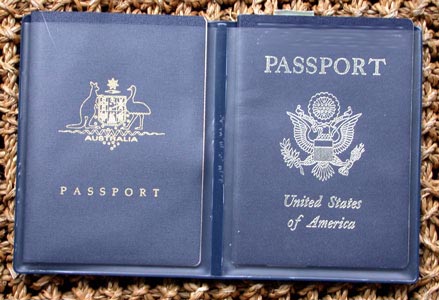
To make things even more complicated, each country has its own unique rules regarding passport validity. Most countries simply abide by the given date, but some – such as Malaysia, Brazil, and India – require a six-month window, while others – such as Switzerland, Greece, and Denmark – require only three months. When exactly does this window start or end? That’s different for every country too. In some cases it’s calculated from the date of entry into the foreign territory, while in others it’s based on the return date. If you’re planning to travel abroad, you can find the specific rules for each country on the State Department’s website.
Keep in mind that passport renewals typically take about six weeks, so it’s always best to plan ahead when making your travel arrangements. If you’re just learning of these rules before an impending trip, you can apply for an expedited renewal, which takes only two weeks, but also costs an additional $60. If you’re already at the airport (like my cousin was) please have a safe trip back to your house.
Broken Secrets
Get updates from: Facebook | Twitter | Email | Kindle
Photo: Amy Barker (cc)
Sources: Wikipedia , Joel Widzer, and The U.S. Department of State
Boxed Wine Isn’t Necessarily Bad Wine
By Chad Upton | Editor
Some people subscribe to the idea that “no wine is bad wine,” and while I agree with the sentiment, I disagree with the statement. Thankfully, bad wine is easy to avoid and award wining wine can be cheap too, especially if it’s in a box.
If you’re not familiar with boxed wine, it consists of a plastic membrane (full of wine) with a spout for dispensing. The “bag” is placed in a cardboard box so it stays vertical for proper dispensing; this also gives it a smaller footprint on the shelf or in the fridge.
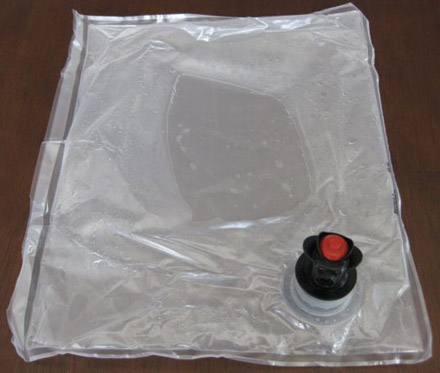
This is a near perfect container for wine. Since wine spoils with exposure to air, the self collapsing nature of this package preserves the wine much longer and more conveniently than a glass bottle and a typical air sucking accessory.
Although boxed wine should be popular with those who drink a lot of wine, it’s also ideal for those who don’t because it lasts for weeks after opening.
I admit, there is some romance to a glass bottle, but boxed wine is a practical solution for every day drinking. Every-day-drinking sounds bad, but I hope you know what I mean, frequent drinking. Actually, that sounds worse. Drinking heavily every night. OK, now I’m just having fun with you.
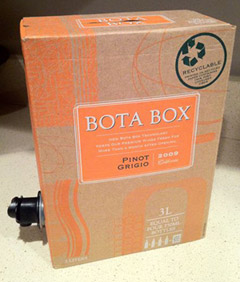
The point is: if you’re shy of boxed wine, you shouldn’t be. There are a number of brands worth considering and although you may not have heard of them, they all appeared on almost every “Best Boxed Wine” list I could find.
They are:
- From the Tank
- Three Thieves
- Black Box
- Bota Box
Decent boxed wine can be had for as little as $12. Some of these wines have ratings of 90+ points from popular wine reviews — an excellent rating, especially considering the price. Because a 3L box is equivalent to 4 bottles of wine, even a $30 box would be a bargain for good wine.
Although Kristen and I don’t drink a lot of wine, we have a tradition: Wine in a Box Wednesday (WIBW)! For us, it’s like a mid-week TGIF. No matter how busy our week is, we always take time to enjoy a glass of wine.
Broken Secrets
Get updates from: Facebook | Twitter | Email | Kindle
PS – Thanks to Mike and Christina for re-introducing us to boxed wine!
Sources: Slate, NY Times, Epicurious, Oprah? Yes, Oprah. :)
More Spent on Flowers at Christmas Than Valentine’s
By Chad Upton | Editor
According to aboutflowers.com, Valentine’s Day is tied for second place with Mother’s Day in most dollars spent on flowers. Surprisingly, Christmas and Hanukkah are tied for first.

It actually makes sense when you look at the breakdown of who is buying them and why.
For Christmas and Hanukkah, the majority of flowers are purchased for people’s own use (ie. decorating). For Valentine’s Day, only 9% are purchased for themselves and it’s not surprising that people spend more on themselves than other people.
If we just consider the people who buy Valentine’s Day flowers, these are some interesting stats:
- 23% of women purchase them for themselves
- 57% of men, purchase them for their spouse
- 25% of men, purchase them for their significant other
While I sometimes question the accuracy of these surveys, I was pretty confident in this data when I read this statistic: 0% of men purchase flowers for themselves for Valentine’s Day.
If you’re interested in the (brief) origin of Valentine’s Day, click here.
Broken Secrets
Get updates from: Facebook | Twitter | Email | Kindle
Photo: Joel Bennett
Sources: About Flowers
People Don’t Explode in Space
By Terry D Johnson
Countless science fiction films have exposed their characters to the vacuum of space – often, with explosive results. Outland’s victims of explosive decompression leave behind gory, reddened walls reminiscent of a Jackson Pollock painting. Perhaps most famously, in Total Recall Arnold Schwarzenegger played an increasingly bug-eyed Quaid when he ventured unprotected onto the airless plains of Mars. Grotesque decompression deaths are a staple of the genre.
These displays of spectacular tissue damage might seem like reasonable speculation, yet we’ve known otherwise for centuries. As early as 1660, the scientist Robert Boyle was exposing animals to vacuum without detonating them. Unconsciousness came quickly to the experimental subjects, but fresh air would quickly revive most subjects if administered before several minutes had passed. Those animals that died of oxygen deprivation did so without painting the walls.

There are several accounts of human beings accidentally exposed to near vacuum. Most dramatically, a test subject at NASA’s Johnson Space Center with a leaky spacesuit experienced a near vacuum. He was unconscious after 14 seconds and remembers feeling the saliva on his tongue beginning to boil, but after the test chamber was repressurized he recovered quickly.
If ever you’re exposed to space for a brief period, don’t try to hold your breath – the pressure difference between your air-filled lungs and the vacuum is likely to cause some damage. Don’t worry about the cold, either – space is chilly, yes, but the lack of air will make the transfer of heat from your body quite slow. There might be some painful swelling, but nothing so dramatic as a messy and very personal explosion.
Broken Secrets
Get updates from: Facebook | Twitter | Email | Kindle
Photo: Wikimedia Commons (gnu)
Sources: NASA, WP An Experiment on a Bird in the Air Pump, WP Robert Boyle
The Banana Plant is an Herb
By Kaye Nemec
We’ve learned about the importance of fruits and veggies on the food pyramid since grade school. We’ve learned that carrots, peas and broccoli are vegetables and apples, pears and strawberries are fruits.
But most of us probably haven’t learned that the banana plant is an herb or that tomatoes, avocadoes, string beans, squash, eggplant, green pepper, okra, green beans, cucumbers and corn kernels are fruits.
Merriam-Webster defines an herb as “a seed-producing annual, biennial, or perennial that does not develop persistent woody tissue but dies down at the end of a growing season.”

Banana plants do not have the typical wood trunk that supports a tree. Its leaves twist and turn around each other to form a stem that can be 12 inches thick and can grow up to 40 feet tall. At the end of each harvest the plants die completely and grow again the next season. The bananas produced by the plant are the fruit of the herb.
A fruit is defined in the botanical world as the part of the plant that bears the seed – therefore putting tomatoes, cucumbers, avocados, green peppers and more in the fruit category.
In the legal world, however, vegetables as we know them remain as is – all fruit classifications thrown aside. In the 19th century the U.S. Supreme Court ruled that fruits and vegetables were to be classified according to how they are commonly consumed.
Broken Secrets
Get updates from: Facebook | Twitter | Email | Kindle
Photo: Spacemonster
Sources: Merriam-Webster, OChef, Live Science, MyPyramid.gov
The Meaning of the Digits on Your Credit Card
By Chad Upton | Editor
There are thousands of different credit cards from the major issuers, but all of them have one thing in common: the meaning of the numbers on the card.
Most major cards have 16 digits on them and each number has a specific meaning.
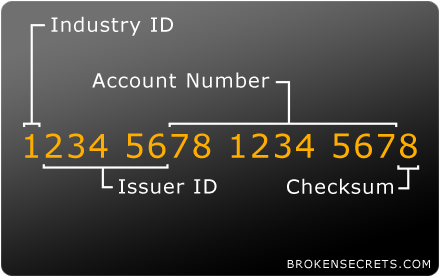
Digit 1 (Industry ID)
- 1 and 2 are Airline cards
- 3 – Travel and Entertainment
- ex. Amex
- 4, 5 – Banking and Financial
- ex. Visa, Mastercard
- 6 – Merchandising and Banking
- ex. Discover, Diners Club
- 7 – Petroleum
- 8 – Telecom
- 9 – Misc.
Digits 2-6 (Issuer ID)
Although all Visa cards start with the number 4, the following 5 digits indicate which bank that issued the Visa card. Mastercards start with 5, Discover starts with 6. You’ll notice that some websites don’t ask you what type of card you have — they obviously know what the digits on the card mean.
Digits 7-15 (Account ID)
The unique number that identifies your account.
Digit 16 (Checksum)
This single digit is one of the most important ones on the card. Much like the last digit of a barcode, the sole purpose of this digit is to allow validation of the rest of the number. In other words, there is a mathematical relationship between the numbers on the card, so if the number is entered incorrectly, the card validator system can indicate the card number was entered incorrectly.
You can validate a card number on your own too. Double every other number, starting with the first number. Add the result of those multiplications to all of the other digits on the card, treating all numbers as individual digits, including double digit results from the doubling operation. If the sum of all these numbers is divisible by ten, the number is valid according to the ISO standard. However, a valid card number doesn’t necessarily mean the number is an active account or that charges can be made with it.
In the early days of credit cards, they didn’t actually check this before imprinting a card for small purchases and larger purchases were verified with a phone call. Today, it’s usually done electronically. When your card is swiped, the number is validated by the point of sale system (using the method above) and if the card number is valid then an electronic request is sent to verify the charge will be accepted by the card issuer.
Some retail stores will ask to see your card so they can manually type in the last four digits on the card. This verifies that the number embossed in the card is the same number that is programmed to the magnet stripe on the back; this is one way retailers can catch counterfeit or reprogrammed cards before the goods leave the store.
Broken Secrets
Get updates from: Facebook | Twitter | Email | Kindle
Sources: Abby’s Guide, HowStuffWorks, Merriam Park, Mint
More US Money is Printed Than MONOPOLY Money
By Chad Upton | Editor
I was reading a recent story on cnbc.com and one “fact” seemed particularly unbelievable. It stated that each year, Parker Brothers prints more MONOPOLY money than the US government prints real currency. They even went so far as to say, “You can bet your little, old shoe that money fact is true!”
CNBC, I will take your bet.
In my attempt to track down the truth, I found that this myth is very wide spread. It’s not just CNBC, dozens of other sites make the same claim. I’m not sure where all of these sites got their info, but I like to go to the source.

The US bureau of Engraving and Printing is responsible for printing paper currency in the US. Their website has a page that details exactly how much currency has been printed each year since 1980. It’s very detailed and includes 4 years when $2 bills were printed, totaling about 500 million $2 bills printed since 1980.
Another interesting fact appears at the bottom of that page: 26 million currency notes are printed each day, with a face value of approximately $974 million. In fact, CNBC has this fact on their page too. Although, they quote it as per year rather than per day. I will give them a bit of credit here, the sentence is confusing and could be interpreted as “per year”, but a quick scan of the page can easily correct that interpretation. For example, more than 974 million $1 bills were printed in 2010. Even more $100 bills were printed. So, it can’t be a per year number.
In 2009, the US government printed a total of $2.1 trillion and in 2010 it was just over $2.0 trillion. That’s a lot of money and 95% of it replaces old money that is worn out.

Next, I tracked down how much money Parker Brothers, a subsidiary of Hasbro, has printed. They started making MONOPOLY in 1935. Until 1998, $15,140 worth of MONOPOLY money was included in each game; current editions include $20,580.
Hasbro states that 250 million copies of MONOPOLY have been sold since 1935 (in 103 Countries and 37 languages). They’ve sold an average of 3.3 million copies per year. If we use the current edition, that would mean they print $67.7 billion during an average year.
At $2 trillion per year, the US government prints much more money than Parker Brothers. In fact, a few years of US currency printing exceeds all 76 years of Parker Brothers printing.
On the other hand, the US mint produces 14-20 billion coins per year. They don’t give a breakdown of the denominations, so it’s impossible to calculate the exact dollar value. Perhaps this myth started as a comparison to the number of coins the US Mint makes each year.
Broken Secrets
Get updates from: Facebook | Twitter | Email | Kindle
Sources: Hasbro.com (faq, corporate info), US Bureau of Engraving and Printing, US Mint, CNBC, Wikipedia (Monopoly)
Emoticons and Other Facebook Tricks
By Kaye Nemec
In almost seven years, Facebook has captured over 600 million users and that number continues to grow. The ‘powers that be’ are constantly changing, updating and tweaking Facebook. While most people wait to see the new and exciting features from each update, you can read on for a few features you can try the next time you log in.
Bold Characters
Surround your text with stars to get bold text in the chat box. For example: *Hi! How are you?* will show up as Hi! How are you?

Underlined Characters
Surround your text with underscores to get underlined text in the chat box. For example: _I’m doing well. How are you doing?_ will show up as I’m doing well. How are you doing
Shapes
There are several different shapes you can use when chatting.
<(“) = penguin
(^^^) = shark
<3 = heart
:putnam: = man’s head/face
The list of smiley faces you can use in chat is lengthy, but here are a few unique options:
8-) = glasses
:-* = lips
8-| = sunglasses
O:) = angel
:|] = robot
Use alt + any combination of numbers on the number pad to add characters to your status, chat and posts. For example:
Alt+14 = ♫
Alt+13 = ♪
Alt+3 = ♥
Alt+5 = ♣
Alt+36 = $
Privacy
When you’re friends with co-workers or family members, there may come a time when your one-of-a-kind status might not be something that one of these ‘friends’ would appreciate. Here’s how to select who gets to read your status and who doesn’t.
- On your profile page click in the ‘status box.’
- Click on the pad lock icon so a drop down menu appears.
- Choose ‘customize.’
- In the ‘These People’ box select ‘specific people’ and type in who you would like to be able to see your status. Or, if there are just a few people you’d like it hidden from, simply fill in the ‘Hide this from these people’ box and click ‘Save Setting.’
Linking to Other Profiles
Interested in linking to someone’s name in your status? Simply type @Joe Smith and a drop down menu will appear. Once Joe’s name appears and you click on it, it will show up as a blue hyperlink in your status, but the @ sign will disappear.
Broken Secrets
Get updates from: Facebook | Twitter | Email | Kindle
Sources: XOMBA.com,fbsmileys.com, Mashable
Photo: marcopako (cc)
Your Pupils Dilate When You Lie
By Chad Upton | Editor
This is one of the reasons some poker players wear sunglasses (they also do it so they can stare at their opponents without being noticed).
In fact, the neurotransmitters that mediate pupil dilation are closely associated with arousal in general.
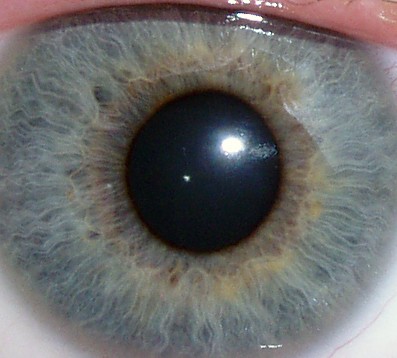 This was proven in a recent study which found that pupil dilation is closely associated with memory and attention functions. In controlled tests, researchers were even able to predict the precise moment when subjects made decisions, based solely on a change in pupil size.
Knowing this, you may want to stick to online poker.
Broken Secrets
Get updates from: Facebook | Twitter | Email | Kindle
Photo: David (cc)
Sources: ESPN, ScienceBlogs.com
Eight US Presidents Were Born British
By Chad Upton | Editor
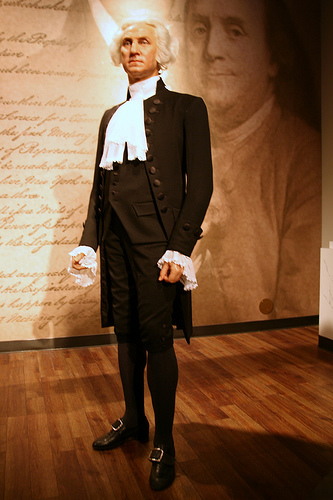
The United States declared its independence from the Kindgom of Great Britian on July 4, 1776. Eight of the first nine Presidents were born before the United States even existed.
They were born in British America, the area that would later make up parts of the United States and Canada. Therefore, these men were technically British subjects at birth.
| Name | Birthday | Birthplace |
| George Washington | 2/22/1732 | Westmoreland, Virginia |
| John Adams | 10/30/1735 | Quincy, Massachusetts |
| Thomas Jefferson | 4/13/1743 | Shadwell, Virginia |
| James Madison | 3/16/1751 | Port Conway, Virginia |
| James Monroe | 4/28/1758 | Westmoreland, Virginia |
| John Quincy Adams | 7/11/1767 | Quincy, Massachusetts |
| Andrew Jackson | 3/15/1767 | Waxhaws Area (NC/SC) |
| William Henry Harrison | 2/9/1773 | Charles City County, Virginia |
*Some of the birthplaces mentioned above were not known by these same names at the time of their birth.
These were all consecutive presidents, except for Harrison. He succeeded Martin Van Buren, who was born in 1782, making him American by birth.
Broken Secrets
Get updates from: Facebook | Twitter | Email | Kindle
Photo: Cliff (cc)
Sources: Wikipedia (USA, US Presidents)


 Broken Secrets