Posts filed under ‘Food and Drink’
Bakery Twist Tie Colors Indicate Freshness
By Kaye Nemec
You may not have noticed before, but if you look closely at the loaves of bread on your grocery store shelves you’ll see that they are sealed with twist ties in a variety of colors. The colors vary not only by brand, but also within the same brand of bread.
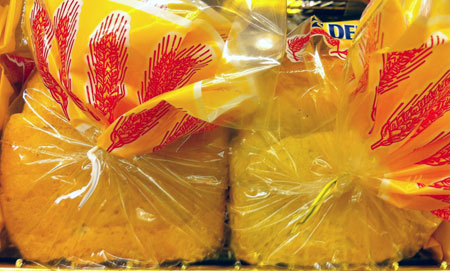
Most bread companies use varying colors of twist ties to track the freshness of bread. For example, bread that was baked on Monday may be sealed with a blue tie; Tuesday may be green, Wednesday orange… etc. The color coding makes it much easier for employees to remove stale loaves and replace them with fresh ones. It is faster to look at the color of the twist tie than it is to read the date code on each bag.
As a consumer you can use this information to get the freshest loaf. However, the color coding system is not consistent between brands, but some people claim the most common system is the following:
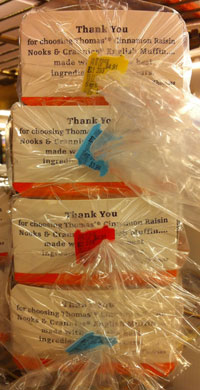 Monday: Blue twisty
- Tuesday: Green twisty
- Wednesday: (No bread delivered)
- Thursday: Red twisty
- Friday: White twisty
- Saturday: Yellow twisty
- Sunday: (No bread delivered)
Without positively knowing which colors represent which days, you’ll have no way of knowing which loaf to pick. You’ll have to pay attention to the color system used by your bread maker. Try calling the customer service number and asking them what their color coding system is. Chances are good they’ll share this info.
Most bread companies deliver fresh loaves to grocery stores several times per week. If you happen to be in the store, pay attention when the deliveries are made and even ask the delivery man.
With each delivery old loaves should be replaced with fresh, new loaves. Because of the frequent deliveries, odds are that you wouldn’t see more than two to three colors for any one brand on the shelf at one time. If you do happen upon a plethora of colors you’ll know the inside scoop and may want to steer clear of that brand unless you know their specific codes.
Some brands also use tab clips that have the date on them, these should help you learn the system fairly quickly.
This secret was also suggested by Heather, thanks for the tip. I should also mention that Shannon suggested hanging on to bread tabs for scraping food off dirty plates.
Broken Secrets
Subscribe on: Facebook | Twitter | Kindle
Sources: Snopes, Thriftyfun.com
How to Get Less Meat on a Deli Sandwich
By Chad Upton | Editor
Some delis put way too much meat on their sandwiches.
Some people will say, “there’s no such thing as too much meat.” For me, I at least want to fit my mouth around it.
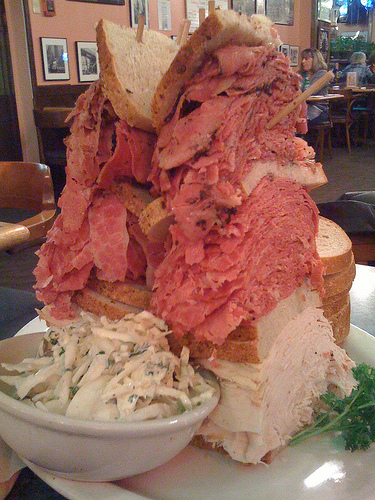
When you order your sandwich, you can ask for it “lite”, which is deli-speak for less meat. Some delis also use the term “half sandwich”, where they give you a full sandwich but only half the meat, other delis will just give you half the sandwich.
There are health benefits to a lite sandwich. Deli meats usually contain a lot of sodium, saturated fat and nitrates. The other benefit of lite sandwiches is the price. Because the meat is the most expensive part, you typically get a break when you order lite.
If you’re buying your own deli meats, look for labels like “healthy” which means the meat contains less fat and less sodium or “lean” meaning it contains less than 10% fat.
PS – I’m still looking for more contributors to help write content. Please contact me here if interested.
Broken Secrets
Subscribe on: Facebook | Twitter | Kindle
Sources: Xomba, Find Articles, All Menus, Yelp (1, 2)
Photo: onefish2 (cc)
How to Take the Bone Out of a Chicken Wing
By Chad Upton | Editor
When we want to know how to do things right, we look to the professionals.
For example, if you want to peel a banana easily and with minimal strings, you’d learn how a monkey does it.
The same goes for eating chicken wings. There are plenty of professional food eaters, who win contests by eating food as quickly as possible. Some of these techniques were developed by them.
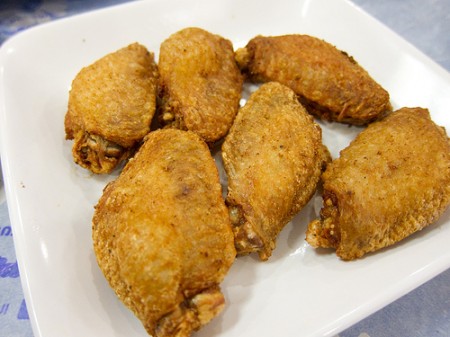
Here’s one great way to get the bones out of a wing:
Here’s a way to eat it with one hand, keeping your other hand free for your 6 shooter, beer mug or tums. You can skip to the 20 second mark on this one:
For those reading this on a device that doesn’t support video, the first video demonstrates removing the bones from a flat chicken wing. Grab the smaller bone and twist it back and forth a couple times, then pull it out. Then do the same for the larger bone, you’re left with all meat and no bones. The second video shows a man placing an entire flat wing in his mouth, biting down and pulling the chicken off the bones and he pulls it out of his mouth.
Thanks to Janine for suggesting this one.
Broken Secrets
Subscribe on: Facebook | Twitter | Kindle
Photo: Charles Haynes (cc)
Why Some Knives Have Serrated Blades
By Chad Upton | Editor
Good knives are expensive, but they’re money well spent when you consider they may outlive you.
There aren’t many purchases you can say that about and like anything that lasts, they need care and attention.
In fact, Japanese samurai swords endured hundreds of years of use, when properly cared for by a Togi professional — a sword polisher whose apprenticeship lasts ten years.
You’re probably aware that knives need sharpening, but do you know why they get dull in the first place?

It’s not just from repeated use, but from repeated misuse. Some misuse is expected, especially with serrated knives.
When you cut on a surface that is harder than the knife blade, that surface dulls the blade by creating a microscopic flat surface on the bottom of the blade. The flat surface is too small to see, but it makes a big difference in the cutting ability of the blade. In knife manufacturing, electron microscopes are used in quality control to inspect the sharpness of the blade.
To keep your knives sharp, it is best to cut on cutting boards made from soft materials such as various types of wood or plastic. While it’s convenient to cut directly on solid surface counter-tops such as granite and quartz, it’s not good for your knives and neither are glass cutting boards.
Plates are a common surface to cut on, but they’re bad for knives. Serrated blades help solve this dilemma; the points touch the plate but the raised edges above the points do not. Therefore, the points are dulled, but the other edges stay sharp.
Serrated blades also work well for cutting through hard rinds of some produce, and crunchy bread crusts too. The sharp points add more localized pressure, allowing better cutting penetration on the foods and act like a saw when the knife is moved back and forth.
There are other practices that can dull your knives too. Letting the cutting edge bang into other utensils in a drawer or the dishwasher can cause nicks and scratches, which adversely affect the knives’ sharpness.
To keep your knives in good repair, you should use a honing steel on the blade for about 30 seconds before each use. It helps remove scratches and bends in the blade, but it does not sharpen it.
For sharpening, a good manual or automatic sharpener should be used every few months. Professional sharpening should be done every few years. Many serrated blades cannot be sharpened, but a honing steel can be used on some.
Broken Secrets
Subscribe on: Facebook | Twitter | Kindle
Sources: Cutco, Electric Knife Sharpeners Blog, Sword Forum Mag, Wikipedia (Serrated Blade)
White Chocolate is Real Chocolate
By Chad Upton | Editor
Somebody once told me that White Chocolate is not really chocolate. The argument is that white chocolate is not made from chocolate liquor and white chocolate does not contain cocoa solids; therefore, it is not real chocolate.
That is not necessarily true.
 Chocolate was discovered by Aztecs in Central Mexico, at least three hundred years ago. The name comes from the Nahuatl word, “chicolatl” meaning “beaten drink.” It is derived from, “chicoli”, which means “beating stick” and “atl”, meaning “water.”
To make chocolate, the seeds of the tropical cacao tree are harvested. They are bitter and must be fermented to make the flavor more palatable. The fermented beans are then dried, roasted and shelled to expose cacao nibs (you can buy cacao nibs, they’re an interesting balance between slightly bitter and mildly sweet — click on the photo for amazon link).
The nibs are ground to produce cocoa mass, which is melted to create chocolate liquor (not to be confused with chocolate liqueur). When chocolate liquor cools, it forms what we commonly refer to as baking chocolate.
At this stage, the chocolate is about 53% cocoa butter (fat), the rest is carbohydrates, protein, tannins and theobromine.
Theobromine is in the same family of chemical compounds as caffeine and is believed to be the proof that chocolate is addictive. Healthy humans can break down reasonable amounts of this compound, but many animals cannot. This is why chocolate can be harmful to pets. White chocolate contains only trace amounts of theobromine, which is what gives other chocolate its brown color.
White chocolate is made from cocoa butter, milk solids, milk fat and sugar. According to the FDA, white chocolate must contain at least 20% cocoa butter to be called “White Chocolate.” The European Union has adopted the same standard for cocoa butter requirements, but there are some other regulations around milk and sweetener contents that differ between the US and the EU.
Confectionery items that look and taste similar to white chocolate, such as “Almond Bark” are not white chocolate. In fact, they’re not chocolate at all. They are usually made from solid or hydrogenated vegetable and animal fats instead of real cocoa butter.
White Chocolate is real chocolate when it’s made from cocoa butter.
Broken Secrets
Subscribe on: Facebook | Twitter | Kindle
Sources: FDA, WP (Cocoa Butter, Chocolate, White Chocolate, Chocolate Liquor, History of Chocolate, Aztec, Theobromine)
Alcohol Does Not Completely Burn Off in Cooking
By Chad Upton
Whether you marinade steaks in beer or use Vanilla extract in your baking, you’re probably left with more alcohol in your food than you realize.
That’s not necessarily a bad thing, it can infuse wonderful flavors. And yes, Vanilla extract has alcohol in it. Actually, it’s mandated by law in the US.
In many cultures, alcohol and food go hand in hand. Fancy wine bars pair meals or selected cheese and chocolate with wine.
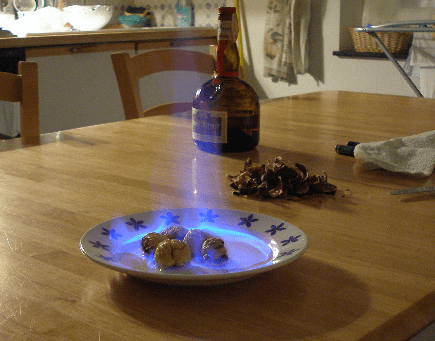
Before modern cough medicines, Doctors prescribed a tablespoon of brandy to calm children’s coughs. Even some existing cough medicines, such as NyQuil, contain alcohol (except the childrens remedy). Monks have been known to brew and drink beer since the middle ages.
The USDA’s Nutrition Data Lab used gas-liquid chromatography to determine how much alcohol remained in food after various cooking scenarios.
| Cooking Method | Alcohol Remaining |
| Flambé | 75% |
| Left Overnight (no heat) | 70% |
| baked 25 mins (alcohol not stirred in) | 45% |
| baked 15 mins (alcohol stirred in) | 40% |
| baked 30 mins (alcohol stirred in) | 35% |
| baked 60 mins (alcohol stirred in) | 25% |
| baked 90 mins (alcohol stirred in) | 20% |
| baked 120 mins (alcohol stirred in) | 10% |
| baked 150 mins (alcohol stirred in) | 5% |
Even after 2.5 hours, 5% of the alcohol remains. I don’t think it’s anything to be too alarmed about. Grandma’s have been serving cookies laced with Vanilla extract to children for many years and most of us turned out just fine. That said, it’s still pretty surprising.
Broken Secrets
Subscribe on: Facebook | Twitter | Kindle
Sources: Wikipedia, O Chef , Trappist Beer, NyQuil
Photo: 5volt (cc)
How They Make Burgers Look Perfect In Ads
By Chad Upton
It’s rhetorical and cliche, but why doesn’t the food you order ever look like the food in the picture?
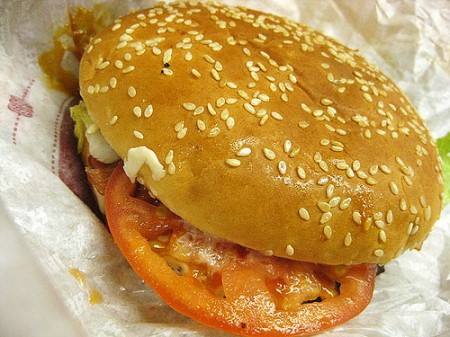
I’ll bite — it’s because your food took a few minutes to make and the food in the picture took a few hours to style. Yes, style.
I’ve rounded up some videos that show you some of the secrets of food advertising. The first video is about burgers and it’s pretty old, but still relevant.
The next video is about pizza and it’s part of a current Domino’s promotion to send in pictures of your pizza for everyone to see.
It’s a pretty well known fact that what you see is not what you’re going to get. But, Burger King recently canceled an advertisement where they misled viewers about the size of the burger. After watching these videos, it’s no surprise how they do it.
If you want to see a nice set of side-by-side photos of what they advertise and what you get, click here.
If you are reading this post on a device that does not support videos, I’ll tell you a bit about what they contain.
The burgers are cooked very little. To make them look grilled, they are brand them with thin skewers. Then they apply food dye for color. A layer of cardboard is placed on the bottom bun so the bun doesn’t get soft. The burger patty is split on the back side, so it can be widened from the front view — this makes the burger look larger. Vegetables are piled on top of the bun and pinned in place so they don’t move. A small shot of condiments are added on the front of the burger (the side the camera is on).
The second video is all about making perfect cheese strings when a slice of pizza is removed from a pizza pie. They go through all of the cheese to make sure every piece is perfect and use a heat gun to perfectly melt the cheese around the star slice, this makes it very stringy when the slice is lifted. The rest of the pizza is screwed down, except for one slice, so the pizza doesn’t move when the one slice is lifted.
There you have it, secrets from fast food advertising.
Broken Secrets
Subscribe on: Facebook | Twitter | Kindle
Photo: jasonlam (cc)
ID is Not Required to Buy Cooking Wine
By Chad Upton
The laws and store policies around the products that require ID and the ones that don’t, are sometimes confusing.
I was in Target a while back and bought a can of compressed air to clean my dusty laptop. I was surprised when they asked for ID at the checkout.
Apparently some people like to get high from the propellant in canned air. It’s unfortunate, these are not recreational drugs, these are asphyxiates that displace the oxygen in the air, reducing the oxygen that reaches your brain and eventually causes death. The solution is to require ID for purchase, although even a 42 year old man died from “huffing” canned air.
Even when you’re using these products as intended, you should avoid inhaling the fumes and ensure adequate ventilation.
I was at Target a few weeks later, looking for ramekins to make Crème brûlée. I also needed a butane blowtorch to caramelize the top of the custard. It turns out that you can buy butane torches and fuel without ID. Thinking back to my teenage years, a blowtorch would have been much more fun than a can of air.
But, cooking wine has the most interesting story.
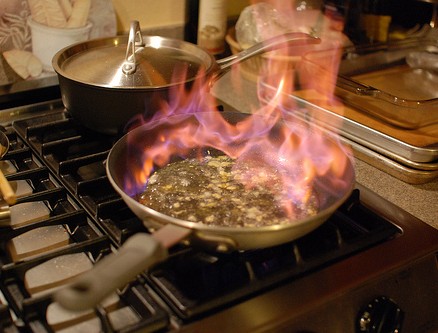
It ranges from 10%-13% alcohol and anybody can buy cooking wine at the grocery store. They even sell it in grocery stores in “dry” areas, where no alcoholic drinks are sold. In fact, Safeway requires ID to buy cough syrup, but not for cooking wine. Some cough syrup, such as NyQuil, contains alcohol. Other cough and cold medications contain a drug known as Dextromethorphan, which is a dissociative psychedelic drug.
My friend Molly told me about this cooking wine loophole and gave me a sample of the product. If you’ve ever tasted cooking wine on it’s own, you’ll understand why anyone is allowed to buy it. Nobody would ever consume it on its own, it’s simply awful.
Wine that is sold as “cooking wine” is usually grape or rice wine. It is then adulterated with salt, which makes it less suitable for cooking and even more undrinkable. If you’re making a recipe that calls for wine, use wine that you’d actually drink and use a wine that pairs well with the food you’re cooking.
Cooking wine has a lot of salt for coloring and as a preservative. Because cooking wine is consumed very slowly, the salt prevents acedic acid from forming and turning it into wine vinegar.
Oh, and if you’re going to make Crème brûlée, my friend Mike showed me that you should skip the butane and go with propane — it has a wider flame that heats more evenly, which gives much better results and in less time.
Broken Secrets
Subscribe on: Facebook | Twitter | Kindle
Sources: Wikipedia (Cooking Wine, Difluoroethane, Dextromethorphan), MSDS, Cooking Wine Without ID (1, 2), Dry Counties, NyQuil
Photo: anitasarkeesian (cc)
Tea Contains Less Caffeine Than Coffee
By Chad Upton
This is one of those things that a lot of people know and a lot people get wrong.
Most coffee has 60-100 milligrams of caffeine per cup. Here’s a list of the most popular coffees and their caffeine content:
| Coffee (16oz) | Caffeine (mg) |
| Starbucks | 330 |
| Caffè Americano (Espresso) | 225 |
| Tim Hortons | 160 |
| McDonald’s | 145 |
| Store Brand (Drip) | 145 |
| Dunkin Donuts | 143 |
| Store Brand (Brewed) | 108 |
| Decaf | 2-5 |
As you can see, Starbucks coffee is the strongest with 330 mg of caffeine in a 16oz serving. It is followed by Starbucks Caffè Americano, which has three shots of espresso in it and more than 100 mg less caffeine in the same size serving. Most of the other brands have about 110-160 mg in a 16oz serving..
So, how does that compare to tea? Let’s have a look:
| Tea (16oz) | Caffeine (mg) |
| Starbucks Tazo Chai | 94 |
| Black | 90 |
| Green | 40 |
| White | 30 |
| Starbucks Tazo Red | 0 |
As we can see, Tea generally has much less caffeine than coffee.
Of course, there are always exceptions. There are some coffees that have less caffeine than most teas, particularly decaf coffee. That might be an unfair comparison since decaf is a man-made product. Although, it might not be that way forever. Caffeine free coffee beans have been discovered, although they’re too bitter for most people’s taste buds.
There are also some black teas that have up to 140 mg of caffeine per 16 oz, which is more than the same size coffee at Dunkin’ Donuts (or Dunkin’ Coffee as they call it in Spain).
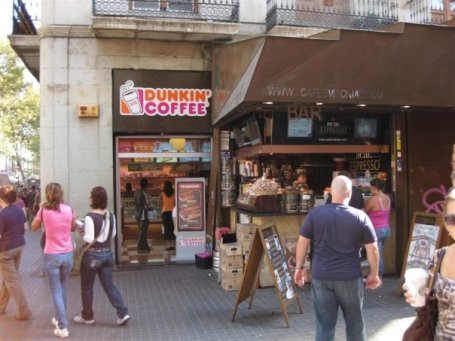
Dunkin Donuts - Barcelona, Spain
There are many other caffeinated beverages that are popular, how do those stack up?
| Product | Serving (oz) | Caffeine (mg) |
| Jolt Energy | 24 | 280 |
| Red Bull | 8 | 80 |
| Mountain Dew | 12 | 55 |
| Mountain Dew Code Red | 12 | 54 |
| Diet Coke | 12 | 45 |
| Coca-Cola Classic | 12 | 35 |
| Sprite | 12 | 0 |
| 7-Up | 12 | 0 |
Caffeine is found in many other foods, such as chocolate. It is also found in guarana beans, which are very similar to coffee beans according to Brett’s Energy Drinks. So, be careful of those guarana filled energy drinks, caffeine is a hell of a drug.
Thanks to Kristen for suggesting this one and Ian for adding front lines insight.
Broken Secrets
Subscribe on: Facebook | Twitter | Kindle
Sources: Mayo Clinic, Brett’s Energy Drinks, Energy Fiend,
Desktop Snacking Without a Greasy Keyboard
With more work and less help, it’s no surprise that nearly 70% of Americans eat lunch at their desks. At 61% the majority of people also snack at their desk throughout the day.
All that food is one reason keyboards and mice are have more bacteria than most toilet seats. Also, office toilet seats are usually sanitized daily, when was the last time your keyboard or mouse were?
This tip is helpful because your hands never touch your food. This prevents your keyboard from getting dirtier and it keeps your hands from passing bacteria to your mouth.
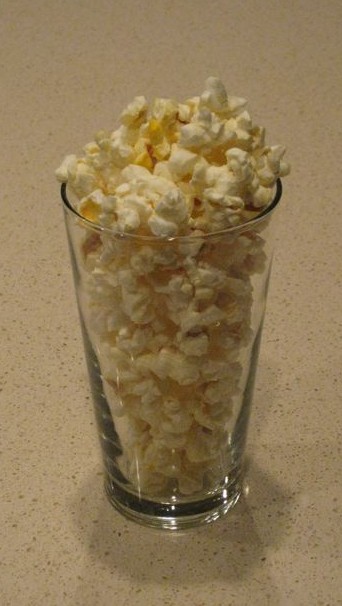
1. Pour bite-size snacks into a cup or glass.
2. Angle cup into your mouth so bite-size snacks fall into your mouth.
3. Chew, swallow and repeat from step 2.
Broken Secrets | By: Chad Upton
Subscribe on: Facebook | Twitter | Kindle
Sources: Home Food Safety Org, ABC News


 Broken Secrets