Author Archive
Boxed Wine Isn’t Necessarily Bad Wine
By Chad Upton | Editor
Some people subscribe to the idea that “no wine is bad wine,” and while I agree with the sentiment, I disagree with the statement. Thankfully, bad wine is easy to avoid and award wining wine can be cheap too, especially if it’s in a box.
If you’re not familiar with boxed wine, it consists of a plastic membrane (full of wine) with a spout for dispensing. The “bag” is placed in a cardboard box so it stays vertical for proper dispensing; this also gives it a smaller footprint on the shelf or in the fridge.
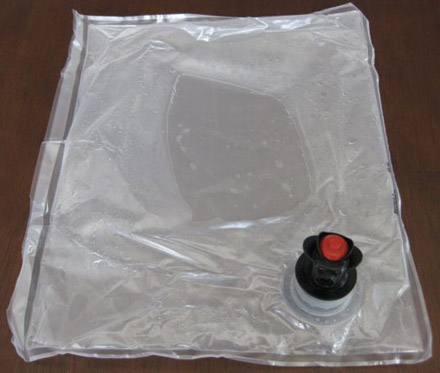
This is a near perfect container for wine. Since wine spoils with exposure to air, the self collapsing nature of this package preserves the wine much longer and more conveniently than a glass bottle and a typical air sucking accessory.
Although boxed wine should be popular with those who drink a lot of wine, it’s also ideal for those who don’t because it lasts for weeks after opening.
I admit, there is some romance to a glass bottle, but boxed wine is a practical solution for every day drinking. Every-day-drinking sounds bad, but I hope you know what I mean, frequent drinking. Actually, that sounds worse. Drinking heavily every night. OK, now I’m just having fun with you.
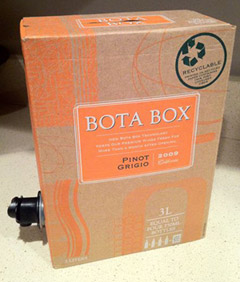
The point is: if you’re shy of boxed wine, you shouldn’t be. There are a number of brands worth considering and although you may not have heard of them, they all appeared on almost every “Best Boxed Wine” list I could find.
They are:
- From the Tank
- Three Thieves
- Black Box
- Bota Box
Decent boxed wine can be had for as little as $12. Some of these wines have ratings of 90+ points from popular wine reviews — an excellent rating, especially considering the price. Because a 3L box is equivalent to 4 bottles of wine, even a $30 box would be a bargain for good wine.
Although Kristen and I don’t drink a lot of wine, we have a tradition: Wine in a Box Wednesday (WIBW)! For us, it’s like a mid-week TGIF. No matter how busy our week is, we always take time to enjoy a glass of wine.
Broken Secrets
Get updates from: Facebook | Twitter | Email | Kindle
PS – Thanks to Mike and Christina for re-introducing us to boxed wine!
Sources: Slate, NY Times, Epicurious, Oprah? Yes, Oprah. :)
More Spent on Flowers at Christmas Than Valentine’s
By Chad Upton | Editor
According to aboutflowers.com, Valentine’s Day is tied for second place with Mother’s Day in most dollars spent on flowers. Surprisingly, Christmas and Hanukkah are tied for first.

It actually makes sense when you look at the breakdown of who is buying them and why.
For Christmas and Hanukkah, the majority of flowers are purchased for people’s own use (ie. decorating). For Valentine’s Day, only 9% are purchased for themselves and it’s not surprising that people spend more on themselves than other people.
If we just consider the people who buy Valentine’s Day flowers, these are some interesting stats:
- 23% of women purchase them for themselves
- 57% of men, purchase them for their spouse
- 25% of men, purchase them for their significant other
While I sometimes question the accuracy of these surveys, I was pretty confident in this data when I read this statistic: 0% of men purchase flowers for themselves for Valentine’s Day.
If you’re interested in the (brief) origin of Valentine’s Day, click here.
Broken Secrets
Get updates from: Facebook | Twitter | Email | Kindle
Photo: Joel Bennett
Sources: About Flowers
The Meaning of the Digits on Your Credit Card
By Chad Upton | Editor
There are thousands of different credit cards from the major issuers, but all of them have one thing in common: the meaning of the numbers on the card.
Most major cards have 16 digits on them and each number has a specific meaning.
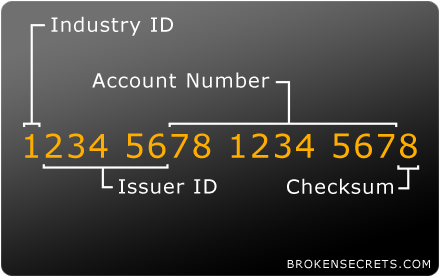
Digit 1 (Industry ID)
- 1 and 2 are Airline cards
- 3 – Travel and Entertainment
- ex. Amex
- 4, 5 – Banking and Financial
- ex. Visa, Mastercard
- 6 – Merchandising and Banking
- ex. Discover, Diners Club
- 7 – Petroleum
- 8 – Telecom
- 9 – Misc.
Digits 2-6 (Issuer ID)
Although all Visa cards start with the number 4, the following 5 digits indicate which bank that issued the Visa card. Mastercards start with 5, Discover starts with 6. You’ll notice that some websites don’t ask you what type of card you have — they obviously know what the digits on the card mean.
Digits 7-15 (Account ID)
The unique number that identifies your account.
Digit 16 (Checksum)
This single digit is one of the most important ones on the card. Much like the last digit of a barcode, the sole purpose of this digit is to allow validation of the rest of the number. In other words, there is a mathematical relationship between the numbers on the card, so if the number is entered incorrectly, the card validator system can indicate the card number was entered incorrectly.
You can validate a card number on your own too. Double every other number, starting with the first number. Add the result of those multiplications to all of the other digits on the card, treating all numbers as individual digits, including double digit results from the doubling operation. If the sum of all these numbers is divisible by ten, the number is valid according to the ISO standard. However, a valid card number doesn’t necessarily mean the number is an active account or that charges can be made with it.
In the early days of credit cards, they didn’t actually check this before imprinting a card for small purchases and larger purchases were verified with a phone call. Today, it’s usually done electronically. When your card is swiped, the number is validated by the point of sale system (using the method above) and if the card number is valid then an electronic request is sent to verify the charge will be accepted by the card issuer.
Some retail stores will ask to see your card so they can manually type in the last four digits on the card. This verifies that the number embossed in the card is the same number that is programmed to the magnet stripe on the back; this is one way retailers can catch counterfeit or reprogrammed cards before the goods leave the store.
Broken Secrets
Get updates from: Facebook | Twitter | Email | Kindle
Sources: Abby’s Guide, HowStuffWorks, Merriam Park, Mint
More US Money is Printed Than MONOPOLY Money
By Chad Upton | Editor
I was reading a recent story on cnbc.com and one “fact” seemed particularly unbelievable. It stated that each year, Parker Brothers prints more MONOPOLY money than the US government prints real currency. They even went so far as to say, “You can bet your little, old shoe that money fact is true!”
CNBC, I will take your bet.
In my attempt to track down the truth, I found that this myth is very wide spread. It’s not just CNBC, dozens of other sites make the same claim. I’m not sure where all of these sites got their info, but I like to go to the source.

The US bureau of Engraving and Printing is responsible for printing paper currency in the US. Their website has a page that details exactly how much currency has been printed each year since 1980. It’s very detailed and includes 4 years when $2 bills were printed, totaling about 500 million $2 bills printed since 1980.
Another interesting fact appears at the bottom of that page: 26 million currency notes are printed each day, with a face value of approximately $974 million. In fact, CNBC has this fact on their page too. Although, they quote it as per year rather than per day. I will give them a bit of credit here, the sentence is confusing and could be interpreted as “per year”, but a quick scan of the page can easily correct that interpretation. For example, more than 974 million $1 bills were printed in 2010. Even more $100 bills were printed. So, it can’t be a per year number.
In 2009, the US government printed a total of $2.1 trillion and in 2010 it was just over $2.0 trillion. That’s a lot of money and 95% of it replaces old money that is worn out.

Next, I tracked down how much money Parker Brothers, a subsidiary of Hasbro, has printed. They started making MONOPOLY in 1935. Until 1998, $15,140 worth of MONOPOLY money was included in each game; current editions include $20,580.
Hasbro states that 250 million copies of MONOPOLY have been sold since 1935 (in 103 Countries and 37 languages). They’ve sold an average of 3.3 million copies per year. If we use the current edition, that would mean they print $67.7 billion during an average year.
At $2 trillion per year, the US government prints much more money than Parker Brothers. In fact, a few years of US currency printing exceeds all 76 years of Parker Brothers printing.
On the other hand, the US mint produces 14-20 billion coins per year. They don’t give a breakdown of the denominations, so it’s impossible to calculate the exact dollar value. Perhaps this myth started as a comparison to the number of coins the US Mint makes each year.
Broken Secrets
Get updates from: Facebook | Twitter | Email | Kindle
Sources: Hasbro.com (faq, corporate info), US Bureau of Engraving and Printing, US Mint, CNBC, Wikipedia (Monopoly)
Your Pupils Dilate When You Lie
By Chad Upton | Editor
This is one of the reasons some poker players wear sunglasses (they also do it so they can stare at their opponents without being noticed).
In fact, the neurotransmitters that mediate pupil dilation are closely associated with arousal in general.
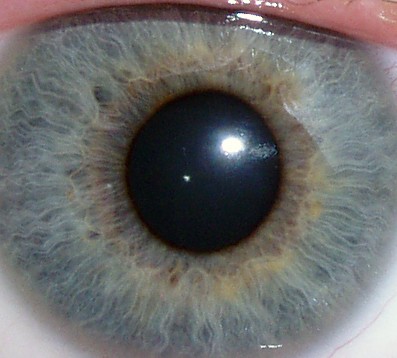 This was proven in a recent study which found that pupil dilation is closely associated with memory and attention functions. In controlled tests, researchers were even able to predict the precise moment when subjects made decisions, based solely on a change in pupil size.
Knowing this, you may want to stick to online poker.
Broken Secrets
Get updates from: Facebook | Twitter | Email | Kindle
Photo: David (cc)
Sources: ESPN, ScienceBlogs.com
Eight US Presidents Were Born British
By Chad Upton | Editor
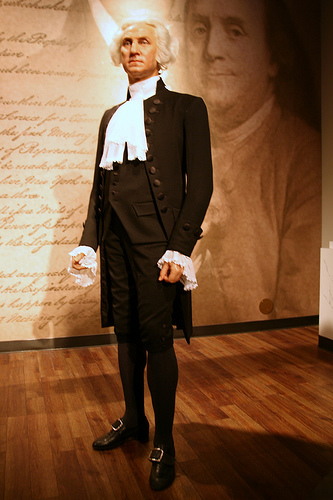
The United States declared its independence from the Kindgom of Great Britian on July 4, 1776. Eight of the first nine Presidents were born before the United States even existed.
They were born in British America, the area that would later make up parts of the United States and Canada. Therefore, these men were technically British subjects at birth.
| Name | Birthday | Birthplace |
| George Washington | 2/22/1732 | Westmoreland, Virginia |
| John Adams | 10/30/1735 | Quincy, Massachusetts |
| Thomas Jefferson | 4/13/1743 | Shadwell, Virginia |
| James Madison | 3/16/1751 | Port Conway, Virginia |
| James Monroe | 4/28/1758 | Westmoreland, Virginia |
| John Quincy Adams | 7/11/1767 | Quincy, Massachusetts |
| Andrew Jackson | 3/15/1767 | Waxhaws Area (NC/SC) |
| William Henry Harrison | 2/9/1773 | Charles City County, Virginia |
*Some of the birthplaces mentioned above were not known by these same names at the time of their birth.
These were all consecutive presidents, except for Harrison. He succeeded Martin Van Buren, who was born in 1782, making him American by birth.
Broken Secrets
Get updates from: Facebook | Twitter | Email | Kindle
Photo: Cliff (cc)
Sources: Wikipedia (USA, US Presidents)
Where the Phrase “Face the Music” Came From
By Kaye Nemec
Have you ever heard someone say, “Well, you better face the music?” Face the music? What does that mean – where did that phrase come from?
The phrase “face the music” has a military history. When disgraced or dishonored soldiers were being relieved of their duties and stripped of their rank their final march was accompanied by drums – it is commonly referred to as “drumming out.”
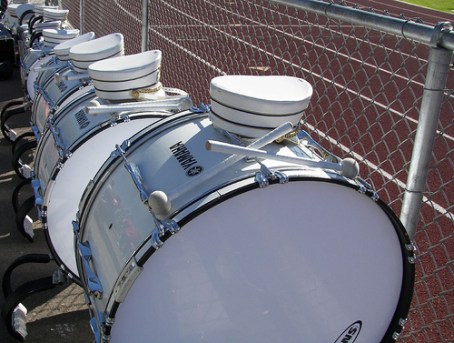
During the Civil War some officers had their heads shaved before drumming out. Although their fellow officers were not permitted to touch them as they passed by, several cases were reported in which the discharged soldier was later found dead.
Some historical references claim that soldiers were forced to sit on their horse backwards as they were marched passed their comrades so they could see and hear the drums – therefore facing the music.
Broken Secrets
Get updates from: Facebook | Twitter | Email | Kindle
Sources: Big Site of Amazing Facts, Wikipedia
Photo: Duane Matsen (cc)
New Contributors are Joining the Team
When I started this blog in 2009, I was writing five days per week. I was doing that in the evenings after my day job and was able to keep it up until August of 2010.
In a summer blog update, I asked for others to contact me if they wanted to contribute to the site. One of the first people to contact me was Kaye Nemec; she was already writing great content for other sites, so it was a perfect fit. Since then, she’s contributed some very popular posts:
- The Word “Nerd” Was First Written by Dr. Seuss
- The Real Names of Brand Name Products
- Bakery Twist Tie Colors Indicate Freshness
Today, I’m happy to announce that we’ve got two more contributors joining the team. Kyle Kurpinski and Terry D. Johnson. They’re co-authors of the educational, yet satirical, book, How to Defeat Your Own Clone. Kyle has a PhD in Bioengineering (among other degrees) and works at a medical device startup in the Bay Area. Terry has a Masters in chemical engineering from MIT and teaches bioengineering at Berkeley. You can checkout more detailed bios of everyone on the about page.
Kyle’s first post, Standard Keyboards are Designed to Slow You Down,will be online tomorrow. We’re excited to be working with these guys and I know you’ll enjoy their work too.
Chad Upton, Editor
The Hidden Lever to Raise Airplane Armrests
By Chad Upton | Editor
Airplanes are cramped places.
The leg room is short, the aisles are thin and the headroom isn’t room at all. The bathrooms provide some private space and a complimentary gymnastics lesson.
If you’re tall, fitting your knees behind the seat in front of you is a painful reality that many of us live with each trip, unless you get an exit row, a courtesy upgrade or a hole in your wallet.
Even if you’re not very tall, when you stand up in your seat, you have to duck to avoid a head-on-collision with the overhead bin, especially in smaller regional jets.
But, a few years ago, I saw a person in the row ahead of me raise the aisle armrest. That was a game changer for me. No more ducking! Simply raise the armrest, then stand up while you slide off your seat into the aisle.
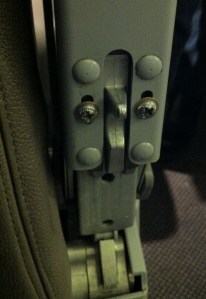
There are a few planes that do not have movable aisle armrests. However, most of them have a small lever or button on the underside of the armrest, near the hinge. Pushing or sliding this lever will release the hinge lock, allowing you to raise the armrest.
Broken Secrets
Finding Home and End on a Mac Keyboard
By Chad Upton | Editor
I use both Mac and Windows computers and I appreciate some attributes of each. For example, I really like the home and end keys on Windows keyboards. These guys make it a breeze to select a single line of text or jump to the end of the line to keep writing after an edit.
Because Apple market share is at an all time high, I’m sure a lot of people are going to notice the absence of these keys when they switch. Unless you’ve got the full-size apple keyboard, the “home” and “end” keys are absent on your desktop or macbook keyboard. But, if you hold down the fn (or control) key, you can use the left and right arrow keys as home and end keys respectively. Hold shift while doing this to select the characters between cursor positions.
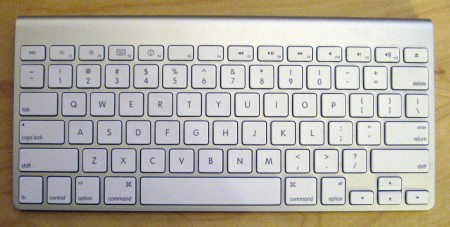
Speaking of the Mac keyboard, the delete key is equivalent to the backspace key on a Windows computer — it deletes characters to the left of the cursor. But, you can make Mac’s delete key function like the Windows delete key if you hold the fn key while pressing it — deleting characters to the right. Another favorite keyboard shortcut on Mac OS is fn + F11 which will temporarily hide your windows to expose your desktop, allowing you to easily select files without going to the finder or minimizing all of your windows. Then press fn+F11 to bring all your windows back to their original positions.
By the way, you can plug a Windows USB keyboard into a Mac, although not all of the task keys function the way they do on a PC.
Broken Secrets


 Broken Secrets