Author Archive
Craft Breweries Cannot Brew More Than 6 Million Barrels Annually
By Kaye Nemec
Major breweries, like Anheuser-Busch, produce over 24 million barrels of beer annually. They are well known around the world and have a major hold on the market. Smaller, much less popular beers are brewed around the world but, to be officially classified as a microbrew or a craft beer they must fall within certain criteria.

The U.S. Brewers Association defines a microbrewery as a brewery that produces no more than 15,000 barrels of beer annually with 75 percent of that volume being sold off-site.
A craft brewery is defined by the U.S. Brewers Association as a brewery that produces no more than 6 million barrels of beer annually. A craft brewery’s best-selling product is an all malt beer or at least half of its total volume is all-malt beer or beer that uses adjuncts instead of lightening the flavor. It also allows up to 25 percent of the company to be owned by an alcoholic beverage company that is not considered a craft brewer.
A Regional Brewery is defined by the Brewers Associate as a brewery with an annual beer production of 15,000 to 6 million barrels.
A Large Brewery is defined by the Brewers Association as a brewery with an annual beer production of over 6 million barrels.
Broken Secrets
Get updates from: Facebook | Twitter | Email | Kindle
Photo: BURИBLUE (cc)
Sources: Medill Reports Chicago, Craft Beer.com, Brewers Association
Your Passport May Expire Before The Expiry Date
By Kyle Kurpinski
Expiration dates are funny things. For instance, if I take a swig from a jug of milk that expires next week, I expect to get a mouthful of milk, not sour gym socks. Unfortunately, expiration dates are occasionally imperfect, and the gym sock thing tends to happen from time to time. But when it comes to something non-perishable, like a coupon booklet or an driver’s license, these dates should be a little more concrete. Or so you would think, anyway.
My cousin was recently on her way to Malaysia when she encountered a bit of a snafu at the airport. For travel to Malaysia, it’s not enough to simply have a “valid” passport (i.e. one that has not yet expired). Rather, US citizens must have at least six months remaining before the printed expiration date. My cousin only had five. She actually made it all the way through security before the airport authorities realized their mistake and stopped her from boarding. Trouble is, she had already flown from Portland to San Francisco with her sorta-valid passport, and now she had no choice but to turn around and go back. Even if her trip to Malaysia was only going to last one day, travel regulations would still have forbade the journey without the six-month buffer. I’m sure there are plenty of logical reasons for such a requirement (contingency for an unexpectedly prolonged trip, prevention of illegal immigration or fraud, etc. etc.), but my cousin’s experience still seems like the travel equivalent of buying your milk in May only to discover that it already soured last Christmas.
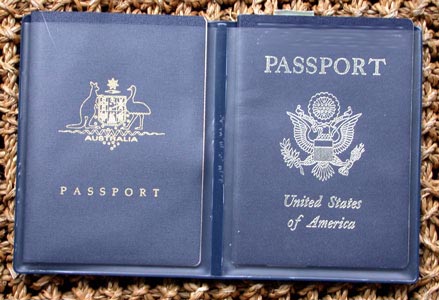
To make things even more complicated, each country has its own unique rules regarding passport validity. Most countries simply abide by the given date, but some – such as Malaysia, Brazil, and India – require a six-month window, while others – such as Switzerland, Greece, and Denmark – require only three months. When exactly does this window start or end? That’s different for every country too. In some cases it’s calculated from the date of entry into the foreign territory, while in others it’s based on the return date. If you’re planning to travel abroad, you can find the specific rules for each country on the State Department’s website.
Keep in mind that passport renewals typically take about six weeks, so it’s always best to plan ahead when making your travel arrangements. If you’re just learning of these rules before an impending trip, you can apply for an expedited renewal, which takes only two weeks, but also costs an additional $60. If you’re already at the airport (like my cousin was) please have a safe trip back to your house.
Broken Secrets
Get updates from: Facebook | Twitter | Email | Kindle
Photo: Amy Barker (cc)
Sources: Wikipedia , Joel Widzer, and The U.S. Department of State
People Don’t Explode in Space
By Terry D Johnson
Countless science fiction films have exposed their characters to the vacuum of space – often, with explosive results. Outland’s victims of explosive decompression leave behind gory, reddened walls reminiscent of a Jackson Pollock painting. Perhaps most famously, in Total Recall Arnold Schwarzenegger played an increasingly bug-eyed Quaid when he ventured unprotected onto the airless plains of Mars. Grotesque decompression deaths are a staple of the genre.
These displays of spectacular tissue damage might seem like reasonable speculation, yet we’ve known otherwise for centuries. As early as 1660, the scientist Robert Boyle was exposing animals to vacuum without detonating them. Unconsciousness came quickly to the experimental subjects, but fresh air would quickly revive most subjects if administered before several minutes had passed. Those animals that died of oxygen deprivation did so without painting the walls.

There are several accounts of human beings accidentally exposed to near vacuum. Most dramatically, a test subject at NASA’s Johnson Space Center with a leaky spacesuit experienced a near vacuum. He was unconscious after 14 seconds and remembers feeling the saliva on his tongue beginning to boil, but after the test chamber was repressurized he recovered quickly.
If ever you’re exposed to space for a brief period, don’t try to hold your breath – the pressure difference between your air-filled lungs and the vacuum is likely to cause some damage. Don’t worry about the cold, either – space is chilly, yes, but the lack of air will make the transfer of heat from your body quite slow. There might be some painful swelling, but nothing so dramatic as a messy and very personal explosion.
Broken Secrets
Get updates from: Facebook | Twitter | Email | Kindle
Photo: Wikimedia Commons (gnu)
Sources: NASA, WP An Experiment on a Bird in the Air Pump, WP Robert Boyle
The Banana Plant is an Herb
By Kaye Nemec
We’ve learned about the importance of fruits and veggies on the food pyramid since grade school. We’ve learned that carrots, peas and broccoli are vegetables and apples, pears and strawberries are fruits.
But most of us probably haven’t learned that the banana plant is an herb or that tomatoes, avocadoes, string beans, squash, eggplant, green pepper, okra, green beans, cucumbers and corn kernels are fruits.
Merriam-Webster defines an herb as “a seed-producing annual, biennial, or perennial that does not develop persistent woody tissue but dies down at the end of a growing season.”

Banana plants do not have the typical wood trunk that supports a tree. Its leaves twist and turn around each other to form a stem that can be 12 inches thick and can grow up to 40 feet tall. At the end of each harvest the plants die completely and grow again the next season. The bananas produced by the plant are the fruit of the herb.
A fruit is defined in the botanical world as the part of the plant that bears the seed – therefore putting tomatoes, cucumbers, avocados, green peppers and more in the fruit category.
In the legal world, however, vegetables as we know them remain as is – all fruit classifications thrown aside. In the 19th century the U.S. Supreme Court ruled that fruits and vegetables were to be classified according to how they are commonly consumed.
Broken Secrets
Get updates from: Facebook | Twitter | Email | Kindle
Photo: Spacemonster
Sources: Merriam-Webster, OChef, Live Science, MyPyramid.gov
Emoticons and Other Facebook Tricks
By Kaye Nemec
In almost seven years, Facebook has captured over 600 million users and that number continues to grow. The ‘powers that be’ are constantly changing, updating and tweaking Facebook. While most people wait to see the new and exciting features from each update, you can read on for a few features you can try the next time you log in.
Bold Characters
Surround your text with stars to get bold text in the chat box. For example: *Hi! How are you?* will show up as Hi! How are you?

Underlined Characters
Surround your text with underscores to get underlined text in the chat box. For example: _I’m doing well. How are you doing?_ will show up as I’m doing well. How are you doing
Shapes
There are several different shapes you can use when chatting.
<(“) = penguin
(^^^) = shark
<3 = heart
:putnam: = man’s head/face
The list of smiley faces you can use in chat is lengthy, but here are a few unique options:
8-) = glasses
:-* = lips
8-| = sunglasses
O:) = angel
:|] = robot
Use alt + any combination of numbers on the number pad to add characters to your status, chat and posts. For example:
Alt+14 = ♫
Alt+13 = ♪
Alt+3 = ♥
Alt+5 = ♣
Alt+36 = $
Privacy
When you’re friends with co-workers or family members, there may come a time when your one-of-a-kind status might not be something that one of these ‘friends’ would appreciate. Here’s how to select who gets to read your status and who doesn’t.
- On your profile page click in the ‘status box.’
- Click on the pad lock icon so a drop down menu appears.
- Choose ‘customize.’
- In the ‘These People’ box select ‘specific people’ and type in who you would like to be able to see your status. Or, if there are just a few people you’d like it hidden from, simply fill in the ‘Hide this from these people’ box and click ‘Save Setting.’
Linking to Other Profiles
Interested in linking to someone’s name in your status? Simply type @Joe Smith and a drop down menu will appear. Once Joe’s name appears and you click on it, it will show up as a blue hyperlink in your status, but the @ sign will disappear.
Broken Secrets
Get updates from: Facebook | Twitter | Email | Kindle
Sources: XOMBA.com,fbsmileys.com, Mashable
Photo: marcopako (cc)
Standard Keyboards are Designed to Slow You Down
By Kyle Kurpinski
It’s no secret that you will probably spend a significant chunk of your lifetime prodding at a keyboard, but have you ever considered why keyboards are designed the way they are? Logic would dictate that the layout of the keys should increase typing efficiency and maximize your output. Reality, however, is not always logical, and the vast majority of modern keyboards are actually designed to make you type slower.
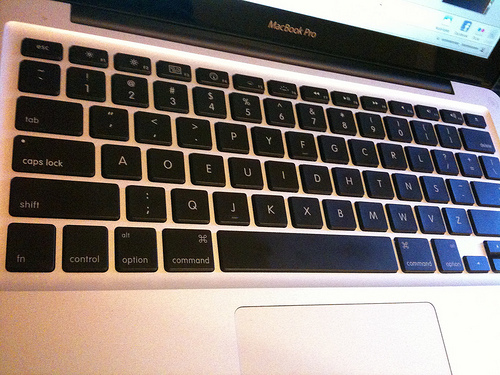
The basic QWERTY layout – the default keyboard layout you’re probably using right now – is a remnant of the very first typewriters. As a kid I used to play with my mother’s typewriter and I would frequently jam the machine by pressing too many keys at once. The same thing could happen if a proficient typist hit two or more keys in rapid succession. Due to the mechanical nature of the typebars, jams were increasingly likely with faster typing speeds. The QWERTY layout (named for the six letters at the left side of the top row) was specifically designed to space out the most common letter combinations, thereby reducing jams by stunting the user’s output. By the time newer devices made typebars obsolete, QWERTY had already cemented itself as the primary standard layout. So if you’re using this archaic configuration today (which I admit, I am), you’re actually making yourself less efficient and potentially increasing your risk of a repetitive strain injury like carpal tunnel. Fortunately, there are other options available.
In 1963, Dr. Augustus Dvorak and his brother-in-law patented the (you guessed it) “Dvorak Simplified Keyboard,” which is one of the more commonly used keyboard alternatives. And no, it’s not just for engineers or computer scientists (or at least, it shouldn’t be). Take a look at the Dvorak layout below and compare it to your QWERTY keys. Note how many of the most common letters in the English language – T, N, S, vowels, etc. – are located in the “home row” where your fingers normally rest. This allows you to type the majority of letters with minimal hand movement. Less common letters like Q, X, and Z reside in the bottom row where keys are the most difficult to reach. On a Dvorak keyboard, approximately 70% of the keystrokes will occur in the home row compared to only 32% on a QWERTY layout.
Other alternative configurations are also available, including one-handed keyboards for people who like to type and use a mouse (or other peripheral) simultaneously, but Dvorak is probably the place to start if you’re looking for a quick way to increase your word-processing efficiency. Yes, it will take some vigilance to re-learn how to type on a completely different layout, but the results could very well be worth it. Besides, doesn’t it feel a little funny to willingly use a device designed to handicap you?
If you do decide to make the switch, the software to run Dvorak is already included with all major operating systems and can typically be activated with a with a simple change of preferences. You won’t even need to buy a new keyboard – Dvorak decal sets are available online (usually for a couple bucks) or if you’re ready to scrap QWERTY altogether you can manually remove and rearrange the keys yourself.
Broken Secrets
Get updates from: Facebook | Twitter | Email | Kindle
Source: Wikipedia
Image: josue salazar
Sarcastic Secret: This is a Toilet Seat
By Chad Upton | Editor
Sure, you can hold it, we all can. But one day, your knees will buckle and you’ll actually want to use a public toilet.

When you need a public toilet, there’s nothing more demoralizing than discovering the last patron was a Neanderthal. Of course, you have to forgive them — cavemen don’t know that attachment is actually a seat. The archaeologist in me suspects that cavemen believe it is a funnel, you know, to help them get everything in the bowl. If that’s true, they may be more advanced than previously understood.
If you ever catch one of these beings, enlighten them. Tell them that other people reluctantly want to sit on that seat.
An abstract and slightly less plausable hypothesis is that some of them are aware that it is a seat, but are worried about catching some disease when they lift it. You can let them in on the toilet-paper-secret: use a tiny wad of paper to lift the seat. Then leave that toilet paper on the floor as a potentially embarrassing trap for someone else to catch on their shoe. Just kidding of course, you can let them in on this other little secret: toilet paper can actually be placed right in the toilet.
Also, direct them to the flush lever. It’s incredibly effective when used.
Broken Secrets
The Word “Nerd” Was First Written by Dr. Seuss
By Kaye Nemec
Although many of us know Dr. Seuss as a children’s author, it was his 15 year career in advertising that really made him famous.
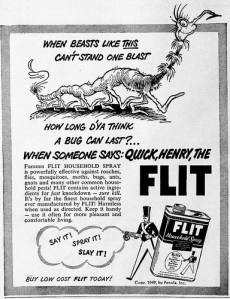
He started working as a freelance writer and illustrator when his talents caught the eye of the ad industry. His first big hit came when he coined the popular catchphrase, “Quick, Henry, the Flit!” Today, it would be comparable to, “There’s an app for that.”
Realizing he had a gift for both illustrating and writing, Seuss wrote his first children’s book, And to Think That I Saw it On Mulberry Street. After submitting it to 27 publishers and receiving 27 rejections, Mulberry Street was finally published with the help of a friend at Vanguard Publishing.
It was a huge hit among teachers and librarians so Houghton Mifflin and Random House asked Seuss to write a children’s book using new-reader vocabulary. They gave him 400 words but told him to cut the list in half. Nine months later, the result was the widely popular, The Cat in the Hat (1957). It uses 223 of the words on the original list and 13 words that are not. Of the 236 words used, 221 are monosyllabic. In three years, about 1 million copies of The Cat in the Hat were sold.
 After the success of The Cat in the Hat, Seuss’ editor, Bennett Cerf, bet him that he could not write a children’s book using only 50 different words – 186 fewer words than he used for The Cat in the Hat. In 1960 Seuss won the bet when he published Green Eggs and Ham, a story of only 50 words, 49 of which have only one syllable. It has since become one of the best-selling children’s books of all time.
Dr. Seuss wrote and illustrated several children’s books, most of which have unique histories or quirky facts associated with them. The first time the word ‘nerd’ was used in print was in If I Ran to the Zoo. That wasn’t his first new word, ‘Grinch’ became mainstream after Seuss used it in How the Grinch Stole Christmas.
Broken Secrets
Get updates with: Facebook | Twitter | Email | Kindle
Photos: Joe (cc), davemc500hats (cc)
Sources: Seussville.com, Wikipedia – Green Eggs & Ham, Wikipedia – The Cat in the Hat, Barnes & Noble
Potatoes: Green Means Stop
By Chad Upton | Editor
If you eat potatoes, in any form, you’ve probably come across a partially green one.
Most importantly, don’t eat the green part — it’s toxic enough that you may get very ill, and it can cause death in rare cases. Secondly, it’s very bitter, so you’re not going to enjoy it. French fries and potato chips are also affected, so avoid the green stuff there too.

The green coloration is chlorophyll. Like many other plants, chlorophyll is formed with enough exposure to certain types of light. Of course, many green leaves are part of a healthy diet, so it’s not the chlorophyll itself that is the problem.
Exposure to light can also cause another reaction that forms a substance called “solanine.” It is not related to chlorophyll, but is often formed at the same time. Solanine is toxic. 16 ounces of a fully green pototo could be enough to make a 100lb person sick.
The green chlorophyll is a good warning about the presence of solanine, but solanine can form when chlorophyll does not. So, even if the potato looks normal, the bitter taste will serve as a warning.
Cooking a green potato will not help, it’s still toxic. But, a cooked potato cannot turn green since the required enzyme mechanisms are destroyed in cooking.
Bottom line: if it’s green or bitter, skip it.
Broken Secrets
Get updates on: Facebook | Twitter | Email | Kindle
Photo: Selva / Eden (cc)
Magazine Mastheads Have a Nautical History
By Kaye Nemec
At the beginning of most magazines and newspapers, somewhere near the editorial page, you’ll find the masthead — the page of a publication that lists who is responsible for the magazine “behind the scenes.” Everyone from editors and writers to advertising staff and designers are listed on the masthead. It may also include history of the publication, advertising rates, subscription and circulation information, contact names and numbers. So, why does this source of information have a clearly nautical name?

The term masthead did indeed derive from a nautical origin. Specifically, it came from a tradition within the shipping industry where brass plates were commonly displayed on the main mast of ships to showcase the owner of the ship, information about the ship and/or the location of its home port.
Broken Secrets
Get updates on: Facebook | Twitter | Email | Kindle
Photo: hans s (cc)


 Broken Secrets