Archive for 2010
The Swastika Was Once a Symbol of Good Luck
By Chad Upton | Editor
Today, the swastika is frequently associated with one of the most horrible and unfortunate times in human history — it was the symbol of Nazi Germany (1933-1945).
Because its recent history is awful, the swastika is nearly taboo in many cultures. But, the symbol has been around for thousands of years, most of those years as a very peaceful symbol.

The name “swastika” comes from the Sanskrit word svastika, meaning “lucky” or “well being.” It is generally used on people and things to denote good luck or wish well being. It goes by many names in many different places: hook cross, crooked cross, angled cross, sun cross, sun wheel, hakenkreuz (German), among others.
The swastika can be traced back about 11,500 years, to the Neolithic period. It’s past and present are deeply rooted primarily in Eastern religions although there are many examples of it in other religions. Long before it had any negative connotation, it was popular in religions and cultures including: Christianity, Buddhism, Hinduism, Chinese and Japanese art and many others.
Many people are unfamiliar with the swastika’s relationship to Christianity. They used it to symbolize Christ’s victory over death. Some cathedrals built during the Romanesque and Gothic eras are decorated with swastikas, including the tile floor of this Roman Catholic Church in France (Amiens Cathedral).

Matilde Moisant, the second woman to get her pilot’s license, wore a swastika pendant on her 1912 uniform for good luck. This was a common practice among early aviators and test pilots.
Although the swastika is generally associated with an awful time, its original meaning is still an important symbol in many cultures, so it’s important to understand that it was a positive symbol for most of its life.
Broken Secrets
Subscribe on: Facebook | Twitter | Email | Kindle
Sources: About, Wikipedia (Swastika, Matilde Moisant, Amiens Cathedral)
Jagermeister Does Not Contain Deer Blood
By Chad Upton | Editor
The word “Jägermeister” was first used in 1934 as the name for senior gamekeepers in the German civil service.
In English, Jägermeister translates to “hunt-master,” but most people know it better as a bitter sweet liqueur.
It was developed by Curt Mast in 1935 as an after meal digestif (to aid digestion). It’s named after the German hunt master and carries a stag on the front of the bottle because the inventor was an avid hunter. The glowing cross above the deer’s head pays homage to the patron saints of hunters, Saint Hubertus (Hubert) and Saint Eustace.
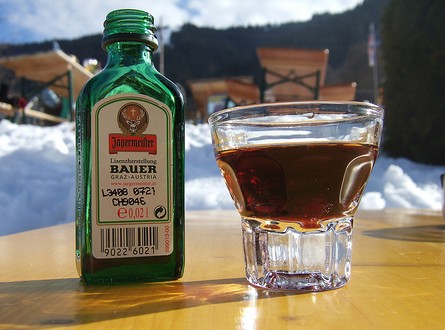
A common rumor is that Jagermeister contains deer or elk blood, although that has been debunked.
There are also rumors that it was originally used as a cough syrup. Although it might taste like it, Jägermeister was not marketed as a cough syrup, but it was introduced during the era of patent medicines and it is and has always been a digestif — a liqueur made from bitter herbs, believed to aid digestion.
 Despite the fact that it was not designed to be medicine, alcohol was often used as a medicine in those times, even given to babies and young children. Frankly, that hasn’t changed all that much, the cough syrup Nyquil still contains alcohol.
Often referred to as “Jager” it is commonly mixed with RedBull to create a “Jager Bomb” (or “Jager Blaster” in some places).
Jägermeister is 35% alcohol by volume (70 proof). It contains 56 herbs, roots, fruits and a variety of spices including: anise, saffron, citrus peel, licorice, ginger, ginseng, juniper berries and even poppy seeds. These ingredients are pressed and steeped in a water/alcohol mixture for a few days before being filtered. Then it gets similar treatment to fine wines — it is aged in Oak barrels to further enhance the flavor (for about a year).
Broken Secrets
Subscribe on: Facebook | Twitter | Email | Kindle
Photo: Ehsan Roudiani (cc)
Sources: The Bitter Truth, Everyday Drinkers, Snopes, Wikipedia (Jägermeister),
Google Search Tricks
By Chad Upton | Editor
Google is an amazing search engine. Most of us use it to find websites with information, but it can do so much more than show you websites with answers. There are hundreds of built in features that can give you the information directly, without having to go to another site.
Movies Times
Enter “movies” followed by your town/city/postal or zip code and you’ll see some movie times for a couple popular movies along with a link to get the full list of movie times for your area.

Track Packages
Just type in a FedEx, UPS or USPS tracking number and Google will give you a link to see the shipping details.

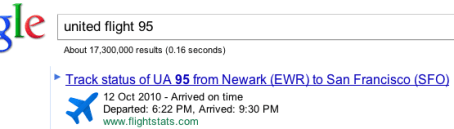
Track Flights
Enter the airline and flight number and search. No more clicks, the info will be right there.
Find the Best Price
Enter the model name or number of a product you’d like to buy. Then click the “shopping” link at the top and Google will show prices at online retailers. To ensure you get the lowest price, you can sort by price (including shipping). There will likely be some retailers that you’ve never heard of, so you can read retailer reviews and sort by their rating as well.
Define a Word
Lets say some fancy pants uses the word “noetic” and you don’t know what it means. You could go to your favorite dictionary site, or you could type “define:noetic” into Google search. It’ll give you a list of definitions from various sites.
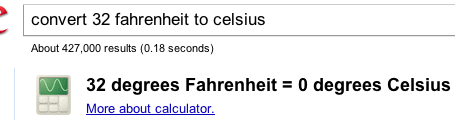
Unit Conversion
Whether you need to convert cups to gallons or go between metric and imperial units, Google’s conversion engine can help.
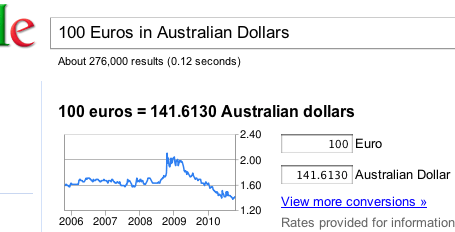
Currency Conversion
Just type in the value and the currency to convert from and to, example: 100 Euros in Australian dollars
Time
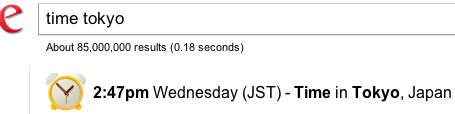
You think you’re doing a nice thing, calling somebody far away to make sure they’re well and give them a familiar voice to talk to. Then they answer the phone as if you woke them up in the middle of the afternoon, but you forgot that’s 4am in Tokyo. You can easily avoid this by checking the local time before calling.
Weather
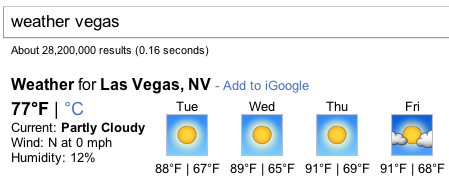
Should you pack shorts or pants for your weekend getaway? Get a 5 day forecast in seconds (and easily switch between F/C).
Stock Quotes
Just enter the stock symbol and search.

There are many more of these features and I’ll be sure to share more later.
Broken Secrets
Subscribe on: Facebook | Twitter | Email | Kindle
Search a Specific Site
Some websites do not have good search functions on them. Sometimes I’ll read something on a site and then I go back to find it later and the site search is horrible. Otherwise, you might use google as your homepage, so it could be easier to initiate the search from there.
For example, you may remember reading why some knives have serrated blades on BrokenSecrets.com. But, you want to read it again or send the link to someone who was interested in it. You can type in google, “serrated site:brokensecrets.com” and it will only show results from BrokenSecrets.com.
Using Google as a Time Machine
Because Google’s spiders are constantly crawling the web, storing pages of data so they can resolve accurate and timely information for your search requests. Google actually lets you view the last set of data that was captured.
This information is helpful is a website cannot be reached, but you still want information from it. It’s also useful if information has changed, moved or been removed, you can potentially look at a previous version of the information.
Hair and Nails Grow Faster in the Summer
By Chad Upton | Editor
Actually, your hair and nails grow faster in sunlight, and we generally have more daylight available and spend more time exposed to it in the summer.
This is because your body produces more vitamin D in daylight, which is important for nail growth. In fact, hair and nails are just a basic form of skin. The epidermis layer of skin is made up of a few types of cells, hair and nails are made from one of those types of cells: keratinocytes.

Fingernails also grow faster on your dominant hand, due to better blood flow. Also, on your dominant hand, the finger nail on your middle finger usually grows the fastest and slowest on your thumb. Fingernails grow about five times faster than toenails.
Despite popular belief, hair and fingernails do not continue to grow after death. As a dead body dehydrates, the skin retracts, which gives the appearance that the hair and nails have grown. But, even while you’re alive, hair and nails are made from dead cells, which is why it doesn’t hurt to cut them.
Broken Secrets
Subscribe on: Facebook | Twitter | Kindle
Photo: Ibrahim Iujaz (cc)
Sources: Straight Dope, Wisegeek, KidsHealth, eHow, Wikipedia
Studios Pay to Have Movies Rated
By Chad Upton | Editor
I always find it funny when movies come out on video and they’re advertised as “unrated.”
 The “unrated” designation seems to imply that the film is so outrageously sexual, horrific or crude that there’s no rating that could possibly classify how extreme it is. But, that’s not usually true.
While the unrated release may be more sexual, horrific or crude than the rated version, it also may not be. To me, it’s just like doing a math test, not handing it in and calling it “ungraded.” In either case, it doesn’t necessarily reflect the nature of the content — it just means that it didn’t get a stamp from somebody with elbow patches.
The movie rating process varies by country. In some places, such as Australia, movies are rated by the government. In other places, such as the United States, an independent organization handles ratings.
In the US, the Motion Picture Association of America (MPAA) actually has a trademark on the ratings known as: G, PG, PG-13, R and NC-17. That means those ratings cannot be used without the permission of the MPAA. That adds credibility to the rating system, but it also adds digits to their bottom line. You see, when a filmmaker or studio submits a film for rating, they pay $2,500 – $25,000 to have their film rated (based on cost of the film and the annual revenue of the studio).
 The MPAA also has an agreement with the major studios: that all theatrical films will be submitted for rating. That’s why most movies that you see in the theater have a rating. It’s not a legal requirement, at least not in most places. In fact, it’s a business decision.
Even though it costs a lot of money to have a film rated, it can be well worth it. The rating that a film receives can dramatically impact the film’s success at the box office. For many films, the lower the rating, the wider the audience. But, in the case of movies that are targeted at older teenagers and adults, higher ratings may be more appealing. This is part of the phenomenon that contributes to the status of the “unrated” marker.
The rating a movie gets is so important that studios will often re-cut and resubmit a film for rating multiple times, until it receives the rating that they want. It’s all marketing, they know how they’re going to promote the film and the rating has a lot to do with it. Each time they resubmit a film, it costs $2,500.
The factors that contribute to ratings include: sexual content, violence, profanity, drug use and other material that may offend some audiences. The interesting part is that films released internationally are often re-cut for each country or cultural area. Sexual content in America generally pushes the rating up while the same content in France and Germany is more socially acceptable and does not necessarily increase the rating there. On the other hand, extremely violent films may be re-cut and toned down for those same markets where intense violence is less acceptable to ensure a lower rating.
 The ratings board is made up of 9 people (mostly men), ranging in age from 44 to 61. More recently, the board has been accused of “ratings creep” — the idea that movie ratings are becoming more lenient over time. A Clockwork Orange originally received an X rating in 1971, reserved for films that are recommended for adults over the age of 18. But the X rating is not part of the MPAA rating system that we know today. A Clockwork Orange was later given an R rating, which suggests that viewers under the age of 17 by accompanied by an adult. Clearly, it got a much lower rating the second time around.
The marketing of “unrated” films suggests they are similar to old X rated films. If you want to see an unrated film, check out some recent releases: The Hangover, Get Him to the Greek and Hot Tub Time Machine.
Broken Secrets
Subscribe on: Facebook | Twitter | Kindle
Sources: Filmbug, FilmRatings.com, Wikipedia (MPAA, MPAA rating system)
Trader Joe’s Marketed the First Reusable Shopping Bag
By Kaye Nemec
About 20 years ago, groceries were often carried in brown paper bags.
One day, someone realized that we were wasting too many trees, so many grocery stores changed to plastic bags. Then somebody realized that plastic bags didn’t decompose in landfills. Now, we’re finally transitioning to reusable bags. These bags cost at least $1 each, sometimes more, and you can re-use them for a long time.
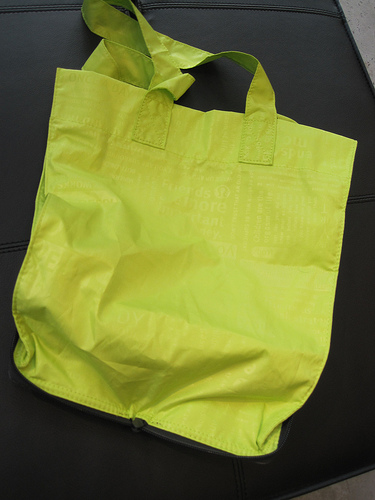
They are an excellent solution to the shopping bag dilemma, at least when you remember to bring them in the store with you. They don’t rip like paper bags and they hold much more weight than plastic bags. But, be careful, you should wash these bags regularly since they can be a breading ground for bacteria.
It turns out that Trader Joe’s was the first super market to offer reusable bags in 1977 with their “save-a-tree” canvas grocery bags.
Most of our international readers and even many of our US readers may not have heard of Trader Joe’s. They’re extremely popular in Southern California and they have stores in about half of the other states. Even if you haven’t heard of Trader Joe’s, you’ve likely heard of their owner, German supermarket giant, Aldi.
 Aldi is a global supermarket brand that has been around since 1961. They have over 8,200 stores and operates in 18 countries. Aldi was started by the Albrecht brothers and that’s where the name Aldi comes from — it means, “Albrecht Discount.”
The first Trader Joes was opened by Joe Coulombe in 1967. In 1979 Coulombe sold the company to Theo Albrecht, who created the trust that owns Trader Joe’s to this day.
Despite the relationship, Trader Joe’s and Aldi are very different – Trader Joe’s is a bright, island-themed store filled with hard-to-find, unique and upscale food selections at a great value. In addition to their innovative selection, Trader Joe’s also offers a wide variety of organic, natural, vegetarian, gluten free and vegan selections. In fact, in 2007 Trader Joe’s eliminated all added Trans fats from all of their private label products. Trans Fats were just the next thing to go in a list that already included artificial colors, flavors, preservatives and genetically modified ingredients.
At Trader Joe’s at least 10 new items can usually be found in the stores each week. You’ll usually have no problem finding an employee to help you with product questions and to ring you up and bag your selections for you. Shopping at Trader Joe’s is an experience, an event, it makes grocery shopping fun.
Like Trader Joe’s, shopping at Aldi is an experience, although in a much different way. It too has a small store format and limited selection with very low prices, but the store looks more like a warehouse – no frills, no decorations and certainly no “character.” Most of the products are stacked in cardboard boxes on pallets instead of actual shelves. Their slogan, “Honest to Goodness Savings,” sums up their philosophy, which is to bring their customers high quality food at the lowest possible price. Aldi only carries around 1400 of the most frequently purchased household and grocery items and 95% of them are store brand – not name brands you’ll recognize.
At Aldi you have to work a little harder for your savings. With only one register open most of the time, customers are moved through the line quickly and they’re responsible for bagging all of their own groceries at a separate counter to make space for the next guest. Looking for a cart to put your purchases in? You must deposit a quarter in order to get a cart and you’ll get your quarter back when you actually return the cart to the store instead of leaving it in the parking lot.
Domestically, a number of vendors create products under both labels – so some products you find at Aldi may be the same things you find in different packaging at Trader Joe’s. Since Trader Joe’s does not exist in the European market, some of their store brand products have begun to pop up on Aldi shelves there.
The next time someone asks if you want paper or plastic, thanks to Trader Joe’s, you can say “neither.”
Broken Secrets
Subscribe on: Facebook | Twitter | Kindle
Sources: TraderJoes.com, Trader Joe’s Timline (PDF), Aldi.com, NewYorkTimes.com , Wikipedia (Trader Joe’s, Aldi)
Photos: lululemon (cc), FoldableBags (cc)
Modern Chewing Gum is Made in a Lab
By Chad Upton | Editor
Chewing gum has been around for a long time. The first form of chewing gum was birch bark tar, dating back about 5000 years in Finland.
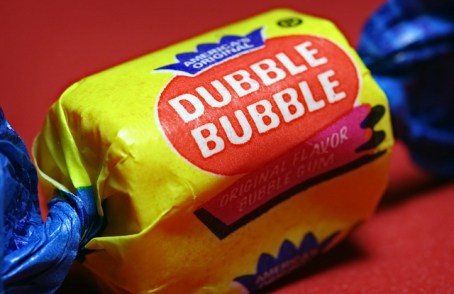
Ancient Greeks chewed a gummy substance from the mastic tree. Aztecs and Mayans chews chicle from the chicle tree.
Chicle is responsible for modern chewing gum. In fact, the famous brand of gum, Chiclets, is named after chicle. Wrigley originally used chicle from a number of natural sources in Central America. But, just like sugar, we found a way to create chicle in a lab, saving the expense of importing it.
In 1937, some scientists at Standard Oil (now ExxonMobil), developed Butyl Rubber, which is almost exactly the same as chicle. It’s also used to make rubber tires, basketballs, footballs, soccer balls and many rubber components used for home construction on roofs and around HVAC fixtures.
Global supplies of butyl rubber primarily come from two companies ExxonMobil and LANXESS, a spin off of Bayer Pharmaceuticals.
Chicle is still used for chewing gum in some markets, such as Japan.
Broken Secrets
Subscribe on: Facebook | Twitter | Kindle
Photo: Darren Hester (cc)
Sources: Wikipedia (Chicle, Chewing Gum, Polyisobutylene)
Some People are Genetically Predisposed to Dislike Broccoli
By Chad Upton | Editor
Broccoli and brussels sprouts are popular vegetables for kids to feed the dog under the table.
My brother and I had a really smart dog growing up, which must be why he didn’t like broccoli either. Although, he always liked to do what we did, so I don’t know if he actually disliked it or if he just liked to make the same face when he ate broccoli too. You know the face, when you squeeze your eyes shut and use your tongue to scrap any residual taste off the roof of your mouth.
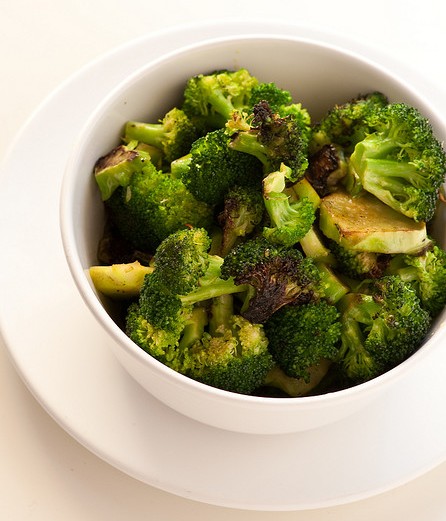
Getting kids to eat their vegetables can be a tough task, but there are plenty of adults who don’t like vegetables either. So why do some people like vegetables such as broccoli and other people passionately dislike them?
There are many reasons why people dislike vegetables. My brother and I always said it was the texture, not the taste. But, it was the taste and it’s scientifically proven.
There is an organic compound called phenylthiocarbamide (PTC) that tastes very bitter. Well, it’s very bitter to some people, it’s tasteless to others. About 70% of people have genetic traits that make them sensitive to the bitter taste of PTC, the rest of the population does not taste it.
While PTC itself is not found in food, there are a number of similar compounds which are. Many vegetables from the cabbage family (broccoli, cauliflower, horseradish, wasabi, mustard, brussels sprouts) contain these compounds.
Additionally, people who do not smoke and do not drink coffee or tea, taste PTC more than those who do consume coffee, tea and cigarettes. One big group of the population who doesn’t consume coffee, tea and cigarettes is children.
So, when you see kids who passionately dislike some vegetables, they may actually taste something that you do not.
Broken Secrets
Subscribe on: Facebook | Twitter | Kindle
Photo: Jules: Stonesoup (cc)
Sources: Indiana Public Media, Science Daily, Wikipedia (Broccoli, Brassica, Brassicaceae, Cruciferous, Kale, Phenylthiocarbamide)
Table Salt Used to Indicate a Person’s Social Status
By Kaye Nemec
While table salt is an important flavoring ingredient in modern day cooking, it had a much more significant reputation in earlier centuries.
It wasn’t until the early 1900s that manufacturers began processing table salt to be used in salt shakers. Before then, salt was served in very elaborate containers that often resembled chairs or thrones.
These “salt chairs” were commonly placed at the head of the table closest to where the most important guest. Salt was considered an extremely important substance that was to be treated with great admiration. Important people sat “above the salt.”

In Russia it was common to have a welcoming ceremony when guests came over that included serving a piece of bread with salt. The salt was served out of the salt chair or throne. Because of the popularity of this ceremony, salt chairs became popular wedding and house warming gifts. Bigger salt chairs signified a wealthier or more prominent place in society.
Typically salt chairs were about 5 inches tall. The salt was stored in what would be the seat of the chair and a lid was placed over the salt. Because the salt could corrode silver, the seat and lid of the chair were usually gold plated. Today, antique “salt chairs” can be found selling at auctions for $500 and up.
Broken Secrets
Subscribe on: Facebook | Twitter | Kindle
Sources: Milwaukee Journal Sentinel, Association of Small Collectors of Antique Silver
Photo: Association of Small Collectors of Antique Silver
September 29, 2010 at 12:01 am Broken Secrets Leave a comment
How to Watch Blocked Internet Videos
By Chad Upton | Editor
The internet is a great place to catch TV shows and clips that you or your PVR missed.
Unfortunately, a lot of websites only allow their video content to be viewed in their service area. It’s not because they’re mean, they may have contracts that prevent them from distributing outside their area, not to mention cost savings reasons.
 That’s right, it’s expensive to stream video over the internet to thousands or hundreds of thousands of people in a reliable way. You need a lot of servers and bandwidth, both of which are expensive, especially in large quantities. If a broadcaster only services one country, they’re not likely going to spend money to reach customers outside of their service area, although they may allow it if there are no restrictions of that nature in their distribution contracts.
Secondly, they may not be allowed to broadcast outside of their broadcast area. Broadcasters buy distribution rights for the shows and other content that they air. These distribution rights are usually sold by country. That means a broadcaster who buys the rights to air a show in the US is not allowed to distribute that show over the internet to another country since they have not bought the distribution rights required to broadcast in that country. In fact, another broadcaster in that country likely has paid for the rights to broadcast that same show there.
There are also legal agreements with members of various guilds and unions that may prevent content from being distributed in certain areas or for a finite time after the original air date.
 Broadcasters can identify which country you’re in when you access their website. They use various methods to determine your location, but the most popular is something called Geo-IP look up. Basically, when you navigate to their website, the network address of your computer is sent to the web server. They can look up that address in a database to see the country that address is registered to. This method is accurate most of the time and in some cases they can actually narrow down the part the city that you live in.
Although there may be legal and ethical issues with it, there are ways to circumvent some of the methods that are used, potentially allowing you to view content from outside their intended region of distribution. These methods may be illegal in your country, so verify the legality of it before doing so.
I think there is at least one ethical use for circumventing regional lockouts. For example, I was in Canada a couple weeks ago and I wanted to catch up on one of my favorite shows. I normally watch the show on network TV and all of the advertising is relevant to me. I wasn’t able to watch videos on the broadcaster’s website from Canada, so I could have used the following method to make it work:
- Install this Firefox plugin: http://addons.mozilla.org/en-US/firefox/addon/967 (requires Firefox browser)
- In Firefox, Go to “tools” > “Add-ons” and click on the “Preferences” button for the Modify Headers add-on.
- Click on the “Headers” tab at the top.
- Then enter: “X-Forwarded-For” in the “Header name” input box (without the quotation marks).
- Enter one of the following IP addresses in the “Header Value” input box (without the quotation marks, and choose the country where the content is accessible from)
USA – 12.13.14.15
Canada – 207.245.252.27
UK – 193.35.131.194 - Select “Add” from the “Selection action” drop down.
- Enter the country name in the “Descriptive comment” input box.
- Click “Add”.
- Now select the one you just added in the list and then click the “Enable/Disable” button. You should see a green circle next to it, indicating it is enabled.
- Close the Modify Headers box, restart the Firefox browser and visit the intended website.
I should note some websites that the above method does not work for:
- cbs.com
- cwtv.com (the CW)
- hulu.com
- sho.com (showtime)
- tnt.tv
There are at least four times that many sites that DO work, although I’d rather not single them out for legal reasons. There are also a few other methods, but this is by far the easiest to setup and use. If you have IP addresses for other countries, let me know and I’ll add them.
Also, it takes a lot of people and money to make these great shows; be sure to support them by purchasing them when they come out on disc or renting them from iTunes, Netflix, Amazon, etc.
Broken Secrets


 Broken Secrets