Archive for 2010
Watering Hard to Reach Plants
I did an interview with the BBC a few weeks ago and I was on the show with Caroline Bloor, head of consumer testing at Good Housekeeping. I shared a few secrets with the audience and she shared a few secrets too, including how to water hard to reach plants.
If you’ve got hanging plants or otherwise hard-to-reach botanicals, you’ve probably overshot the pot with the watering can.

Instead, trying putting ice cubes in the pot. They’ll melt slowly and water the plant. They’re much easier to water with and if you drop one, it’s much easier to clean up than its thawed relative.
Thanks for sharing this secret, Caroline.
Broken Secrets | By: Chad Upton
Photo: ell brown (cc)
Rotten Eggs Float
Whether you throw away the carton and use the egg holder in your fridge or you just don’t believe the expiry date, there will come a time when you question the edibility of eggs.
There is an easy way to test them.
Fill a container with water and gently place the egg inside it. If it sinks, it’s good to eat. If it floats, throw it out. If it weighs the same as a duck, it’s a witch.
Why?
Eggs naturally have a small air pocket in them. In fact, a bright light is used during a process called candling to determine the size of this air cell. The size of the air cell is used to determine the grade of an egg. Grade AA eggs have the smallest air cell, and as the air cell gets large the egg is given a lower grade (A, B…etc).

This air cell increases as the egg ages. There are two schools of thought about why. Some say the eggshell is porous and allows some liquid to escape and air to enter. Others say a chemical reaction takes place inside, which results in the larger air chamber and the awful smell when they are rotten. I couldn’t find a definitive answer to why the air cell increases in size, but nobody disputed the fact that it does.
Because the air cell increases, it makes the egg less dense, meaning it will float in water with enough time.
The smell of rotten eggs is a popular description for the smell of sulfur. There’s good reason for that, eggs contain a fair amount of sulfur because it is necessary for feather formation. This smell becomes more prevalent as eggs age.
Thanks to my wife Kristen for this secret.
Broken Secrets | By: Chad Upton
Source: Eggs WP, Sulfur WP, What’s Cooking America, O Chef
Some Palm Trees Can Survive Freezing Winters
Palm trees usually symbolize warm and tropical climates. From Hollywood, we know the streets of Los Angeles and Miami are lined with beautiful palm trees. Hollywood portrays New York and Chicago as cold and windy, which they are for part of the year. But, there are real palm trees in both New York and Chicago.
New York has had palm trees in the Brooklyn Botanic Garden since the 1980s. Chicago has palms at the beach on Lake Michigan.
Although we closely associate palms trees with warm climates, there are a some palm species that can survive freezing winters.

Any variety of palm that can survive colder geographies that are not usually considered palm regions, are called “hardy palms.” Many of them are native to higher elevations in Asia and survive freezing weather with little or no damage. (more…)
Punctuation is Not Allowed in Mailing Addresses
Whether it’s a personal or business letter, every piece of mail I receive has the address formatted differently. Some even have the return and destination addresses formatted differently.
Since the post office has very strict requirements for addressing a letter, they should all be exactly the same. The post office guidelines are recommended for fastest delivery and I’ve compiled a list of rules that are the most surprising or commonly abused.
Since most of my readers are in North America, I’ve compared the requirements from the US Postal Service and Canada Post — they’re very similar and they contain good practices that are applicable to sending mail in most places.
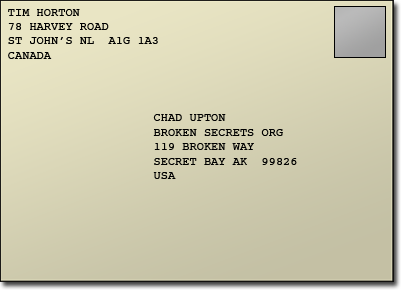 Mail is typically sorted by a machine, but if the machine can’t determine the address then it will be dropped in a bin for a human to sort it. Most of the requirements are design to make it easy for the machine to understand where you’re trying to send your letter.
No Punctuation Allowed
One rule that will surprise most people: no punctuation is allowed. I know your third grade teacher said you should put a comma between the city and the state, and maybe she was right at the time, but that’s not right anymore. Don’t use periods either, using punctuation will only slow the mail down. It’s going to be a tough habit to break, I know. There is one exception, and that is when the name of the City, Street or Town contains punctuation, such as an apostrophe (for example: St John’s). (more…)
iPhone and iPod Tricks
Apple has sold 50 million iPhones and 35 million iPod touch devices, so there are a lot of people who can benefit from these secrets.
This is by no means a complete list, but I wanted to provide some of the most useful and least well known iPhone tricks. Most of this list also applies to the iPod touch; if you know someone with one of these, be sure to send them a link to this article.
Double Click the Home Button
The button on the front of the phone is called the “home” button. You can choose what happens when you double click it. Mine is set to go to my phone favorites, making it quicker to dial my people. You can get to this screen by going to Settings > General > Home.
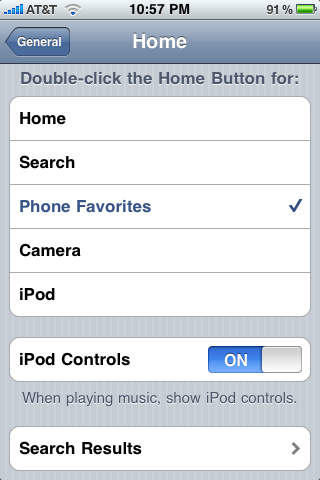
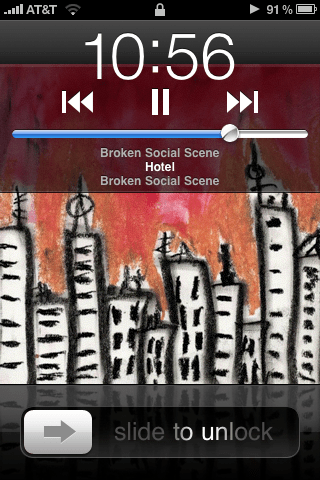
As you can see on the option screen above, there is an option for “iPod Controls.” When those are on and the phone is in standby mode (blank screen), you can double click the home button to see the current song/artist/album cover and show audio controls (volume/forward/back/play/pause) — see below for example. If you want to fast forward or rewind, hold the forward/back buttons respectively.
Every UPC Barcode Has 30 Bars
Virtually every product has a barcode on it. In North America, 12 digit UPCs are used. In Europe and parts of Asia, 13 digit EANs are the norm. Both systems are a unique set of numbers that represent that specific product. The numbers are printed for humans to read and represented as a barcode for computers to read.
The UPC (Universal Product Code) and EAN (European Article Number) are very similar; in fact, the EAN standard is heavily based on the 12 digit UPC standard.
The first UPC was scanned at a checkout in Troy, Ohio in 1974; it was a 10-pack of Wrigley’s Juicy Fruit gum. The UPC format is very well designed and hasn’t really changed since then.
All UPCs have 30 bars. Grab any product with a 12 digit UPC and count them. Some bars are thick and some thin, but there are 30 total. Thick bars are technically made up of a varying number of thin bars as you can see in the illustration below, but thick bars are only counted as a single bar for the purpose of this description.

Each of the 12 numbers accounts for 2 bars, which gives you 24 bars. Then there are 6 guard bars that give the scanner consistent reference points. There are 2 guard bars on each end and 2 in the middle for a total of 30 bars.
Each digit is represented by 2 black bars and white space of varying thickness. The guard bars in the middle divide the 12 digits into groups of 6. The same digit on the left and right sides will be represented differently by the bars, this allows the scanner to correctly identify upside down barcodes.
The first 8 digits refer to the company that registered the UPC. The next three digits uniquely identify the product.
The last digit in the sequence has nothing to do with the product itself, it’s called a check digit. It helps the computer identify a scanning error.
The check digit is a bit complicated, but here’s how it works. Add up the digits in the odd numbered positions (first, third, etc) and multiply by three. Next, add the digits in even positions to the first number, then find the remainder when divided by 10. If the remainder is not 0, then subtract the result from ten. That number should equal the last digit, if it doesn’t then the computer knows there was a scanning error and you get to scan your self-checkout item a fourth time.
There are some rumors that the first few digits can be used to identify the country of origin, but that’s not true. With 12 digit UPCs, no digits are used to identify a country. 13 digit EANs reserve the first three digits for country of registrar. This country code simply refers to the country where the code was registered and is in no way related to where the product is made.
UPCs are registered with a non-profit organization called GS1. There is also a website for looking up UPCs, called the UPC database. It can be searched by UPC or by product description.
Broken Secrets | Written By: Chad Upton
Sources: UPCs, EANs, About.com
Images: Wikipedia (gnu)
How Ballparks Stripe Their Grass
In North America, professional baseball fields are the highest form of manicured lawns. Elsewhere, professional football pitches and cricket fields are admired.
Achieving the striped affect is pretty straight forward. The grass appears lighter and darker because the blades of grass are bent in opposite directions. The lighter looking grass reflects more light because of the angle of its blades and the darker ones reflect less light because of their angle.

To bend grass in opposite directions, start by cutting the lawn in opposite directions. The back and forth method is the simplest example.
Most people cut their lawn like that anyway, but the stripes aren’t as dramatic as the professional fields. To improve the contrast, be sure to set your mower at its highest setting. Longer blades of grass bend better and will have a more dramatic look. In fact, longer grass makes for greener grass too — it protects the roots from drying out and turning yellow.
But, here’s the professional stripe trick, after cutting at least two different directions, roll the grass with a lawn roller. Roll the lawn in the same direction that you mowed, this bends the grass better, which intensifies the affect.
Lawn rollers can be bought or rented at many home and garden stores.
Broken Secrets | Written By: Chad Upton
Source: Scotts
Photo: pamhule (cc)
Keeping Secrets Safe at Home
You probably have things in your home that you want to keep safe: cash, checks, credit cards, jewelry, computer data, documents and other valuables.
In case of fire or theft, the best place to put them is in a fireproof safe. This might sound like overkill, but affordable models start around $30.
Safes are an obvious place to put valuables, so you want a bolt-down model — thieves don’t usually have time to open a safe during a robbery but they’ll want to take it with them and open it later.
If you’re looking for a less obvious hiding place, there are many options. You can buy “diversion safes” that look like everyday objects such as: canned food, bleach, candles, books, clocks and many other items.
 If you’re going to use one of these safes then you should store it with other similar items; it doesn’t work well if there is a can of fruit in your sock drawer.
The fake bleach container and candle are both good since there are many places you might find those in your house. The bleach container could make a good hiding spot for the spare key in your garage.
The other thing about these “safes” is that they’re not always that safe. For example, they’re not fireproof and they’re very easy to get into, but they can be useful for storing a bit of spare cash when thin-mint go on sale.
If you don’t want to buy a diversion safe, you can make your own. Pringles cans work well.
Sometimes, it just comes down to location. Reader’s Digest interviewed a number of convicted burglars to find out their secrets to successful home robberies and among other things, the robbers revealed that they rarely ever go into kids rooms. Simply putting stuff in your kids rooms may be secure enough, although you may never find it again either.
The same interviews revealed that robbers don’t go near your house if they see a flickering TV or hear a radio because that’s a sure sign that somebody is home. You can buy a small device that emulates a flickering TV and it’s much cheaper to buy and operate on a timer than a real TV.
Although these hiding places would be great for an Easter egg hunt, they shouldn’t be used for really valuable items. The best place for that stuff is in a proper safe, safety deposit box or federally insured instrument such as a bank account.
Broken Secrets | Written By: Chad Upton
Sources: Reader’s Digest, Reader’s Digest, FakeTV.com
Remove Farmville Updates from Your Facebook Feed
Many of my friends play Facebook games like FarmVille and Mafia Wars. Although my Facebook news feed is littered with requests, I don’t have any interest in watering their crops or feeding their puppies. All that noise makes it difficult to get to the heart of Facebook productivity, making jokes and sending pokes.
Don’t get me wrong, Facebook is a lot of fun and a great way to stay in the loop, but I wish there were fewer FarmVille updates.
Thankfully, Facebook has made it very easy to hide these updates. If you put your mouse over an update, a “hide” button will appear in the top right corner (figure 1).

Figure 1
Click the hide button and you’ll have the option to hide all updates from that person or hide the updates from that application (figure 2).

Figure 2
Click “Hide FarmVille” and you’ll never see another FarmVille update. The same technique works for other applications (“apps”) such as Mafia Wars, Cafe World and others. On that note, if you’re not already a fan, join Broken Secrets on Facebook — I won’t spam your feed, I promise.
Broken Secrets | Written By: Chad Upton



 Broken Secrets