How to Accelerate and Slow Banana Ripening
February 3, 2010 at 1:05 am Chad Upton 36 comments
I love bananas.
They are a nearly perfect fruit. They taste great. They’re fairly inexpensive. They have their own protective skin and they contain many nutrients such as: vitamins A, B1, B2, B3, B5, B6, B9, C, Calcium, Iron, Magnesium, Phosphorus, Potassium and Zinc.
But, if I had to register a complaint about bananas, it would be their shelf life. Keeping them perfectly ripe is a fine art — one worth mastering.
The first trick is something my wife, Kristen, taught me: don’t buy all your bananas from the same bunch! Pick a couple green ones and a couple that are ripe/near ripe. Then you have some you can eat right away and others that will be ripe when you’re ready for them.
The interesting part is that those two bunches are likely the same age. You assume the less ripe ones are newer, but the food distributors control ripeness. They have large, air tight banana ripening vaults that give them very precise control over banana ripening. They’re usually divided into multiple sections, so bananas can be kept at different stages of ripeness. If they’re selling a lot of bananas, they can accelerate the ripening so they will be ripe when they arrive at the store. If sales are slow, they can slow ripening to avoid waste.
How do they do that?
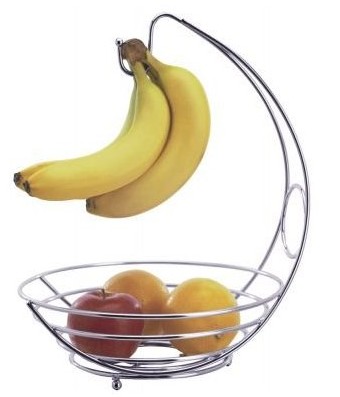 Ethylene gas is used to induce ripening. In fact, bananas ripen themselves by producing ethylene and that’s why adding more ethylene to the air will speed banana ripening further. It’s really that simple.
To accelerate ripening at home, you just need ethylene gas. Luckily, tomatoes, apples, pears and bananas all produce it at an increasing rate as they ripen. If you put an apple or tomato in a bag with bananas, that will speed the ripening. Because bananas produce it, you can place the bananas in a bag to trap the gas and ripen them faster.
To slow ripening, you need to remove ethylene. You can’t remove ethylene completely, but you can slow its reaction by putting ripe bananas in the fridge. The skin of the banana will turn brown, which is normal, and the fruit inside is still good. You can keep bananas in the fridge for a couple weeks and they may not look good, but they still taste great. Do not put unripe bananas in the fridge, it will impede the early stages of ripening and spoil the fruit.
Some retailers also have “un-gassed” bananas; they aren’t as vivid a yellow color as the gassed bananas and are usually a mix between green and a muted yellow color, but the flavor of un-gassed bananas is generally better.
If you haven’t read the post on peeling a banana without the strings, click here to check it out.
Go bananas and follow me on twitter.
Broken Secrets
Written By: Chad Upton
[available on Kindle]
.
Sources: Ripening, Banana, Raw Food Health
Entry filed under: Around The House, Be Efficient, Be Frugal, Be Green, Demystified, Food and Drink, ProTips. Tags: apple, banana, calcium, ethylene, Food and Drink, foodie, iron, magnesium, pear, potassium, ripe, spoil, tomato, zinc.
36 Comments Add your own
Leave a comment
Trackback this post | Subscribe to the comments via RSS Feed


 Broken Secrets
1. Janek | April 20, 2010 at 9:10 am
Bananas tend to ripen slower if you separate the bunch apart.. not exactly sure how but give it a shot!
2. Guy | June 15, 2010 at 7:06 pm
This is because the bananas excrete the ethylene, so if they are bunched together more gas is trapped, and they start producing more of the gas themselves so it’s a vicious circle and BAM, you have overripe bananas. Bananas are so cool.
3. Marcos | August 8, 2011 at 1:30 pm
Ethylene is one of three factors that effect ripening process.
4. Neo | August 12, 2011 at 1:38 pm
i am a school student and i am testing this theory>
5. Rachel | August 15, 2011 at 3:52 pm
This explains everything! I had a bunch of bananas together and they ripened so quickly I’m having a hard time keeping up eating them.
6. gisselle | October 4, 2011 at 4:41 pm
you are a *******
7. agnes | October 10, 2011 at 4:58 pm
Instead of paper bag, can I use trash bag inside of big brown box, and put apples of tomatoes in it.
8. jack | February 20, 2012 at 12:08 pm
This does not work at all
9. Chad Upton | February 24, 2012 at 12:10 am
There are a couple of things discussed. Which ones did you try and for how long?
10. CM | March 11, 2012 at 10:55 pm
I tried the fridge method and it did nothing but cool the banana. It remained green and unpeelalbe. I then but another unripened banana in brown bag and that did nothing .. After 3 weeks with still unripened green bananas I gave up.
Any suggestions to help ripen these particular bananas?
11. monkeyman | August 4, 2012 at 3:13 pm
you put green upripend bananas in the fridge? the article said specificially NOT to do this :) Try reading it again.
12. Jordan | March 19, 2012 at 8:28 am
Thanks man, very helpful. Do you know of any handy substances that can be used to remove the ethylene gasses?
13. wee | April 26, 2012 at 8:37 pm
wooooooooooooooooooo
14. Chance Wall | May 17, 2012 at 9:16 pm
I’ve tried putting bananas in plastic bags by themselves and removing as much air as possible to slow down the ripening and extend banana life. The results were that they stayed greener longer, but became squishy-er than normal bananas. The actual fruit is almost liquidy and probably wouldn’t even taste good anymore (I’m not going to make the observation on taste!) My question is what do YOU think caused the squishy-ness of the banana to happen? Your opinion is greatly appreciated!
15. Gnostradamus | January 24, 2013 at 8:35 pm
Read the article again. Hint: putting it in a bag does not remove ethylene.
16. Rampo | May 21, 2012 at 9:27 am
Plastic bags trap in moisture, resulting in the “squishier” fruit. Paper bags work much better with bananas.
17. Harvesting Happiness | June 26, 2012 at 10:40 am
Awesome that I found this … I seem to have the opposite problem from most people. I can never have enough ripe bananas. I always end up begrudgingly opening and biting into an unripe one and instantly regret it!
Thanks!
18. Bobby | July 11, 2012 at 7:15 pm
All you guys who were unsuccessful in ripening, hastening and delaying the ripening of your bananas, please read the article again and again and again! It’s quite simple to follow. If you want a more detailed technical procedure, you can get me as a consultant. LOL! … fbrlead@yahoo.com
19. Ripen bannans | Tribalgamingin | August 4, 2012 at 8:29 am
[…] How to Accelerate and Slow Banana Ripening « Broken SecretsFeb 3, 2010 … I love bananas. They are a nearly perfect fruit. They taste great. They’re fairly inexpensive. They have their own protective skin and they contain … […]
20. Harvest - Bananas.org | September 4, 2012 at 12:33 pm
[…] […]
21. Chico | September 7, 2012 at 8:05 am
Your understanding of the use of ethylene in banana ripening is flawed.
Ethylene is a trigger that starts the ripening process. Heat ripens bananas. Once triggered, the addition of more ethylene gas or the removal of the gas will not change anything. One of the advantages of using the gas is to achieve a uniform start to the ripening of a modern ripening room which usually contains a tractor trailer load of bananas, that’s 960 boxes. Bananas will happily, and tragically, start to ripen on their own if shipping temperatures are not tightly controlled and/or the introduction of stray ethylene is not prevented.
The banana ripener uses heat as a control of the various ripening cycles. Bananas create their own heat as they ripen which makes the ventilation/cooling of the ripening bananas the key factor.
If the ripener needs to speed up production to meet demand, he will use shorter ripening cycles with greater swings in temperature control. Unfortunately, short cycles means the bananas have been ripened quickly and will continue to ripen quickly in the stores and in your homes. That is why they sometimes turn so quickly on your counter.
Bananas are an ethylene producer and are ethylene sensitive. Some fruits are producers only while others neither produce nor are sensitive to ethylene.
Bananas are easily the largest volume item in a supermarket’s produce section and a major revenue source. Hard to find a fresher fruit … from the time they are harvested in the tropics to the store shelf frequently two weeks.
22. David | April 11, 2015 at 9:42 am
You are spot on. I have ripened hundreds Of thousands of bananas.I cool and vent room with oxygen longer to slow,and vent less with heat to accelerate. Usually 59 To 62 Degrees F is sufficient.I have seen banana pulp temperatures in boxes reach 100 on its own if not properly maintained.Then there is no way to cool or save.You better start eating.
23. mike whiting | October 14, 2012 at 9:30 am
now everybody. look up what a properly ripened banana really looks like. its got to be one of the biggest sins of unknowing waste ever! most banana lovers will be shocked when learning that they have been throwing away the poor things even before they become perfectly ripe. believe it or not, yellow is still extremely raw. really,check it out. it takes quite a while. just imagine. sweeter, tastier,more delectable,not to mention loooonger lasting. ENJOY!!!
24. Laurence Peria | July 1, 2013 at 6:53 am
Why do bananas ripe slower when covered with rice and covered with newspapers?
25. Laurence Peria | July 1, 2013 at 6:54 am
Pls. Answer me
26. Chico | October 25, 2013 at 6:27 am
Covering bananas with rice and newspapers may retard ripening for several reasons. While temperature is one of the main factors, humidity must also be monitored. Rice absorbs moisture which is why people in the southern US often put rice in their salt shakers. In drier areas, humidity levels in ripening rooms must be taken into account.
Additionally, bananas require adequate oxygen to support ripening as well as venting the by-product of ripening, carbon dioxide. The rice and newspapers impact this.
Ripening bananas is more technically involved than presented in the discussion here. It’s not easy to keep it simple and within the confines of this exchange.
27. David | April 11, 2015 at 9:57 am
Yes you need to keep high relative Humidity in rooms. A dry banana has less weight and flavor.Thus costs merchant money.
28. Sara | November 8, 2013 at 6:14 pm
Here’s a great video clip from a nutritional expert on Bananas. http://www.youtube.com/watch?v=9fssfTT2wd0&t=11m48s
29. Bananas Have More Sugar Than Mars Bars | Broken Secrets | November 13, 2013 at 2:02 am
[…] How to Accelerate and Slow Banana Ripening […]
30. Moncler Outlet Kids Forest Down Fur Hood Jacket Suit Navy | December 15, 2013 at 1:35 am
Pumpkin vegetables are usually not decreased calories. An oz for cooking vegetables contains pertaining to A hundred and forty calories. Fortunately that little vegetables within a portion groups Ten grms for necessary protein. These days, with the excessive fat within pumpkin vegetables: A serving carries 17 grms for excessive fat, but it is a healthier saturated fats. This vegetables incorporate monounsaturated, polyunsaturated, as well as omega3 saturated fats, which can be perfect for various reasons. I am going to arrive at which often intimately as i take a look at pumpkin start up oil as well as pumpkin start up oil many benefits.
Moncler Outlet Kids Forest Down Fur Hood Jacket Suit Navy http://www.moncleroutlet-2014.co.uk/moncler-outlet-kids-forest-down-fur-hood-jacket-suit-navy-p-64.html
31. Jeffrey Miller | December 5, 2014 at 1:21 pm
I’ve found that placing bananas in paper bags in the fridge gives you the best of both worlds. The paper is permeable enough to allow ethylene to escape, but seems to minimize the browning effect of the fridge.
32. Matt | September 11, 2015 at 4:47 am
Wow, the first one is a really great tip! Thanks for sharing.
33. How To Build A Banana Ripening Room | Asia Bank | July 26, 2016 at 10:53 pm
[…] How to Accelerate and Slow Banana Ripening | Broken … – How to Accelerate and Slow Banana Ripening. February 3, 2010 at 1:05 am Chad Upton 32 comments. I love bananas. They are a nearly perfect fruit. They taste great. […]
34. How To Accelerate The Ripening Of Bananas | ItHowTo | August 15, 2016 at 11:32 am
[…] How to Accelerate and Slow Banana Ripening | Broken Secrets – How to Accelerate and Slow Banana Ripening. February 3, 2010 at 1:05 am Chad Upton 33 comments. I love bananas. They are a nearly perfect fruit. They taste great. […]
35. shopping | October 22, 2017 at 4:40 pm
I hardly drop remarks, but after looking at a few of the responses on How to Accelerate and Slow Banana Ripening | Broken Secrets.
I do have 2 questions for you if you tend not to mind.
Could it be only me or do some of the remarks come across like they are written by brain dead individuals?
:-P And, if you are writing on other social sites, I would like to keep up with you.
Would you list of the complete urls of your social pages
like your Facebook page, twitter feed, or linkedin profile?
36. How to Accelerate and Slow Banana Ripening. – Social Pigeon | February 28, 2019 at 6:09 pm
[…] Keeping them perfectly ripe is a fine art. Want to learn how to master it? Click here: […]