Posts tagged ‘medicine’
Most Medications Still Good After Expiration
By Chad Upton | Editor
If you check your medicine cabinet, chances are good you’ve got some expired medication in there. Are they still safe and effective or are they fit for the trash?
First of all, this post is for information purposes only and it is not suggesting you take any drugs after their expiration date — always check with your doctor or pharmacist before making any decisions about pharmaceuticals.
The Federal Drug Administration regulates drugs in the United States. They have extensively studied drug expiration dates for the US government. Specifically, the US military stockpiles large quantities of drugs for regular troop usage and emergencies. If those drugs are not used, the cost to replace them can be high.
The FDA found that 88% of drugs tested remained potent for a year after their expiry date; some lasted up to 14 years. Experts caution these results cannot be directly translated to your medication since the military stores their drugs in climate controlled environments that represents ideal conditions.

That said, the FDA and many in the drug industry, including one pharmacist I talked to off the record, agreed that certain drugs are still good up to a year after the expiration date.
Many popular drugs are safe after their expiration date, but there are known exceptions too. For example, Tetracycline, an antibiotic, becomes toxic and should not be taken after its expiration date. Aspirin, on the other hand, is known to be good for a while after its expiration date.
If the drugs are still good, why do drug companies put these short expiry dates on the bottles? It’s hard to say for sure, but there are a couple things we know.
1. The drug companies are required to ensure their products are 100% effective up to the expiration date. That means they need to do testing. The longer the expiration time they shoot for, the longer it will take to release a new product to market, which is bad for business and customers. In most cases, the products have at least a 1 year shelf life.
2. Every company wants you to buy as much of their product as possible. The drug companies can’t really control how much you use their product, but shorter expiration dates may convince you to buy more, even if you haven’t used all of the product yet.
To be safe, you should check with a pharmacist before taking any expired drugs. When you are ready to dispose of your medicine, check out this previous post: How to Dispose of Medicine.
Broken Secrets
Subscribe on: Facebook | Twitter | Email | Kindle
Photos: hit thatswitch (cc)
Caffeine Makes Headache Medicine Work Faster
Not all, but some medicine actually contains caffeine to make it work faster, particularly headache relief medications.
I went to CVS pharmacy and snapped this picture of their headache relief formula.
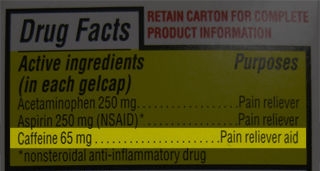 As you can see, the main ingredients are acetaminophen (aka “Tylenol”) and Aspirin. But, there is a significant amount of caffeine too.
At 65 mg, that’s about the same amount of caffeine as a cup of coffee. Caffeine allows faster absorption of these drugs and makes them 40% more effective according to Web MD. That means you don’t need to take as much, saving you some money and reduces side effects.
Although it reduces the amount of painkiller you need to take, it raises the amount of caffeine you consume. This creates a slight risk of additional headaches due to caffeine withdrawal when you stop. Be sure to read the package directions and not take more than recommended.
Broken Secrets | Written By: Chad Upton
Sources: Web MD, International Coffee Organization, WP Caffeine, WP Codeine,
Listerine Was Once Sold as Floor Cleaner
By Chad Upton | Editor
If you haven’t noticed, the popularity of hand sanitizer has exploded. It’s in our desks, cars, purses and homes. I have seen dispensers at subway stops, hospitals, airports and restaurants. We are obviously obsessed with killing germs and fighting viruses.
With H1N1, Mad Cow, SARS and others, you can’t blame us for being careful. It seems like hand sanitizer came out of nowhere, but it’s not new, and neither is the principle.
 The first time I saw hand sanitizer was in 1995. I worked at a restaurant and we were told to use it hourly. At the time, it seemed like a magical potion. I thought the concept was weird: I wasn’t washing anything off my hands, I was rubbing it in.
The truth is, hand sanitizer is more effective at killing bacteria than soap and water. That said, soap and water is far more effective at removing visible dirt.
For the most part, hand sanitizers use a variety of alcohols as their active ingredient. To be effective at reducing bacteria, they should contain at least 60% alcohol, and most contain 60% to 85%. A few brands (worth avoiding) contain as little as 40% alcohol and some hospital solutions have as much as 95%.
So, where did this idea start?
It began in 1867 with a British surgeon, Joseph Lister. He published a series of articles in the British Medical Journal stating that surgery patients had less tissue infection if the incisions and surgical instruments were treated with carbolic acid prior to surgery.
At the time, they didn’t wash their hands or anything else before surgery. They thought gangrene wounds were caused by stinky air. Seriously. The same stinky air they blamed for cholera, black death and bubonic plague. They later realized the stinky air was actually the result of rotting wounds, not the cause.
His work lead to the germ theory of disease. It was the equivalent of suggesting the Earth was round, when everyone else thought it was flat. Fortunately, it was very easy to demonstrate the success of his theory and it became widely accepted.
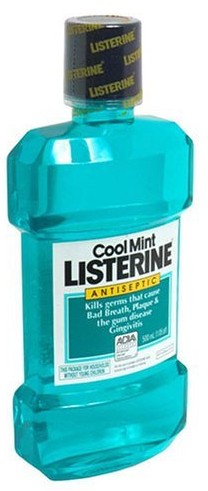
In 1879, Listerine was named after him. It was originally developed as a surgical antiseptic, but that’s a pretty small market. To increase sales, they began marketing it as a floor cleaner and a cure for gonorrhea. That brought company revenues to about $115k, but marketers had another idea in the 1920s.
In this era of patent medicines, there were products to cure every known illness. The Listerine folks weren’t going to let this bandwagon pass by. All they needed was the perfect illness, something that everyone had and Listerine could cure; so, they made up the term, “chronic halitosis” (bad breath).
You see, bad breath hadn’t been invented yet. At that time, bad breath was just known as “breath.” Their best effort was an ad campaign that suggested young people would never find marriage with a condition such as bad breath. Over 7 years, revenues skyrocketed to $8 million.
Listerine is still sold as an antiseptic today, and primarily marketed for oral health. Depending on the flavor, it contains 21.6% to 26.9% alcohol.
Broken Secrets | Facebook | Twitter | Email | Kindle
Sources: WP Hand Sanitizer, WP Lister, WP Listerine


 Broken Secrets