Posts tagged ‘history’
How Does Information Get On a CARFAX Report?
By Chad Upton | Editor
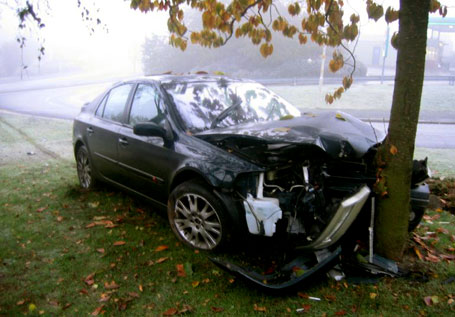
It’s not unusual for somebody to completely destroy their car and walk away unharmed.
This happens because newer cars are designed to crumple on impact, just like a bike helmet made from dense foam. The frame, hood and even the power train components absorb the energy from the impact in order to help protect the occupants. Of course, air bags may also deploy, which protect the occupants from hitting hard surfaces inside the vehicle.
When an insurance company declares a car as a “total loss” it means they are not going to pay to fix the car; although, they may sell the vehicle to somebody who plans to use it for spare parts. That person may then fix the car and try to sell it.
Unfortunately, a car that has been in a major accident may have hidden safety and reliability problems. So, if you’re buying a used car, you’ll want to know its history.
If you’ve ever looked at a used car, you’ve probably come across CARFAX.
It’s a service that provides historical information about used cars. For $35 or less, you can enter the VIN (vehicle identification number) of a used car and get a report about its ownership, accident history, mileage discrepancies, lemon status, flood damage, fleet use (taxi, police…etc) and many other things the seller may not want you to know.
I think this is a great idea, but I’ve always wondered how they get all the information.

I was talking to a guy that runs an auto body shop, so I asked him. He said that he has done work on cars that were nearly totaled and the information did not show up on CARFAX; he had also done minor work that has shown up.
He said that CARFAX buys info from insurance companies and other sources. Some insurance companies have a non-disclosure agreement, where they will not disclose information about your car and its accidents while other insurance companies are willing to sell that information to make money.
I verified this information with CARFAX and it’s true. CARFAX gets information from thousands of sources and has over 6 billion records on file. They have deals with motor vehicle bureaus in every US State and Canadian Province, where they get information about mileage, flood damage, titles, lemon buybacks, accidents, thefts, liens and ownership transfers.
They also get information from auto auctions, car dealers, repair and service facilities, rental companies, state inspection stations, fire departments, law enforcement, car manufacturers, import/export companies and many others. That’s not to say that all companies of these types provide this information, but many do.
In some cases, they have mutually beneficial relationships. For example, car dealers may provide information about vehicles they service, but they may also request information about used cars that they want to take as trade-ins, buy at auctions or sell to their customers.

In any case, CARFAX warns that they may not always have all of the information, since there are many sources that they do not have access to. In 2005, they had 6,100 sources of information. Now, they have grown to over 34,000 sources.
CARFAX does provide a couple of free services that may be worth while if you’re purchasing a used car. The Lemon Check is one of them. This free service, will tell you if the car you’re about to buy was ever declared a lemon, meaning it was serviced for the same problem 3 times and bought back from the owner by the manufacturer. You definitely want to avoid a lemon.
You can also perform a record check with CARFAX for free. This will tell you how many records they have on file for the VIN you entered. If you’re thinking about buying a CARFAX report, you should try this free option first to see if it’s worth buying the report about the car you’re interested in.
Broken Secrets | Facebook | Twitter | Email | Kindle
Sources: CARFAX (Data Sources) MSN, MyVin
Photo: Ian Hampton (cc), jasonbolonski (cc)
Michelangelo Hid Images in Sistine Chapel Paintings
The most amazing work of art I’ve ever seen is David by Michelangelo. At 17 feet tall, bulging veins and muscles render an immaculate representation of human anatomy and the flaccid pose captures the mood before his fight with Goliath.
There is no doubt, Michelangelo’s understanding of anatomy is incredible, but not surprising. His art education included dissecting cadavers while studying at the church of Santo Spirito. This is not a well known fact since he tried to hide his anatomist roots, destroying nearly all of his anatomic notes and drawings.
Maybe cadavers are harder to come by these days, but that’s not part of the art curriculum at most modern schools. That privilege is usually reserved for medical students, which is why it’s no surprise that three medical journals have published findings of hidden anatomic references in Michelangelo’s Sistine Chapel paintings.
It took four years (1508-1512) for Michelangelo to paint the walls and ceiling of the Sistine Chapel. The last four panels he painted include the suggested anatomic representations.
In the forth panel, Dr Frank Meshberger suggests the similarity between the red cloth surrounding god and the image of a human brain (Journal of the American Medical Association, October 1990).

The brain-like shape is highlighted
In the third panel, Dr Garabed Eknoyan likens the wrap surrounding god to a human kidney, as reported in Kidney International in 2000. According to Eknoyan, Michelangelo was interested in the kidney function since he suffered from kidney stones during his adult life and mentioned it in letters and poems.

Do you see a Kidney shape?
Finally, in the first panel (image below), Ian Suk and Rafael Tamargo, report in the journal Neurosurgery (May 2010) that the neck details do not accurately represent a goiter, as previously believed. They argue that goiters typically occur lower in the neck and Michelangelo would not have made such an inaccurate representation given his demonstrated accuracy of anatomic details in all of his other paintings. Secondly, they believed as a deeply religious man, he would not depict god with this deformity. Most convincingly, they say the painting accurately details a ventral view (from below) of a brainstem, cerebellum, temporal lobes and optic chiasm. (more…)
The Origin of April Fools’ Day
Tomorrow is Tom Foolery’s birthday. Well, not exactly, but you should be suspicious if someone is serving cake.
Your spouse or roommate may hide your keys, unscrew all the light bulbs or take the batteries out of the TV remote. Maybe Google will have another ruse about free printing or postdated emails. No matter who pranks you tomorrow, you’ll want to know how it all started.
 April 1st is “April Fools’ Day” in many countries around the world. In some countries such as the UK, Australia and South Africa, the jokes end at noon. Someone who plays a joke after noon is considered an “April Fool.” In North America, Brazil and much of Eastern and Southern Europe, the jokes last all day.
The shenanigans can be traced back as far as Chaucer’s Canterbury Tales (1392). The tale is set “Syn March bigan thritty dayes and two.” It was supposed to mean 32 days after March (May 2nd) which is the anniversary of the engagement of King Richard II of England to Anne of Bohemia. But, readers misunderstood it as March 32nd, which of courses doesn’t exists and was interpreted as April 1st. In the tale, Chauntecler is tricked by a fox. (more…)
The History of St. Patrick’s Day
March 17th is the big day. I’m giving you some notice so you can dig to the bottom of your laundry pile, find your green shirt from last year and put it in the washing machine.
If you can’t find a green shirt, go with a blue one instead. According to historians, blue was the original color associated with Saint Patrick. In fact, the 1912 dress code for Lord Chamberlain specified that the household of the Lord Lieutenant of Ireland should wear St. Patrick’s blue.
The 1924 Irish Olympic football team wore St Patrick’s blue and the Northern Ireland team (known then as the “Ireland association football team”) wore St. Patrick’s blue jerseys from 1882 until 1931, when they switched to green.
Let me tell you why… (more…)
The History of Valentine’s Day
By Chad Upton | Editor

Where did Valentine’s Day come from?
I’d like to say that some marketing genius at Hallmark was looking for a good reason to sell cards between Christmas and Easter, but that’s not the case. Although, they’re not shy about making the best of it — Valentine’s Day is the second most popular holiday for sending cards (Christmas is the leader). Approximately one billion Valentine cards are sent each year.
In elementary school, we used to decorate giant Valentine’s Day envelopes and hang them from our desks. Then we would buy a box of Valentine Cards and write a nice message for every person in our class, except the ones we didn’t like. After that, we’d walk around the room and drop the cards in each others envelopes. That was usually the end of the day, but just before we left, the teacher would feed us cake until we were mad and turn us loose on the neighborhood. (more…)


 Broken Secrets