Why It Is Called a Swan Song
By Kaye Nemec
If you’ve been watching NBC’s The Sing Off, you’re probably familiar with the term “swan song.” At the end of each episode, the group that gets voted off leaves the stage as they perform what host Nick Lachey refers to as their swan song.
 A swan song is used in reference to any final theatrical or dramatic performance. It can also be said that a political candidate is singing his/her swan song during their final political campaign or final term of office.
The term “swan song” comes from the belief that Mute Swans (Cygnus olor) were completely silent until the last few moments of their life, when they would sing a beautiful song. Although this is an ancient myth and was proven to be false, as far back as 77A.D., the legend has lived on and the term swan song has become mainstream.
Although Mute Swans do have a straight trachea that prevents them from making loud noises and, although they are usually pretty quiet, they are not mute. They make hissing, whistling, snorting and soft bark-like noises.
Broken Secrets
Get updates on: Facebook | Twitter | Email | Kindle
Photo: Christian Roberts (cc)
Sources: University of Michigan, Wikipedia
How to Dispose of Household Hazardous Waste
By Chad Upton | Editor
Every home has things that should NOT go in the trash. Yet, many people don’t know what to do with them or even what some of these items are.
Some examples are:
- batteries
- compact fluorescent light bulbs
- paints and stains
- pesticides and herbicides
- fertilizers and poisons
- cleaners and disinfectants
- car fluids
- medicines and prescription drugs
The main concern is that when many of these hazardous materials make it to landfills, they will eventually leech into our water supply and have potentially dangerous consequences.
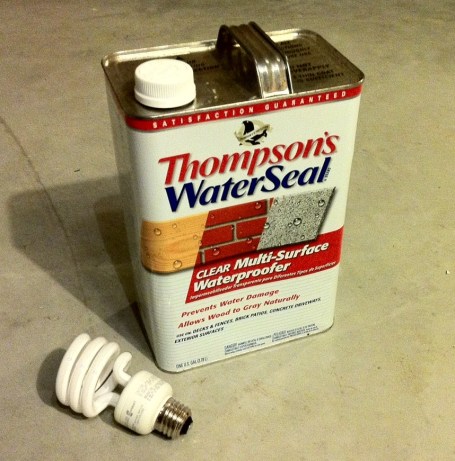
Many large retailers such as Lowe’s, Radio Shack, Best Buy, Sam’s Club, Whole Foods and many others will accept certain types of batteries, Ni-Cad and Car Batteries being the most popular types accepted. Some retailers, like Home Depot and Lowe’s, will also accept compact fluorescent light bulbs.
For most other hazardous materials, you’ll likely need to go to your city’s drop off depot. Sometimes this service is paid for by your taxes, other cities charge a usage fee depending on what you’re dropping off.
A great site to help you find a nearby retailer or city depot to recycle or safely dispose of some of these items is earth911.com. You tell it what hazardous material you have and where you are, it will try to tell you the nearest place you can take it. I got really good results for everything I tried.
For medicines, check out this previous post: How to Dispose of Medicine.
Broken Secrets
Subscribe on: Facebook | Twitter | Email | Kindle
Sources: Oregon Live, Earth 911, City of Toronto
Why We Clink Glasses When We Toast
By Chad Upton | Editor
Many of you will be clinking glasses with family and friends this time of year and there are a number of theories about where this custom started.
One belief is that ancient societies believed that noise would scare away the demons (that they believed) were lurking around every corner. Firecrackers and noise makers are popular instruments to ring in the New Year, also believed to stem from the idea that noise would scare away evil spirits, clearing the way for good things to happen. Wedding bells and clinking glasses are other examples of this belief in practice.
Another legend says that nobles used to try to poison each other, so drinks were clinked to slosh liquid from one drink to the other, demonstrating that the guest’s drink was safe if the host was willing to drink from his now “contaminated” drink. Among trusted associates, table members adopted the “drink clink” to signify their trust that drinks were not poisoned without making a mess of the table — it was a sort of handshake.

A fairly reputable website, Snopes.com, disputes this theory, claiming that poisoning was not common enough for it to change the behavior of society. They also believe that too much liquid would be wasted for it to be practical. I generally trust snopes and usually agree with their proof and supporting statements, but their explanation on this matter has much more proof against than for it.
First of all, the argument that it was messy isn’t very strong. If you believed your life was at stake, you wouldn’t consider it a waste to spill some wine in exchange for your health.
Secondly, there is plenty of proof that poisoning was very common throughout history. The BBC says, “During the age of the Roman Empire, poisoning became a common activity at the dinnertable, especially in the high circles of society. It was certainly a convenient way of getting rid of unwanted family members, as [Emperor] Nero demonstrated.” They have a well researched article that demonstrates poisoning as a common occurrence and a popular anxiety among royals and high society for much of recorded history.
In fact, poisoning wasn’t just common in medieval times, it’s still popular now. There are multiple homicide and suicide cases every year that involve poisoning. In 1998, food was poisoned at a village festival in Japan, killing 4 and injuring 40 others. Recent intelligence has suggested that Al Qaeda groups have discussed poisoning buffets.
Poisons have changed a lot over the years, although arsenic was popular for more than ten centuries, until a method became available to detect it in the deceased. Many modern poisons are actually prescription drugs, including fentanyl — one of the drugs found in Michael Jackson body during the autopsy.
Regardless of poison threats, we continue to clink our glasses as a way to connect with each other. This has been nearly ubiquitous for more than 100 years. In fact, glass makers actually consider the sound that glasses make an important design element. So, Pay attention during your next toast, the sound may be as sweet as the sauce.
Broken Secrets
Subscribe on: Facebook | Twitter | Email | Kindle
Photo: AL404 (cc)
Sources: Snopes, Wine Intro, BBC, CNN
Property Donations are Tax Deductable
By Chad Upton | Editor
While it’s pretty common to get a tax receipt for monetary donations to charity, not everyone knows you can get a tax deduction for donating household items too.
Some of these items include:
- Clothing and Linens
- Indoor and Outdoor Furniture
- Toys and Games
- Appliances and Electronics
- Tools and Automotive Items
- Books, Magazines, Movies and Music
- Musical Instruments
That’s right, you can donate magazines and musical instruments. But, don’t go raiding your Doctor’s waiting room, useful magazines in good condition are worth a maximum of $0.50 each.
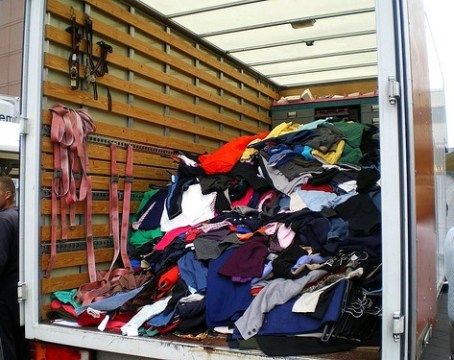
To make a claim, you need the charity or other qualified group to endorse a receipt that shows the name of the charity, the date and location of the donation and an itemized list of the articles along with the fair value of each. For donations under $250, a receipt is not required when it’s impractical to get one, such as when you deposit items in an unattended drop box. But, you’ll still need to provide the details (what, where, when, how much).
So, how do you figure out the fair market value of a book or a trombone? I recommend a free online tool from Turbotax, called ItsDeductible. They provide values based on IRS guidelines (Publication 561) and allow you to print a list that you can bring with you for the charity to sign. For full details, see the charitable donation guidelines in Publication 526.
They estimate a Fuzzy Dice to hang from a rear-view mirror is worth $3 in good condition (seriously). A good trombone is worth between $57 and $82. Do you have an extra coffee maker or microwave in storage? You could be looking at $10 or $20. Do you still have your neighbor’s tile saw? It could be worth $92 on your their tax return.
Your donations can be made to many organizations. There are the traditional charities such as: Goodwill, Salvation Army, Red Cross, CARE, United Way…etc. Donations of money or useful items also qualify for tax deductions when they are made to places of worship (churches, synagogues…etc), government (Federal, state, local), nonprofit schools and hospitals, public parks and recreation facilities, veteran’s groups, Boy and Girl Scouts, Boys and Girls Clubs of America and many other organizations.
Broken Secrets
Subscribe on: Facebook | Twitter | Email | Kindle
Big thanks to Chris for this tip.
Photo: Jen Waller (cc)
Sources: IRS (Publication 526 – Contribution Guidelines | Publication 561 – Determining Value of Donated Property), TurboTax, Money Blue Book
Babies Don’t Shiver
By Kaye Nemec
When adults are cold, our bodies shiver to engage our muscles and produce more body heat. When babies are cold their bodies do not react in the same way. Instead of shivering, babies warm themselves by burning body fat.
Babies are born with brown thermogenesis fat, also known as brown fat (because of its color). Brown fat is basically a fat-burning type of fat. Scientists used to think brown fat was only found in babies but recent studies suggest it does not actually disappear with age. For adults this could end up being the ultimate diet solution. For a baby it is critical for temperature regulation.
Brown fat is filled with mitochondria. When the body is fueled with food (sugar) the mitochondria help to transform sugar into energy in the form of heat. This heat warms the babies until they are able to shiver like adults.

Does this process warm them? Yes. However, some studies suggest this takes away calories that should be used to help the baby grow.
It is usually recommended that babies are dressed warm and in layers but ask your pediatrician for specific recommendations on ways to keep your baby warm, like what temperature you should keep your house at.
Broken Secrets
Subscribe on: Facebook | Twitter | Email | Kindle
Sources: Riley Hospital for Children, brainyweightloss.com, Chicago Tribune
Photo: Kaye Nemec
9 Volt Batteries Contain 6 AAAA Batteries
By Chad Upton | Editor
The batteries in most consumer electronics produce 1.5 volts each.
Different products use different numbers of batteries to achieve different voltage requirements. For example, a TV remote might be designed to run on 3 volts, so two 1.5 volt batteries will provide the necessary voltage when connected in series.
Larger devices, such as radios with large speakers or large kid’s toys, typically have larger batteries, like C and D cells. Smaller devices often use AA and AAA batteries, allowing the devices themselves to be smaller. All of these batteries output 1.5 volts, but the larger batteries have much higher capacities, meaning they last longer. D batteries have four times the capacity as AA’s. So, if you’re going to be blasting music on the beach, you’ll change fewer batteries if your radio uses D batteries.
There are many other types of batteries that are not 1.5 volts. One of the most popular is the nine-volt battery, which is technically called a PP3 battery. Smoke detectors, garage door remotes, transistor radios and a variety of other devices use these batteries.
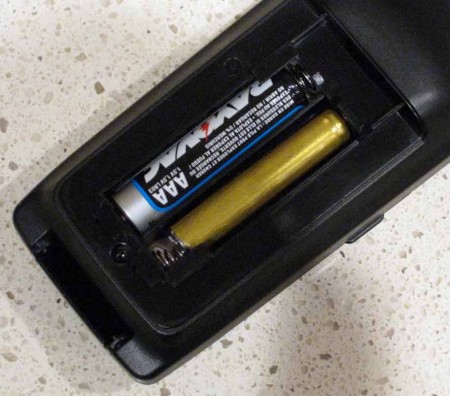
They’re pretty convenient, giving you the voltage of six batteries after only inserting one battery. In fact, that’s exactly what they are — they’re just containers that link six smaller batteries together. Here’s a picture of a nine-volt battery that I took apart:
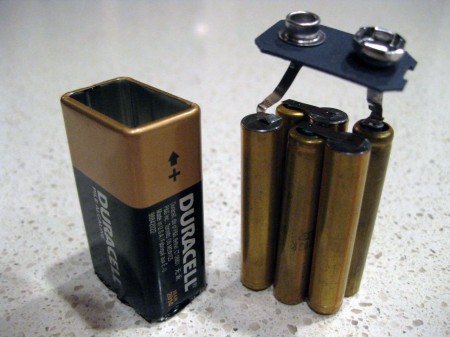
Each of the six batteries outputs 1.5 volts, giving a total of 9 volts when connected in series. The name brand nine-volt batteries usually contain six quadrouple A batteries (AAAA) which are rather uncommon in consumer electronics but find a home in medical devices such as glucose meters.
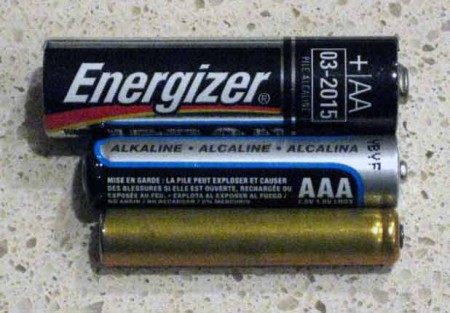
Some of the lesser known battery brands may contain 6 flat cells which are not easily reusable. As you can see in the picture above, AAAA batteries are very close in size to AAA cells. That’s worth noting since they could save the day if you’re short on AAAs:
Keep in mind, device manufacturers often use standard batteries in their rechargeable products and you can replace them yourself.
Broken Secrets
Subscribe on: Facebook | Twitter | Email | Kindle
What the Toaster’s Bagel Button Actually Does
By Chad Upton | Editor
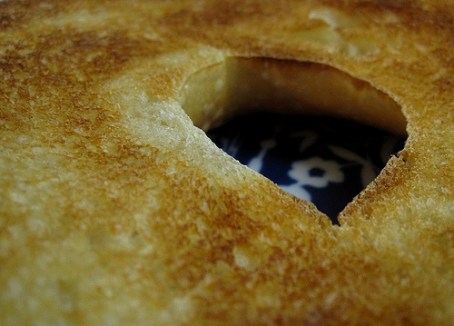
Some toasters have a bagel button and it’s obviously meant for when you want to toast a bagel. But, what does that button actually do?
Firstly, it increases the toasting time since bagels are thicker. Secondly, it increases the heat of the inner elements and decreases the temperature of the outer elements so you don’t burn the outside of the bagel.
It’s also useful for English muffins or other thick items.
Broken Secrets
Subscribe on: Facebook | Twitter | Email | Kindle
Photo: wintersoul1 (cc)
Source: Oster
Design and History of the Northface Logo
By Kaye Nemec
Northface is a performance apparel, equipment and footwear company that started over 40 years ago. Although most of their products are geared towards mountaineers, climbers and hikers, the company was, ironically, started on a beach. In 1966 two young men with a passion for hiking were living in San Francisco’s North Beach neighborhood; they decided to turn their hobby into a living by starting a small, mountaineering retail business. Today, they are known around the world as a leader in endurance products among outdoor performance enthusiasts.
The name North Face was chosen because the north face of a mountain is the coldest and most treacherous side and the goal was to create gear that would assist climbers in successfully traversing these conditions.

The logo they chose for the The North Face company is an interpretation of Yosemite National Park’s Half Dome, a rock formation rising 8,800 feet above sea level. In 1865 Half Dome was declaredto be completely inaccessible to anyone and this was believed to be true until 1875 when George Anderson was the first person to successfully reach the summit.
Today thousands of people reach the summit every year and several of them are likely using North Face gear while they do it.
Broken Secrets
Subscribe on: Facebook | Twitter | Email | Kindle
Sources: The North Face: Our Story, Dinesh.com, NPS.gov
Most Medications Still Good After Expiration
By Chad Upton | Editor
If you check your medicine cabinet, chances are good you’ve got some expired medication in there. Are they still safe and effective or are they fit for the trash?
First of all, this post is for information purposes only and it is not suggesting you take any drugs after their expiration date — always check with your doctor or pharmacist before making any decisions about pharmaceuticals.
The Federal Drug Administration regulates drugs in the United States. They have extensively studied drug expiration dates for the US government. Specifically, the US military stockpiles large quantities of drugs for regular troop usage and emergencies. If those drugs are not used, the cost to replace them can be high.
The FDA found that 88% of drugs tested remained potent for a year after their expiry date; some lasted up to 14 years. Experts caution these results cannot be directly translated to your medication since the military stores their drugs in climate controlled environments that represents ideal conditions.

That said, the FDA and many in the drug industry, including one pharmacist I talked to off the record, agreed that certain drugs are still good up to a year after the expiration date.
Many popular drugs are safe after their expiration date, but there are known exceptions too. For example, Tetracycline, an antibiotic, becomes toxic and should not be taken after its expiration date. Aspirin, on the other hand, is known to be good for a while after its expiration date.
If the drugs are still good, why do drug companies put these short expiry dates on the bottles? It’s hard to say for sure, but there are a couple things we know.
1. The drug companies are required to ensure their products are 100% effective up to the expiration date. That means they need to do testing. The longer the expiration time they shoot for, the longer it will take to release a new product to market, which is bad for business and customers. In most cases, the products have at least a 1 year shelf life.
2. Every company wants you to buy as much of their product as possible. The drug companies can’t really control how much you use their product, but shorter expiration dates may convince you to buy more, even if you haven’t used all of the product yet.
To be safe, you should check with a pharmacist before taking any expired drugs. When you are ready to dispose of your medicine, check out this previous post: How to Dispose of Medicine.
Broken Secrets
Subscribe on: Facebook | Twitter | Email | Kindle
Photos: hit thatswitch (cc)
Why Airplane Shades Must Be Up for Takeoff and Landing
By Chad Upton | Editor
 You may not have heard of this, but it’s law in some countries and it’s growing in popularity around the world. The reason is similar to why the airlines dim the interior lights during takeoffs and landings at night.
In short, it’s for safety in the event of an accident. With the window shades up, passengers and crew can spot dangers outside the planes before they open an emergency exit. Dangers like fire, water and running airplane engines can be hazardous if someone opens an emergency exit right into them.
During bright daylight, it also allows your eyes to adjust to the brightness outside, which could be critical during an accident.
Broken Secrets
Subscribe on: Facebook | Twitter | Email | Kindle
Photo: contraption (cc)
Sources: Airliners.net, Straight Dope


 Broken Secrets