The Meaning of Care Symbols on Clothes Tags
By Kaye Nemec
When it’s time to wash a new item of clothing, most people check the tag to see what the manufacturer recommends for washing and drying.
Sometimes instructions are easily spelled out, other times the consumer is given a set of symbols to interpret. With no explanation or key to reference, there is no way to know what these symbols mean. Before you take a gamble with your clothing purchases, use the chart below as a reference guide for the most common symbols. For an extensive list of care symbols visit Textileaffairs.com.
 |
Machine Wash Normal |
 |
Machine Wash Cold |
 |
Machine Wash Warm |
 |
Hand Wash |
 |
Do Not Wash |
 |
Do Not Bleach |
 |
Tumble Dry Normal |
 |
Do Not Dry |
 |
Iron Normal |
 |
Do Not Iron |
 |
Dry Clean |
 |
Do Not Dry Clean |
Broken Secrets
Get secrets on: Facebook | Twitter | Email | Kindle
Sources: Textile Affairs
McDonald’s Imports One Third of Mexican Sesame Seeds
By Chad Upton | Editor
Sesame seeds come from sesame plants where the seeds grow in pods.
The seeds range in color from very dark to nearly white and are used in foods from Europe, Asia, The Middle East, North America, South America and virtually everywhere else. They are found in everything from sushi to breadsticks and soup to hamburger buns.

A tasty Middle Eastern dip known as Tahini, is made from ground sesame seeds and salt (and sometimes other spices too). Sesame seeds are also very popular in a variety of baked goods including breads, bagels and crackers. In Togo, a small country in West Africa, uses sesame seeds as a main ingredient in soup. They’re also used in Greek cakes.
Sesame seeds are popular because they add a subtle savory nut-like flavor. They taste good because they’re high in polyunsaturated fats (the “good” fat). It should be mentioned that heat from cooking or baking damages the polyunsaturated fats.
The largest producers are India and China, and one of the largest consumers is McDonald’s, which buys one third of the Mexican sesame seeds imported by the US annually.
Broken Secrets
Get secrets on: Facebook | Twitter | Email | Kindle
Sources: Wikipedia (Sesame, Polyunsaturated Fats), Purdue.edu
Photo: Oceandesetoiles (cc)
What Does Esquire Mean?
By Chad Upton | Editor
It’s a magazine. It’s a watch brand. It’s a title or a suffix that may follow a person’s name.
Throughout time, the precise meaning of the title has fluctuated.
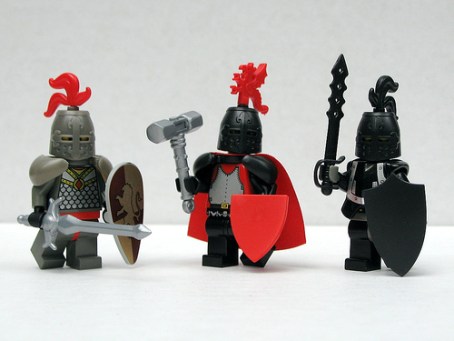
In medieval times, an Esquire (or “Squire”) was the rank below Knight, generally a Knight in training. Later, it symbolized a noble man, usually born with wealth and power.
Today, Esquire has a different meaning. Although it’s not particularly common, when it is seen, it is usually follows a person’s name (ex Johnnie Cochran, Esq).
In that case, it identifies him as a laywer — more specifically a barrister (although this distinction is not generally made in some countries such as the US). It may also designate judges or other town officials.
In England, it may be used to describe any man, but it also has more formal uses. For example, when British men are invited to Buckingham palace, their mailing address will include the Esquire suffix, while foreign men will be addressed as “Mr.”
It is bad form for one to identify themselves with the Esquire title, it should only be used in reference to someone else. Also, it supercedes all other titles. In other words, if “Esq” follows a name, “Mr” should not precede it.
Broken Secrets
Get secrets on: Facebook | Twitter | Email | Kindle
Sources: Random House, Princeton.edu, Wikipedia (Esquire), Esquire.com
Photo: Andrew Becraft (cc)
Motel 6 Charged $6.00 for Motel Rooms
By Kaye Nemec
In 1962 a couple of building contractors decided to open up a chain of motel rooms that would be available at extremely low rates. It took two years for their business plan to be developed and, in the end, they decided to market themselves as a “no-frills” motel chain, offering customers an alternative to the higher-end hotels that were becoming popular. The budget-saving strategies included black and white, coin operated TV’s in the rooms, basic room décor and no on-site restaurants. The low cost plan allowed them to charge only $6.00 per night for a room.

Today corporate policy still states that Motel 6 will always have the lowest rates of any national chain.
On a related note, Super 8 was opened in 1972 with rates starting at $8.88 per night.
Broken Secrets
Subscribe on: Facebook | Twitter | Email | Kindle
Sources: Wikipedia, Wikipedia (Super 8)
Photo: J. Stephen Conn
The President’s Limo Carries a Supply of the President’s Blood
By Chad Upton | Editor
My car is well equipped for typical roadside issues. I’ve got jumper cables, a flashlight, gloves, tools, snacks and a space pen for writing notes on Earth’s coldest days.
The space pen is probably extreme, but that’s nothing compared to the US President’s limo.
It’s officially known as “The Presidential State Car” and unofficially known as “Cadillac One”, a reference to the naming convention of presidential aircraft like Airforce One. It’s a custom built vehicle, based on a heavy duty truck chassis, which can carry a lot of weight, much of which comes from heavy armor to protect the occupants from gunfire and explosives.

The passenger compartment is hermetically sealed to protect against chemical attacks and includes its own oxygen supply and fire fighting system. There are two driver vision enhancement systems that allow the driver to see in complete darkness and see through thick smoke.
The doors do not open by simply pulling on the doorhandles, apparently only the secret service knows exactly how to unlatch the doors. None of the windows roll down, except for the driver’s, which drops just enough to pass a big mac through.
With its top speed of 60 mph (96.5 km/h), it’s not going to win any car races, but that’s not bad considering the estimated 15,000 lbs this tank weighs. That’s part of the reason it has heavy duty truck tires that are re-enforced with bulletproof kevlar.
There is a full communications and command center on board, along with multiple weapons. In the event that the president gets badly wounded, there is even a backup supply of his own blood on board.
I assume it has a space pen too.
Broken Secrets
Subscribe on: Facebook | Twitter | Email | Kindle
Sources: Wikipedia, Popular Mechanics, Jalopnik, Telegraph
Photo: Wikimedia (cc)
Blog Update – Thanks, Inspiration and Helping Out
By Chad Upton | Editor
I want to start by thanking everyone for all of the great secrets you have suggested, there are many — we hope to validate and feature many of them.
Also, I want to thank everyone for reading and spreading the word. We’ve now got thousands of daily readers and nearly 1500 fans on facebook. Last but not least, a big thanks to Kaye, Kyle and Terry for writing great secrets for you guys to read.
I also want to thank someone who doesn’t have a visible contribution to this blog, but whom this blog owes a lot: Neil Pasricha (Author of 1000awesomethings.com and The Book of Awesome). Back in mid 1995, Neil and I started a tiny website that racked up just over 100 hits in the year that it lived on geocities.
Although it wasn’t a popular website, it was a good website and it gave us a thirst for building great websites. We both went on to bigger and better sites before we eventually found our current place on the internet. Neil has been a big supporter of this site, providing lots of input and advice.
Neil has a book coming out in a couple weeks, The Book of (Even More) Awesome, and I’d love it if we could help him out by ordering the book before it comes out. You see, all US pre-orders count toward the first week of sales, which gives him a good shot at the NY Times best sellers list, which can really make a book successful. Neither of us charge a dime for our website, have banner ads, or ask for anything in return. But, sometimes people do ask how they can help out or how they can donate money. I’m not asking you to, but if you want to give back then this is a great way you can help out and get an Awesome book in return. Click the book in the top right corner of the blog and you’ll be taken to Amazon.
Also, if you’re in the Toronto area, I’ll be going to Toronto for Neil’s book launch on April 26th (7pm, Indigo @ Bay/Bloor) if you want to drop by and say hi.
Before I wrap this up, I want to mention a new development at Broken Secrets too. I recently began contributing secrets to the Yahoo Answers blog. The Yahoo Answers team and community have been very welcoming and this is a great chance to further spread our enlightening secrets.
Thanks again for your continued support.
Broken Secrets
Why Some Restaurants Provide Wet Towels at Meals
By Chad Upton | Editor
If you’ve ever flown first class or eaten at a first class restaurant, you’ve probably been handed a wet towel. The first time this happens, you’ll probably be confused and look to others for guidance on what to do with it.
Generally, it is used to clean your hands. This tradition comes from Japan, where “oshibori” (wet towels) are handed out before meals, to clean hands. In Japanese restaurants, they may be hot or cold, depending on the season. Some people may also use the towels to clean their face.
This tradition has been expanded outside of Japanese restaurants where the practice varies greatly. In Western restaurants, wet towels may be served beforeand/or after the meal — to clean your fingers and around your mouth. According to Etiquette Scholar, it is not polite to clean beyond these areas, such as your neck or behind your ears, in a restaurant.
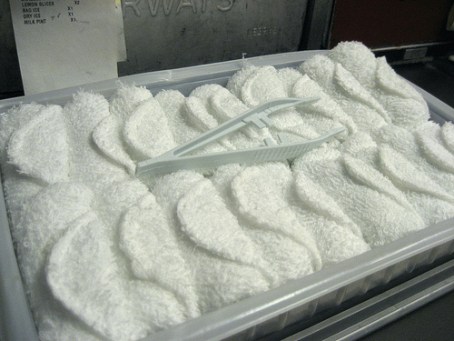
Many airlines offer wet towels, particularly in first class. They are sometimes offered immediately after takeoff, which is standard in first class on British Airways, among others. These towels are usually hot, but may be cold if you’ve just boarded from a particularly hot environment or if the cabin air conditioning is out-of-order. At this time, they are useful to clean your hands before eating or to clean the travel sweat off your skin (forehead, back of your neck, etc.). On longer flights, wet towels may also be served after a meal or just prior to landing.
Wet towels are traditionally made from cotton and moistened with water. Lemon juice is sometimes added to the water for its fragrance and degreasing properties. In recent years, pre-moistened disposable towels have gained popularity and are often wrapped in a plastic package. These towels come unscented and in a variety of fragrances. They sometimes contain other cleaning solutions such as alcohol.
The next time you’re given a wet towel, you can tell everyone what it’s for and where this tradition came from.
If you’re interested in a particularly long, fairly humorous and sometimes snobby discussion about wet towels, you’ll love this thread on FlyerTalk.com.
Broken Secrets
Get secrets via: Facebook | Twitter | Email | Kindle
Photo: Christopher Doyle (cc attribution)
Sources: FlyerTalk.com, PlanetTokyo, Wikipedia, Airline Towels, Etiquette Scholar
Secret Uses for Olive Oil
By Kaye Nemec
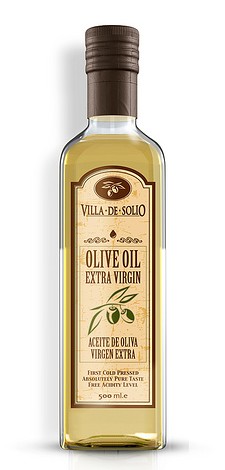
A few weeks ago I accidentally bought waterproof mascara. For those of you familiar with waterproof eye make-up, you know that the term “waterproof” is not used lightly. It is also soap, face wash and wash cloth proof. Conveniently, make-up brands sell make-up remover to use along with their semi-permanent products. But, determined to get the mascara off of my eyes before sleeping with it on all night and running to Target in the morning, I searched for another option and what I landed upon was olive oil. After testing it out and getting a positive result, the doors to a world of uses for olive oil that I never knew existed were opened. Read below for some of the most practical uses.
 Shaving lubricant
- Polish – olive oil can be used as a substitute for furniture polish. Just dab a small amount of olive oil on a soft cloth and polish wood furniture as you normally would. Also use it to shine stainless steel and brass.
- Moisturizer – olive oil makes a great skin moisturizer. Rub it into your hands, use it to moisturize cuticles etc. Using it to remove eye make-up also allows you to moisturize the soft skin around your eyes safely.
- Frizz control – use a small dab of olive oil to tame unruly or frizzy hair (side note: dryer sheets also work well for this).
- Snoring/Coughing – take a sip of olive oil to lubricate your throat. Do it before bed to help prevent snoring and do it if you have a scratch or tickle in your throat to prevent coughing.
- Diaper rash cure – wipe a small amount of olive oil onto a baby’s bottom to help clear up diaper rash.
Broken Secrets
Secrets via: Facebook | Twitter | Email | Kindle
Sources: Curbly, Yahoo Green
Photo: PackAge (cc)
How to Chop Onions Without Crying
By Kyle Kurpinski
Plants, like all other living organisms, are composed of cells. When you eat a vegetable, or chop it with a knife, some of these cells are ruptured and their contents are released. Certain plants, like the onion, have developed defense mechanisms against this type of destructive action. When onion cells are destroyed, enzymes called alliinases initiate a series of chemical reactions resulting in the release of synpropanethial-S-oxide (also known as onion lachrymatory factor, or LF), a volatile gas that stings the eyes. To combat the stinging effect of the gas, the lachrymal gland at the corner of each eye produces tears to help wash the irritant away. For the plant, LF is an excellent natural deterrent against roaming herbivores, but for humans, it makes us look quite silly and emotional when preparing salad.

There are many ways to reduce or eliminate the “onion effect” during chopping, all of which involve minimizing your exposure to the noxious LF gas:
1) Chop under water. Copious amounts of water can help prevent LF gas from reaching the eyes. Try peeling the onion under running water and/or chopping the onion in a large water-filled bowl.
2) Chill or freeze the onion. The enzymes required to produce LF work well at room temperature, but are inhibited under colder conditions. By chilling the onion before cutting, you greatly reduce the activation of the chemical reactions.
3) Use a sharp blade. A sharper blade causes less damage to the onion cells, thereby releasing less chemicals.
4) Use a fan. Disperse the LF gas by aiming a small fan towards your cutting area and away from you.
5) Wear goggles. Protective eyewear can help prevent LF gas from reaching your eyes. You’ll need something that forms a seal around your eyes, however; standard glasses won’t do.
6) Do not chop the root. The root of the onion contains a greater concentration of the alliinases than the rest of the plant. By avoiding the root (or at least saving it for the end) you can reduce the amount of LF produced during chopping.
7) Chew gum. This one is a little weirder, and doesn’t seem to work as well for many people, but it’s still an option if you can’t do any of the above. Supposedly, vigorous chewing causes you to breathe more through your mouth, which disperses the LF gas and directs it away from your eyes and lachrymal glands.
8) Use a “better” onion. If you’re desperate for a truly tear-free onion, genetic engineering provides an alternative to freezing and gum chewing. In 2008, researchers at the New Zealand Institute for Crop & Food Research utilized gene-silencing technology to suppress a gene required for LF production. No more LF, no more sobbing over your chopping board.
Broken Secrets
Get secret updates: Facebook | Twitter | Email | Kindle
Source: Wikipedia – Onion, Wikipedia – Alliinase, e-How
Image: Wikipedia
The Incident – Why Buses Open Their Door at Railroads
By Chad Upton | Editor
Although it was required by law for school bus drivers to stop at railway crossings in 1938, drivers were not required to open their door.
On December 1st of that year a gruesome accident changed that. It was a blizzard in Salt Lake City, Utah and a school bus driver stopped his bus at a railway crossing. Because of the snow, the visibility was terrible and the driver was not able to see an approaching freight train.
24 of the 40 passengers died, including the driver. According to surviving passengers, the train was broadsided without notice. Although the driver was familiar with the train schedule, the weather had delayed the train which should have passed two hours earlier. To make matters worse, the train was travelling faster than normal to make up for lost time.
Unfortunately, the same crossing saw accidents in 1995, 1997 and 2002. Thankfully, it is now closed.
The snow ultimately led to the horrific crash in 1938, but investigators wanted to know if any precautions could have prevented it. Stopping the bus and looking for trains works great when the visibility is good, but it’s useless in snow and fog. Opening the bus door (and driver’s window), allows the driver to hear trains.

Today, opening the door and/or driver side window is law in many parts of the United States and Canada. The same law is also extended to trucks that carry hazardous materials.
Some crossings do not require these vehicles to stop and they are marked with an “Exempt” sign. This is typical if the crossing is no longer active.
Railroad crossing signals do fail and there are thousands of collisions each year between trains and cars, many of which end in fatalities. Although the signals are fairly reliable, it doesn’t hurt to pay close attention when you approach railway crossings.
Broken Secrets
Get secret updates: Facebook | Twitter | Email | Kindle
Sources: The Pittsburgh Press, NSC.org, Deseret News
Photo: You Need Style (cc)


 Broken Secrets