The First IBM ThinkPad Was a Paper Notebook
By Chad Upton | Editor
IBM’s first notebook computer went on sale in 1992. The name ThinkPad was borrowed from a notebook they already made — a paper notebook.
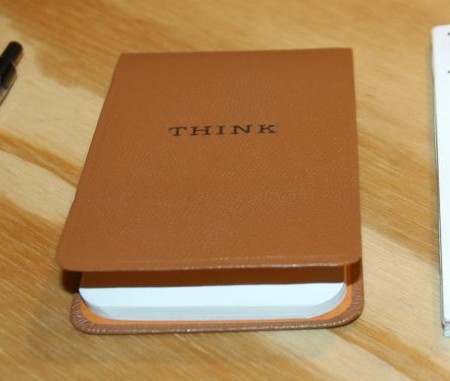
In the 1920s, IBM’s corporate slogan was “THINK!”
For inspiration, employees and customers were given paper notebooks with the word “THINK” embossed in the cover.
While on a coffee break, IBM researcher Denny Wainwright was inspired by the notepad and came up with the name for their notebook computer line, “ThinkPad.” In fact, the idea for the notebook computer was first conceptualized on the paper inside one of the brown leatherette notepads.
In 2005, IBM sold the ThinkPad brand for approximately $1.75 billion. While they’re not known for style, both IBM and Lenovo manufactured ThinkPads are renown for high quality and reliability.
Broken Secrets | Facebook | Twitter | Email | Kindle
Photo: Chris Metcalf
Calculating the Distance to Lightning Strikes
By Chad Upton | Editor
I love watching electrical storms. The time between strikes builds anticipation; the light show is epic and the sound is awe inspiring.
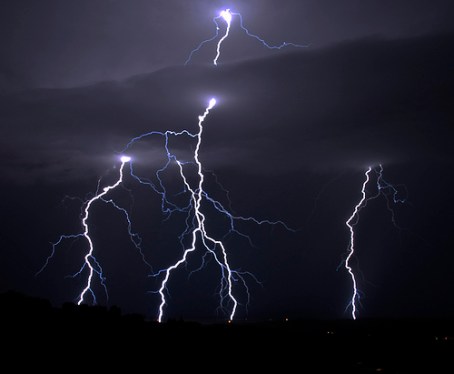
As a kid, I heard that if you count the seconds between the sight of the lightning and the sound of the thunder, the distance to the strike is one mile for every second you count. It’s a simple model, but it’s far from accurate.
It’s actually closer to 5 seconds for every mile.
For those who don’t know, you see the lightning before you hear the thunder because light travels much faster than sound, about 200,000 km per second faster (186,282 miles per second).
Depending on the environment, sound travels at about 350 meters per second (1150 feet per second). To calculate the distance, you can multiply the number of seconds by the speed of sound in your preferred units above.
If you count 10 seconds between the lightning and the thunder, the strike was about 3.5 km (2.17 miles away). To make it easier, use this lightning distance calculator.
Thanks to Kristen for this suggestion.
Broken Secrets | Facebook | Twitter | Email | Kindle
Image: John Fowler (cc)
Sources: Lightning Strike Distance Calculator, Wikipedia (Speed of Light, Speed of Sound)
The Origin of Father’s Day
By Chad Upton | Editor
Although I often think about how lucky I am, I rarely take the opportunity to thank my dad. I’m sure most people are the same and that’s one of the reasons why we take one day every year to honor our fathers.
The first Father’s Day was celebrated on July 5, 1908 in Fairmont, West Virginia. It was inspired by two recent events. Several months earlier, 210 men died the Monongah Mining Disaster, many of whom were fathers. Also, the first Mother’s Day celebration took place nearby only a few months prior.
But, the founding of Father’s Day is often credited to Sonora Dodd, who independently started her own Father’s Day celebration in Spokane, Washington two years after the first one in Fairmont, West Virginia. Her father was a widowed single dad who raised six children on his own. This was unusual for the time since widowed men typically remarried quickly or found others to care for their children. The heroism of Sonora’s dad inspired her to create a day that recognized fathers.
Father’s Day is celebrated all over the world at different times of the year, although most countries recognize it at some point during the summer months. Father’s Day celebrates all fathers, paternal bonds and the influence of father’s on society.
You don’t have to buy your dad an awesome gift, you can give him something that he probably tried to give you: food, fun and great memories. If possible, go visit your dad and do something that he will enjoy.
I’ll give you a few ideas. You could take him to visit a childhood home and remember the good times you had there. You might go for dinner at one of his favorite greasy spoon restaurants or buy a load of fireworks and set his deck on fire again.
On that note, perhaps you and your father don’t get along well. But, hopefully you can find an example of some positive contribution your father has made to your life and be thankful for that. If nothing else, try to let him know that you appreciate that.
I wish that everyone could be as lucky as my brother and I, to have a great dad who has made many sacrifices, along with our mom, to give us wonderful experiences, beneficial opportunities and unconditional love.
Thank you.
Broken Secrets | Facebook | Twitter | Email | Kindle
Sources: Wikipedia, TimeAndDate.com
Things You Didn’t Know You Could Clean (or Cook!) in Your Dishwasher
By Kaye Nemec
Dishwashers were an amazing invention. Long gone are the days of hand washing and drying dishes every night. Now we can simply load up the dishwasher, turn it on and wake up to a fresh load of sparkly, clean dishes.
What many of my fellow dishwasher-loving friends may be pleased to learn is that your dishwasher has some major, hidden potential that extends way behind your basic dinner plate and water glass. Below is an extensive list of items that can also be washed in your dishwasher BUT, before scrolling down read this: your dishwasher can also be used for cooking.
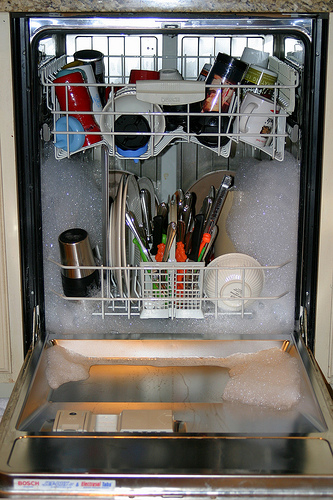
It’s true. And of all things, salmon seems to be the most popular choice for dishwasher cuisine. Sounds like a bad internet rumor but it has been proven accurate over and over again. Check out this recipe if you’re so inclined.
Trying to prepare a Thanksgiving meal for your entire extended family? Save yourself some time by throwing all your baked potatoes in the dishwasher. They won’t cook and/or mash themselves but it will save you the time of having to scrub them all clean!
Now, on to that list of other dishwasher safe items…
- Baseball caps
- Small toys
- Flip-flops
- Garden tools (without wood handles)
- Plastic hair brushes and combs
- Toothbrushes
- Fake flowers (on a light setting)
- Kitchen sponges, vegetable brushes etc.
- Makeup brushes
- Hubcaps and wheel covers
- Pet toys
- Broom heads and dust pans
- Fan faceplates
- Sports equipment (shin guards, knee pads, golf balls etc.)
- Vent covers
- Window screens
- Keyboards (some swear by this, some would never trust it)
Broken Secrets | Facebook | Twitter | Email | Kindle
Sources: Real Simple, Home Ever After , The Bachelor Guy
Photo: tidefan (cc)
Whales Have Regional Dialects
By Chad Upton | Editor
It’s pretty common knowledge that whales, dolphins and various porpoises “speak” to each other in a language we don’t completely understand. Sperm whales in particular, speak in a series of clicks called “codas.”

Much like we recognize the voices of our friends, whales can tell which member of their group is clicking. Also like people, researchers have discovered that whales from different regions have distinct accents.
Sperm whales have a call known as the “Five Regular” which is used by sperm whales worldwide. It’s a series of five evenly spaced clicks believed to be used for individual identity.
This communication is very useful for navigating in dark waters — whales can dive as deep as 1000 meters (3280 ft)!
Broken Secrets | Facebook | Twitter | Email | Kindle
Image: Tim Bayman (cc)
Sources: Science Daily, Wikipedia (Whales)
Some Avacados Contain Half the Fat of Others
By Kaye Nemec
‘Tis the season for backyard barbecues, refreshing drinks and summertime snacks — like guacamole made from fresh avocados. There are several guacamole recipes available but obviously the ingredient you can’t do without is avocado.
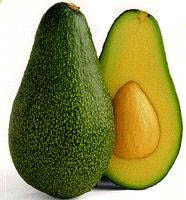 Seventy-five percent of the U.S. avocado crop is made up of Haas avocados grown in California. These are the avocados most people in the U.S. are familiar with and are, most likely, the only variety they can even name. But, it turns out there are other varieties of avocados – and one of them even has half the fat of a Haas avocado.
Fuerte avocados are grown in Florida and are actually larger than Haas avocados. Traditional Haas avocados have about 22 ½ grams of fat and 250 calories. The Fuerte varieties have only about 11 grams of fat and 125 calories.
Additional varieties of avocados include Zutano, Bacon and Cocktail. The Cocktail avocados are only one or two ounces each and do not contain the pit found in most other varieties.
Broken Secrets | Facebook | Twitter | Email | Kindle
Sources: Avocado Central, WHFoods
Photo: ingserban
Starbucks is Named After a Moby Dick Character
By Chad Upton | Editor
In 1971, an English teacher, a history teacher and writer started a coffee roasting business in Seattle.
It’s not surprising that such an intellectual group would have an affinity for classics like Moby Dick. In fact, Starbucks was nearly called Pequod, the name of the whaling ship in Moby Dick. Thankfully, one of the partners rejected the name. Instead, they went with Starbucks, the name of Pequod’s first mate.

Although Starbuck was a fictional young quaker from Nantucket, there were a number of real sailors from that era named “Starbuck.” Naming a coffee company was not the first time the Starbuck name was borrowed either. There is an island in the South Pacific, a popular region for whaling, called Starbuck Island.
Starbuck Island was heavily mined for phosphate in the late 1800s and many ships were wrecked there. The high frequency of shipwrecks was probably caused by the reefs that surrounded the island, but there is a mythical explanation too.
In Greek Mythology there are seductresses who lure sailors to shipwreck on the coast of their islands. These mythical creatures are called Sirens and the Starbucks logo contains one.
Broken Secrets | Facebook | Twitter | Email | Kindle
Images: Wikimedia (Starbucks)
Sources: Wikipedia (Starbucks, Moby Dick, Starbuck Island, Siren)
Indy 500 Winners Celebrate with Milk
By Chad Upton | Editor
Forget champagne this Sunday, one of the most popular car races in the world will award the winner an unusual prize: milk.
This Indiapolis 500 tradition was inspired by Louis Meyer. After winning his second Indy in 1933, he requested a glass of buttermilk. He requested another glass after his third win in 1936, but was given a bottle instead.
A photographer captured Meyer holding up three fingers, signifying his third win, and holding his glass of milk in the other hand. A dairy executive saw the photo and realized the marketing potential by promising the winner of future races a bottle of milk.

The tradition has persisted to this day, apart from 1947 to 1955 and two other exceptions when drivers declined to drink the milk. Most notably, in 1993, Emerson Fittipaldi drank orange juice instead of milk. He owned orange groves in his native Brazil and wanted to promote the citrus industry. The self promotion and break from tradition earned criticism from fans.
Although Meyer started the tradition with buttermilk, that’s not an official option — the winner can choose between skim, 2% or whole milk. However, the winner can buy a lot of buttermilk with the cash prize, estimated around $1.5 million.
Broken Secrets | Facebook | Twitter | Email | Kindle
Photo: Tim Hohm (cc)
Sources: Wikipedia (Indy 500, Emerson Fittipaldi), Yahoo, about.com
Pro Baseball Teams Use 900,000 Balls Each Year
By Kaye Nemec
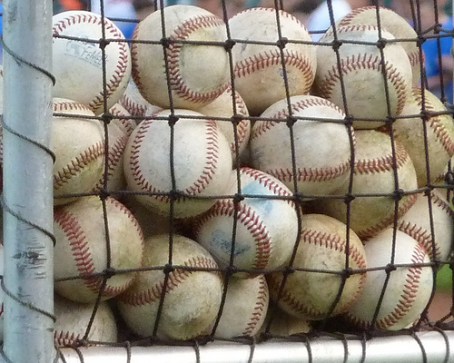
It’s the top of the 6th inning in the Milwaukee Brewers vs. Washington Nationals baseball game and the TV announcers just provided me, and the rest of the at-home audience, with an interesting fact. According to the Brewer’s equipment manager, 6 dozen brand new baseballs are prepared before each home game. Some games an additional 2 or 3 dozen balls will be used before the final out.
And that got me researching…
On average, Major League Baseball teams go through 900,000 baseballs each season. Any time a ball is thrown in the dirt, dinged by a bat or scuffed up, it is taken out of the game and of course, all homerun and foul balls go home with a lucky fan. Thousands of additional balls are tossed into the stands by generous players.
In order to prevent teams from having to travel with dozens of balls, equipment managers have agreed that the home team will provide the away team with 6 dozen balls before each game. Individual teams are still responsible for providing their own batting practice balls – which is usually 14 or 15 dozen balls, some of which are brand new and some that have been used in a game.
Some used balls are also sent to minor league teams to use for practice. Thankfully 900,000 balls are not simply thrown out each year. However, some would argue they are still a complete waste given the price tag. If you calculate in tax and shipping, the average cost of a dozen baseballs is $72.00. That means the MLB is spending around $5.5 million dollars each season on baseballs alone.
Sources: Post-Gazette
Photo: Paul Hadsall
Shakespeare Coined Hundreds of Words and Phrases In Use Today
By Kyle Kurpinski
Among high schoolers (and even among many adults) William Shakespeare’s writing has a reputation for being horrendously confusing. Consider this quote from The Tempest (IV, i, 51-54):
Look thou be true; do not give dalliance
Too much the rein: the strongest oaths are straw
To th” fire i’th” blood: be more abstemious,
Or else, good night your vow!
I am well out of high school, but passages like that remind me why I majored in Engineering and not English Lit.
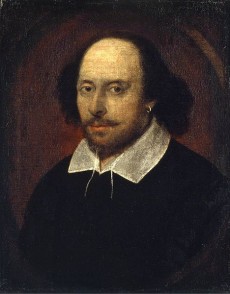
Yet, the Bard’s reputation for using baffling and “archaic” language isn’t necessarily well-deserved. Estimates vary as to the exact number of unique words found in Shakespeare’s complete works, but there is a general consensus that his plays and poetry contain approximately 1,700 words never previously seen in print, and not all of them are obscure relics like crant (garland/crown) or rigol (circle). Here is just a small sampling of “everyday” words originally given to us by William Shakespeare:
 Bloody
- Bump
- Critic
- Eyeball
- Gloomy
- Gossip
- Housekeeping
- Hurry
- Laughable
- Lonely
- Obscene
- Road
- Skim milk
If that wasn’t enough of a contribution, the Bard also created phrases such as:
- Wear one’s heart upon one’s sleeve
- Love is blind
- Good riddance
- Heart’s content
- Discretion is the better part of valour
- A foregone conclusion
Shakespeare didn’t necessarily invent all these bits of language; he wrote at a time when English was rapidly evolving and mass publishing was in its early stages, so in some cases he may have only been the first to print them. But even if he didn’t coin all these terms from scratch, most scholars seem to agree that he was probably responsible for a fair share. Confounding verses and outdated words aside, Shakespeare should be remembered for what he was: one heck of an incredible writer and a pioneer of new language. To see more of Shakespeare’s commonly used words and phrases, click on the sources below.
Broken Secrets | Facebook | Twitter | Email | Kindle
Source: No Sweat Shakespeare, Shakespeare-Online, WordSpin, The Phrase Finder, Wikipedia
Image: Wikipedia


 Broken Secrets