Posts filed under ‘Demystified’
Defenestrate Means: To Throw Out of a Window
Whenever someone tells me a computer frustration story, it usually ends with the phrase, “I almost threw it out the window.”
If you prefer more concise dialogue, then you’re probably reading the wrong website, but I can share a helpful word with you: defenestrate. It means, “to throw out of a window.” Used in a sentence, “I nearly defenestrated my computer.”

Today, this word is typically used for humor, but it has a very serious past. It comes from Latin, de means from and fenestra means window or opening. The word was coined around 1618, upon what is now known as the Second Defenestration of Prague. (more…)
One US Highway Uses Kilometers Instead of Miles
Mile markers line our highways. Like many other things, they were invented in ancient Greece. Originally, they were called “milestones” because they were stone posts engraved with the number of miles to and from the next town. They were made from granite, marble and other materials; they can look a lot like modern day tombstones and originals still exist in many places.
 If you’re not familiar with mile markers, they are small signs next to the highway that indicate the distance from the beginning of the highway. If you’ve ever seen small signs that only contain a number, it’s likely a mile-marker.
In the United States, most even-numbered interstates have mile markers that start at zero on the west coast and increase as the highway runs east. Along odd-numbered interstates, which run north/south, the mile-markers start at zero in the south and increase as the highway goes north. In most States, exit numbers are determined by the nearest mile marker number.
In Canada, the system is similar, although kilometers are used for the mile markers and exit numbers. In India, the markers also indicate the total distance between the two cities where the marker is located. Systems similar to these exist in most other countries.
There are some inconsistencies in the United States where exits are numbered sequentially rather than by mile markers. States that number in this way are Connecticut, Delaware, Massachusetts, New Hampshire, New York, Rhode Island, and Vermont.
There is also one interstate where the mile markers are actually labeled in kilometers. Interstate 19 in Arizona, between Tucson and the Mexican border, uses kilometers for mile markers and destination signs. Speeds are still posted in miles-per-hour.
The metric signs were installed in the 1980s when it looked like the United States was converting to the metric system. Complete conversion to metric never happened, but most of the signs along this interstate still stand. Going forward, metric signs will be replaced with US standard unit signs (“miles”) as construction projects along the highway are complete. As of 2009, one such project has been completed.
Broken Secrets | By: Chad Upton
Sources: Interstate System, Trans-Canada, Route Markers, Milestone, I19
Photo: amandabhslater (cc)
Rotten Eggs Float
Whether you throw away the carton and use the egg holder in your fridge or you just don’t believe the expiry date, there will come a time when you question the edibility of eggs.
There is an easy way to test them.
Fill a container with water and gently place the egg inside it. If it sinks, it’s good to eat. If it floats, throw it out. If it weighs the same as a duck, it’s a witch.
Why?
Eggs naturally have a small air pocket in them. In fact, a bright light is used during a process called candling to determine the size of this air cell. The size of the air cell is used to determine the grade of an egg. Grade AA eggs have the smallest air cell, and as the air cell gets large the egg is given a lower grade (A, B…etc).

This air cell increases as the egg ages. There are two schools of thought about why. Some say the eggshell is porous and allows some liquid to escape and air to enter. Others say a chemical reaction takes place inside, which results in the larger air chamber and the awful smell when they are rotten. I couldn’t find a definitive answer to why the air cell increases in size, but nobody disputed the fact that it does.
Because the air cell increases, it makes the egg less dense, meaning it will float in water with enough time.
The smell of rotten eggs is a popular description for the smell of sulfur. There’s good reason for that, eggs contain a fair amount of sulfur because it is necessary for feather formation. This smell becomes more prevalent as eggs age.
Thanks to my wife Kristen for this secret.
Broken Secrets | By: Chad Upton
Source: Eggs WP, Sulfur WP, What’s Cooking America, O Chef
Punctuation is Not Allowed in Mailing Addresses
Whether it’s a personal or business letter, every piece of mail I receive has the address formatted differently. Some even have the return and destination addresses formatted differently.
Since the post office has very strict requirements for addressing a letter, they should all be exactly the same. The post office guidelines are recommended for fastest delivery and I’ve compiled a list of rules that are the most surprising or commonly abused.
Since most of my readers are in North America, I’ve compared the requirements from the US Postal Service and Canada Post — they’re very similar and they contain good practices that are applicable to sending mail in most places.
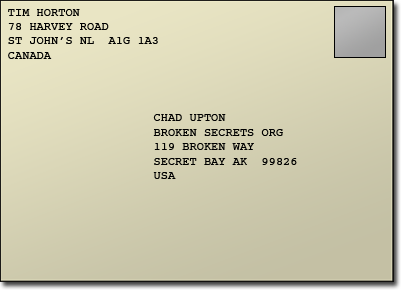 Mail is typically sorted by a machine, but if the machine can’t determine the address then it will be dropped in a bin for a human to sort it. Most of the requirements are design to make it easy for the machine to understand where you’re trying to send your letter.
No Punctuation Allowed
One rule that will surprise most people: no punctuation is allowed. I know your third grade teacher said you should put a comma between the city and the state, and maybe she was right at the time, but that’s not right anymore. Don’t use periods either, using punctuation will only slow the mail down. It’s going to be a tough habit to break, I know. There is one exception, and that is when the name of the City, Street or Town contains punctuation, such as an apostrophe (for example: St John’s). (more…)
Every UPC Barcode Has 30 Bars
Virtually every product has a barcode on it. In North America, 12 digit UPCs are used. In Europe and parts of Asia, 13 digit EANs are the norm. Both systems are a unique set of numbers that represent that specific product. The numbers are printed for humans to read and represented as a barcode for computers to read.
The UPC (Universal Product Code) and EAN (European Article Number) are very similar; in fact, the EAN standard is heavily based on the 12 digit UPC standard.
The first UPC was scanned at a checkout in Troy, Ohio in 1974; it was a 10-pack of Wrigley’s Juicy Fruit gum. The UPC format is very well designed and hasn’t really changed since then.
All UPCs have 30 bars. Grab any product with a 12 digit UPC and count them. Some bars are thick and some thin, but there are 30 total. Thick bars are technically made up of a varying number of thin bars as you can see in the illustration below, but thick bars are only counted as a single bar for the purpose of this description.

Each of the 12 numbers accounts for 2 bars, which gives you 24 bars. Then there are 6 guard bars that give the scanner consistent reference points. There are 2 guard bars on each end and 2 in the middle for a total of 30 bars.
Each digit is represented by 2 black bars and white space of varying thickness. The guard bars in the middle divide the 12 digits into groups of 6. The same digit on the left and right sides will be represented differently by the bars, this allows the scanner to correctly identify upside down barcodes.
The first 8 digits refer to the company that registered the UPC. The next three digits uniquely identify the product.
The last digit in the sequence has nothing to do with the product itself, it’s called a check digit. It helps the computer identify a scanning error.
The check digit is a bit complicated, but here’s how it works. Add up the digits in the odd numbered positions (first, third, etc) and multiply by three. Next, add the digits in even positions to the first number, then find the remainder when divided by 10. If the remainder is not 0, then subtract the result from ten. That number should equal the last digit, if it doesn’t then the computer knows there was a scanning error and you get to scan your self-checkout item a fourth time.
There are some rumors that the first few digits can be used to identify the country of origin, but that’s not true. With 12 digit UPCs, no digits are used to identify a country. 13 digit EANs reserve the first three digits for country of registrar. This country code simply refers to the country where the code was registered and is in no way related to where the product is made.
UPCs are registered with a non-profit organization called GS1. There is also a website for looking up UPCs, called the UPC database. It can be searched by UPC or by product description.
Broken Secrets | Written By: Chad Upton
Sources: UPCs, EANs, About.com
Images: Wikipedia (gnu)
How Ballparks Stripe Their Grass
In North America, professional baseball fields are the highest form of manicured lawns. Elsewhere, professional football pitches and cricket fields are admired.
Achieving the striped affect is pretty straight forward. The grass appears lighter and darker because the blades of grass are bent in opposite directions. The lighter looking grass reflects more light because of the angle of its blades and the darker ones reflect less light because of their angle.

To bend grass in opposite directions, start by cutting the lawn in opposite directions. The back and forth method is the simplest example.
Most people cut their lawn like that anyway, but the stripes aren’t as dramatic as the professional fields. To improve the contrast, be sure to set your mower at its highest setting. Longer blades of grass bend better and will have a more dramatic look. In fact, longer grass makes for greener grass too — it protects the roots from drying out and turning yellow.
But, here’s the professional stripe trick, after cutting at least two different directions, roll the grass with a lawn roller. Roll the lawn in the same direction that you mowed, this bends the grass better, which intensifies the affect.
Lawn rollers can be bought or rented at many home and garden stores.
Broken Secrets | Written By: Chad Upton
Source: Scotts
Photo: pamhule (cc)

Pure Vanilla Extract is 35% Alcohol
I made vanilla crème brulée a few weeks ago and I used a lot of pure vanilla extract, almost twice the amount the recipe suggested. I did a Grand Marnier flambé on top and although it tasted great, the best part was the excuse to buy a blowtorch.
 Now, when you buy something labeled “pure”, you expect it to match the definition of pure, “unmodified by an admixture; simple or homogeneous.” But, that’s not what you get with pure vanilla extract.
In the United States, the FDA requires Pure Vanilla Extract to contain alcohol if it’s going to be called “pure.” Specifically, it must contain at least 35% alcohol and 13.35 ounces of vanilla bean per gallon.
It turns out this is not a rip off, alcohol actually helps extract the flavor from the vanilla beans. Not only that, vanilla extract gets better with age, maturing in about 2 years.
Alcohol free versions are available, but will not be labeled as “pure.”
Broken Secrets | Written By: Chad Upton
Sources: dictionary.com, wikipedia, FDA, Arizona Vanilla
Photo: Jocelyn | McAuliflower (cc)
Why U-Hauls Have Arizona License Plates
Most U-Haul vehicles have Arizona license plates. Here’s a typical example.
The following picture was taken in the Toronto area, the information on the side is about Newfoundland and the license plate is, of course, from Arizona.

That might seem unusual, but most U-Hauls in Canada actually have Arizona plates too. The fact is, all corporate owned U-Haul rental vehicles in the lower 48 States and Canada have Arizona license plates. That’s right, Alaska and Hawaii don’t have Arizona plates, but all of Canada does. There are actually a few good reasons for this.
When I first noticed this trend, I assumed that U-Haul got a sweetheart deal in Arizona. It turns out their head office is in Phoenix, so it seems reasonable that they would register vehicles there. They also get a really sweet deal there, but this deal is not exclusive to U-Haul, it’s good for anyone with a billing address in Arizona. (more…)
Neil Armstrong’s Famous Words Include a Mistake
The famous words from the Apollo 11 “Journey to the Moon” were spoken by Neil Armstrong after his first step on the lunar surface, “That’s one small step for man, one giant leap for mankind.”
Most people know these words well because the recording is frequently played in everything from TV commercials to training videos. But, depending on your age, you might not know that’s not what he intended to say. He meant to say, “That’s one small step for a man, one giant leap for mankind.” He apparently said “man” instead of “a man.”
Armstrong was sure he said the “a” but later stated, “Damn, I really did it. I blew the first words on the moon, didn’t I?” Armstrong has since indicated that he intended to say the “a” and when the quotation is written he would prefer the “a” is included in parenthesis: “That’s one small step for [a] man, one giant leap for mankind.”
There has been great debate over what he actually said. In 2006, a researcher in Australia claimed that the “a” was spoken, but that it was inaudible due to transmission and recording equipment of the time. Using high-tech computer software, he was apparently able to detect the missing word. Other researchers have disputed this claim. Since one theory is that the “a” is inaudible, that will be a hard case to prove. I think another clue is the gap between the words. You can decide for yourself if there was room for an “a” between the words “for” and “man” — I have embedded the video, which includes the famous quote.
Broken Secrets
Written By: Chad Upton
Follow BrokenSecrets on Twitter
Sources: Snoops, Wikipedia, Wikiquote, Space Week


 Broken Secrets