Posts filed under ‘Demystified’
The Purpose of Color and Registration Marks on Packaging
I first noticed these marks on cereal boxes as a kid. After pouring a bowl of cereal, I’d read the front panel, then the back and eventually I’d be reading the subscript on the top panels.
The folding panels of many cardboard packages contain colored boxes and cross-hair markings. I always wondered what they were for.

The cross-hairs are called “registration marks” and they may be used for different purposes during the printing and package making process.
In the initial stages of the printing process, they are used to ensure the printing plates are properly aligned in multiple color processes. Technicians use these marks to perform the initial setup and make adjustments during the print run. Advanced printing presses also have sensors to check for alignment and make automatic adjustments.
The registration marks may also be used to align materials in other machines that do cutting, folding and gluing.
The color boxes are used by printing technicians to verify the proper quantity of ink is being laid on the printed material. This allows them to match color samples to ensure consistency from start to finish of the printing run and even across printing facilities that print the same materials around the world.
Thanks to Todd M for suggesting this secret.
Broken Secrets | By: Chad Upton
Subscribe on: Facebook | Twitter | Kindle
Sources: Computer Hope, Wikipedia (Registration), Sensors
What are Truck Weigh Stations for?
There are truck weigh stations scattered along most major highways in the US, Canada, Taiwan and other countries. Obviously they’re there to weigh trucks, but why do trucks need to be constantly weighed?
Vehicles that weigh more than 26,000 pounds or have 3 or more axles have to pay fuel taxes. Motor homes and other private (non-commercial) vehicles are generally exempt. For example, if you see a race-car team drive by, you’ll often see “not for hire” on the side of the cab. That suggests the vehicle is exempt from the fuel tax charges and keeps other trucking companies from soliciting their services.
Truck weigh stations were originally developed for states to collect the fuel taxes they were owed by the commercial trucks using their roadways. It is similar to the licensing concept that I talked about in a previous post, Why U-Hauls Have Arizona License Plates.
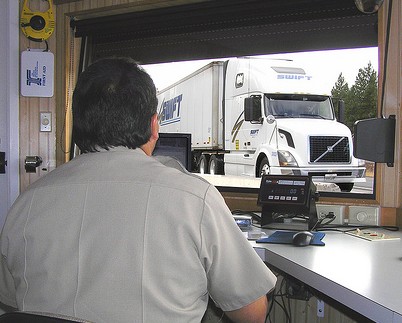
In North America, weight stations aren’t directly used for that purpose anymore. There is now an International Fuel Tax Agreement which allows truckers to file a quarterly tax report. Weigh stations are still used to enforce the tracking and submission of the logs and the payment of the fuel tax.
The scales are still used to enforce weight restrictions. The federal weight restriction is 80,000 pounds. Trucks need a trip permit to transport a load exceeding that weight.
Some weigh stations are pretty high-tech, supporting “weigh-in-motion” technology. This technology can allow truckers to bypass weigh stations entirely. This involves the truck driving over a scale that is built into the right lane of the road, usually about a mile before the weigh station. Depending on the weight of the vehicle, its history and the history of the trucking company, the weigh station operator or an automated system will decide if the truck needs to pull into the weigh station.
Truckers who use these systems have a transponder in their truck, similar to those used for electronic toll collection. If they can skip the weigh station, they will usually get a green light on the transponder. If they need to pull in, they will get a red light.
Weigh stations are also used for safety inspections of vehicles. Truckers often refer to weigh stations as “chicken coops.” Check out my post on trucker signals for more trucker slang.
Broken Secrets | By: Chad Upton
Subscribe on: Facebook | Twitter | Kindle
Sources: Wikipedia (weigh station, IFTA, weigh in motion)
Photo: OregonDOT (cc)
Carousels Were Invented By The Military
Depending on where you come from, you may call carousels by another name, perhaps: “merry-go-rounds”, “flying horses” or “roundabouts.”
They have been popular rides for the past 200 years, but they started off as military training machines. In fact, the word “carousel” comes from the Spanish word, carosella, which mean “little battle.”
This name was fitting because carousels were originally used to train knights to use their swords while riding on a horse that moves up and down. Objects were placed along the outside of the carousel; the knights tried to stab the objects or catch them on their swords.

Jousting competitors also trained on carousels, but, when Catherine de Medicis’ husband was killed in a sudden jousting accident (or “lost” as they called it back then), the carousel quickly became a safer form of entertainment. Crowds would watch as entertainers would catch objects on their swords and travel in circles until they got dizzy.
That sounds more boring than actually going to a mid-evil times restaurant, so spectators naturally wanted a shot at riding the carousel and even catching one of the objects on their sword. This is how it became the popular amusement ride it is today.
In fact, a small number carousels still exist that have an obstacle as part of the ride. On these carousels, riders will try to grab a brass ring as they ride around on the carousel. There are steel rings as well, and those are often thrown at a target to discourage people from keeping them as souvenirs. The brass ring can often be redeemed for a prize, which is usually a free ride on the carousel.
This is also where the term, “catch the brass ring” comes from.
Broken Secrets | By: Chad Upton
Subscribe on: Facebook | Twitter | Kindle
Sources: Wikipedia, Big Site of Amazing Facts
Photo: Swamibu
There are Three Stanley Cups
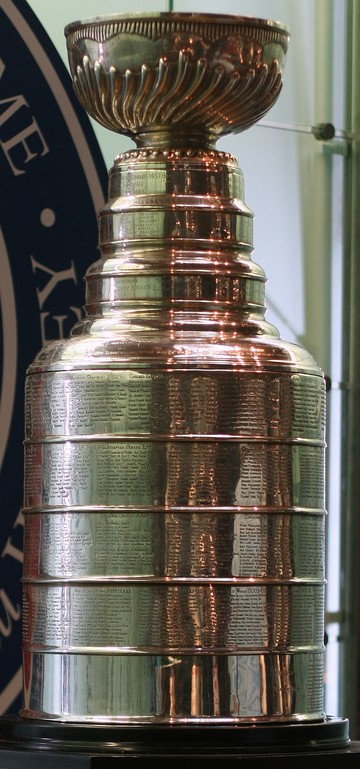 Congratulations to the 2010 Chicago Blackhawks for winning their first cup since 1961 last night.
For those who don’t know, the Stanley Cup is the National Hockey League’s playoff trophy. 30 franchised teams from Canada and the United States compete from October to June for the honor of having the players, coaches, managers and staff names engraved in the cup.
There are six historic bands (“rings”) at the top of the cup where names were engraved between 1893 and 1927. Then there are five main bands on the body of the cup where more recent names have been engraved. The historic bands never change, but the oldest of the five main bands is retired when a new ring is added to make room for new names.
The retired rings are displayed in the Hockey Hall of Fame in Toronto Canada and the cup itself is always accompanied by a minimum of one Hockey Hall of Fame representative.
After winning the Stanley Cup, the team captain will be presented with the cup. It is a tradition for the players to skate a lap around the rink with the cup held above their head. This tradition was started by Ted Lindsay of the Detroit Red Wings in 1950. He did it to give the fans a better look at the trophy.
After the winning game, there is usually a home-town parade. Each winning player is also allowed to spend an entire day with the cup. Players have baptized their children with the cup, swam in their pool with the cup and even fed their dogs from the cup.
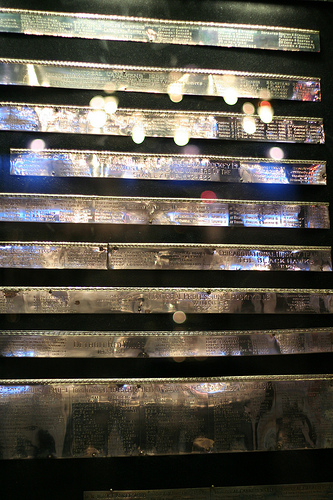
Rings removed (retired) from Stanley Cup
There are three Stanley Cups in total. The original “cup” resembles a large bowl and is mounted to a wooden stand. It no longer has bands at the bottom and was retired after its first 71 years of service — it remains on display at the Hockey Hall of Fame. Then there are two nearly identical cups. One is the official cup and bears the official seal on the bottom, the other is a replica and remains on display at the Hockey Hall of Fame when the official cup (“Authenticated Cup”) is elsewhere.
The easiest way to spot the real cup is to look at the 1984 Edmonton Oilers engraving. Basil Pocklington’s name has been crossed out with X’s. He is the father of Peter Pocklington, the Oiler’s owner at the time and his name was added in error. The NHL claims Peter added his father’s name to the engraving list and they failed to validate that list. Peter claims it was the engraver’s error and the list with his father’s name on it was a list of people who should receive miniature replicas.
The full size replica cup does not contain Basil’s name at all.
Broken Secrets | By: Chad Upton
Subscribe on: Facebook | Twitter | Kindle
Sources: Wikipedia (Stanley Cup, Peter Pocklington, NHL)
Photos: Colby Cosh (cc), Vidiot (cc)
How to Buy the Right Shoes for Your Feet
Considering how much time you spend wearing shoes, how much time have you spent understanding what’s unique about your feet?
Unless you’re an avid runner or maybe work at a shoe store, you probably don’t know how to buy shoes that compliment your feet and the way you use them. It can be hard enough to find a shoe that looks good, fits on your foot and feels comfortable, but it takes even more to find a pair that fits your arch and the angle of your ankles. But there is a way.
Even if you don’t run, you can still benefit from buying the right running (or walking) shoes — especially if you spend a lot of time on your feet at work or at play.
For example, the only “running” I do is running errands, but I often wear running shoes because they’re comfortable and lightweight. With the right shoes, there is less stress on your feet, ankles, knees and hips.
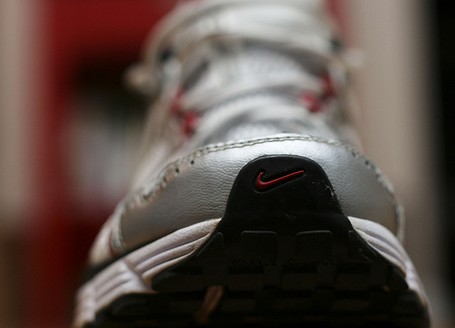
When you walk, the heel of your foot will touch the ground first and as you roll your foot forward, your weight will be transferred to the front of your foot. Depending on the angle of your foot, you may be putting more weight on the inside or outside of your foot. Doing that hundreds or thousands of times a day can lead to pain and discomfort in your feet and other parts of your body.
If your hips, knees or ankles produce external rotation, you will be more likely to angle your feet as you walk (known as pronation of the foot). Your shoes can compensate for natural irregularities or make them worse and that’s why it’s important to get the right shoes.
Good shoe stores will help determine your arch type and level of pronation. Once you know your arch type and pronation, there are different shoes that will suit you. A local running shop is a good place to start, they’re generally the most knowledgeable retailers of shoes. Some websites with good fitting advice are: Road Runner Sports, Zappos, Dick’s and New Balance.
One way to determine your arch type is by standing (to put weight on your feet), then sliding your index finger under your arch. If you get your finger up to 1/2 an inch under your foot then you’ve got a low arch. 1/2 inch to 1 inch is a medium arch. More than an inch is a high arch.
The other way to determine arch type is the paper bag test. You wet your feet and stand on a paper bag. Looking at your wet footprint and the size of the gap left by your arch, you can tell if you have a low, medium or high arch. This way is pretty common, but it’s a bit more subjective than the index finger method.
To determine your pronation (ankle roll), you’ll need the help of a friend. They will stand behind you to see how your ankles behave as you walk. If your ankles stay very straight, then you have neutral pronation. If they roll slightly inward or outward then you’re considered an under-pronator. If they roll inward excessively, then you’re an over-pronator.
Another way to determine pronation is to put a used pair of your running shoes on a flat surface and see if the shoes tilt inward towards each other, or tilt outward, away from each other.
 Shoes are divided into three categories for different feet type: stability, motion control and neutral. Stability shoes are for under-pronators. Motion control shoes are for severe over-pronators and perhaps obviously, neutral shoes are for neutral pronation.
Most online retailers categorize shoes into these groups. A good shoe store will be able to tell you which shoes are your type as well.
The other approach to running footwear is: barefoot. There is a popular book on running called Born to Run which suggests that we are literally born to run in our bare feet and the best runners in the world come from tribes of barefoot runners who run well into old age without injury.
For now, I think I’ll stick with my runners.
Thanks to Kristen for suggesting this secret!
Broken Secrets | By: Chad Upton
Subscribe on: Facebook | Twitter | Kindle
Sources: Wikipedia (Foot type), New Balance (Running Gait), Zappos, Dick’s
Photo: Jason Alley (cc)
A Secret Government Spaceship is Circling the Earth
The US government recently launched a secret space plane called the X-37B. You’ve probably never heard about it and that’s because nobody is really talking about it.
We do know that the X-37B was launched on April 22, 2010. It was originally a NASA project in 1999, but was transferred to the department of defense in 2004. It looks very similar the space shuttle, but it’s unmanned and about a quarter of the size. It also operates very similar to the space shuttle, it is launched by powerful rockets and it lands like an airplane. It has a small cargo bay, about the size of a pickup truck bed.
For safety and security, a little over 14000 space objects are cataloged and tracked. The objects include satellites, debris and rocket bodies. Tracking these objects reduces the chance of a collision between them. In fact, there are a few public websites that let you view this information, some will even plot satellites on a map so you can try to spot them when they’re over your area. The location and orbit of the X-37B spacecraft has not been announced by the government.
However, a group of amateur astronomers and sky watchers believe they have enough sightings to identify the craft and it’s orbit. The space plane has been tough to spot since it seems to be operating in a low orbit, similar to the height of military spy satellites. There are a lot of satellites in the sky, 75 military satellites plus 15 search and rescue; 37 gps and 19 Navy navigation satellites. Then, there are thousands of other satellites for communications, science and entertainment uses.

China and Iran are both on edge about what this space plane is capable of. According to China, it may signal the start of a space arms race.
Experts believe the X-37B is just another spy plane, except it can stay in the air for 270 days before returning for fuel. The sky watchers who are tracking the space plane have seen it over Iraq and Afghanistan and believe it is currently testing surveillance equipment. Because it can return to earth and be redeployed very quickly, it’s likely that it will serve a number of different roles as needed.
As for the name, it’s just a test plane series number. For example, the X-24A was the model of the plane used in 1963 to test the re-entry heat-shields that would end up on the bottom of modern day space shuttles.
When the X-37B does return to earth, it will land on a runway in California. If it veers too far off course, it will self destruct. Seriously.
Broken Secrets | By: Chad Upton
Subscribe on: Facebook | Twitter | Kindle
Michelangelo Hid Images in Sistine Chapel Paintings
The most amazing work of art I’ve ever seen is David by Michelangelo. At 17 feet tall, bulging veins and muscles render an immaculate representation of human anatomy and the flaccid pose captures the mood before his fight with Goliath.
There is no doubt, Michelangelo’s understanding of anatomy is incredible, but not surprising. His art education included dissecting cadavers while studying at the church of Santo Spirito. This is not a well known fact since he tried to hide his anatomist roots, destroying nearly all of his anatomic notes and drawings.
Maybe cadavers are harder to come by these days, but that’s not part of the art curriculum at most modern schools. That privilege is usually reserved for medical students, which is why it’s no surprise that three medical journals have published findings of hidden anatomic references in Michelangelo’s Sistine Chapel paintings.
It took four years (1508-1512) for Michelangelo to paint the walls and ceiling of the Sistine Chapel. The last four panels he painted include the suggested anatomic representations.
In the forth panel, Dr Frank Meshberger suggests the similarity between the red cloth surrounding god and the image of a human brain (Journal of the American Medical Association, October 1990).

The brain-like shape is highlighted
In the third panel, Dr Garabed Eknoyan likens the wrap surrounding god to a human kidney, as reported in Kidney International in 2000. According to Eknoyan, Michelangelo was interested in the kidney function since he suffered from kidney stones during his adult life and mentioned it in letters and poems.

Do you see a Kidney shape?
Finally, in the first panel (image below), Ian Suk and Rafael Tamargo, report in the journal Neurosurgery (May 2010) that the neck details do not accurately represent a goiter, as previously believed. They argue that goiters typically occur lower in the neck and Michelangelo would not have made such an inaccurate representation given his demonstrated accuracy of anatomic details in all of his other paintings. Secondly, they believed as a deeply religious man, he would not depict god with this deformity. Most convincingly, they say the painting accurately details a ventral view (from below) of a brainstem, cerebellum, temporal lobes and optic chiasm. (more…)
U-Shaped Plumbing Stops Sewer Gases
Look under any sink, shower or bathtub in your home and you’ll find a U shaped plumbing arrangement. This plumbing configuration may go by the following names: p-trap, j-trap, u-trap or s-trap. Depending on how you look at it, it can look like any of these letters.
Technically, the term “s-trap” describes a slightly older variation of this plumbing technique, but the term is often used to describe the one seen below. For short, we’ll just call it “the trap” because it traps water.
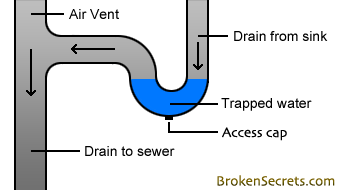
Trapping water serves two main purposes.
The first is prevent sewer gases from entering a building through the drain pipes. These gases smell bad and are bad for your health.
The second is to catch small items that are inadvertently dropped down the drain, such as jewelry. There is typically an access cap on the bottom of the trap that can be used to retreive valuables or clean out the trap — they tend to collect hair and other debris.
When water enters the trap, it pushes the same amount of water out the other side of the trap. This means the trap will always maintain the same amount of water in it. Traps may dry out due to evaporation if a particular drain is not frequently used. If you have a rarely used drain, it might be a good idea to run the water for a minute every 4-5 weeks.
Broken Secrets | By: Chad Upton
Secrets on: Facebook | Twitter | Kindle
Donate 15 minutes to help someone else
Sources: Wikipedia, Water Evaporation
Fake Smoke is Not Usually Dry Ice
I frequently hear people refer to fake smoke as “dry ice.” It’s true, you can make smoke from dry ice. But, in many cases, it’s dangerous and inconvenient.
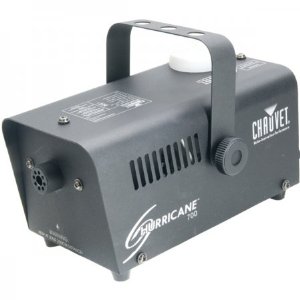
That’s why they invented fog machines. Fog machines are made up of a small heater, a fluid reservoir and a pump. These machines vaporize mineral oil, glycol or glycol/water mixtures to produce fog. Low powered machines for home use are pretty affordable, you can get a decent one from Amazon for $40. Around Halloween, many other stores carry them too.
Fog machines are great for enhancing lighting effects and creating an eerie mood. The fog usually fills the room from floor to ceiling, but cooling the fog with ice creates layered fog that stays below your knees.
In sixth grade, my friend Troy and I had a vision for our school air guitar competition. He saw himself as lead lip sync-er, rocking out to Tone Loc’s Wild Thing. I didn’t know that song when he mentioned it, nor did I care — I just wanted lots of smoke and lasers.
I called a few equipment rental houses and got quotes to rent a fog machine and lasers. It was a hefty amount for an 11 year old, but I was making a name for myself in the newspaper delivery business and I was willing to spend the money — I knew that lasers would help us win the competition.
I shared my creative vision with the drama teacher and he said, “no smoke.” He had worked with dry ice before and said it makes the floor slippery; it was a liability he wasn’t willing to take on. I told him, “people don’t use dry ice anymore — there is new technology that is completely dry and doesn’t make the floor wet.” He wouldn’t listen and said his decision was firm: no smoke. Without smoke, you can’t see lasers, so that meant we were back to the boring house lights.
I told Troy that smoke and lasers were off. He could tell I was upset, but he said with great confidence, “It’s alright. We’ll still win.” Comparing our rehearsals to the other groups, I knew he was wrong
In the end, smoke and lasers wouldn’t have made a difference. You see, Troy was the most hyper kid I knew. On the day of the show, he focused all of that energy into his performance and he completely stole the show.
That day I learned, you don’t need smoke to see lasers. Everybody has amazing potential and the secret lies in how you focus that energy.
Broken Secrets | By: Chad Upton
Follow BrokenSecrets on Twitter
Sources: Theatrical Smoke, Fog Machines, Dry Ice
Survivor Contestants Cannot Share Winnings
This Sunday is the season finale of Survivor. I’m more of a Lost fan (hence the photo below), but these secrets are interesting even if you don’t watch the show. For those who do watch the show, this will give you plenty of things to think about on Sunday night.
Survivor is a serious contest. In fact, contestants are not allowed to make a pact where one or more will intentionally lose and the winner agrees to share the prize money with them. It is in their contract that they will face a $5 million penalty from CBS if they are caught doing this. Why have this rule? It ruins the drama, it takes away the cut throat nature of “surviving.”

There are often 300 or more crew members hidden at a nearby “base” camp. Depending on when and where the show is being made, the crew accommodations and working quarters vary from tents, cabins and shipping containers to hotels. The base camp has proper showers, bathrooms, catered meals and even a bar. A small group of crew members work in shifts at the contestant’s camp to keep their cameras and microphones trained on the cast day and night.
You never see the camera crews because they take great care not to be seen. In fact, the cast is not even allowed to talk to the production crew. The cast is only allowed to talk to the producer (Mark Burnett) and of course the host (Jeff Probst).
Junior crew members help test out the obstacles, puzzles and events. They actually have a dress rehearsal where these crew members will run the course just like the cast members do. This gives the production crew a chance to find the best camera angles and practice who will be shooting what. (more…)


 Broken Secrets