Author Archive
The Real Reason Cell Phones are Banned on Planes
I should start by saying that smartphones and simple cell phones are not banned on planes everywhere. Air France started allowing passengers to use their cell phones in 2008. Since then, a few Eastern airlines have followed suit.
These airlines use an in flight system that mimics cell phone towers found on the ground. The system relays the call/text/email to a satellite and back to the ground from there. Similar systems have been on cruise ships for years. On cruise ships, they use these systems because there aren’t any ground based cell phone towers in the middle of the ocean.
When you drive in a car, your cell phone call may jump from tower to tower as you travel out of range from one tower and into range of another. These jumps used to cause an echo with early cell phone networks, but it is pretty seamless today. Well, at least in your car it is. Airplanes move much more quickly and the network cannot pass your call from tower to tower at that speed. That’s why airplane systems typically bounce your call off a satellite, which it can easily maintain a connection to.
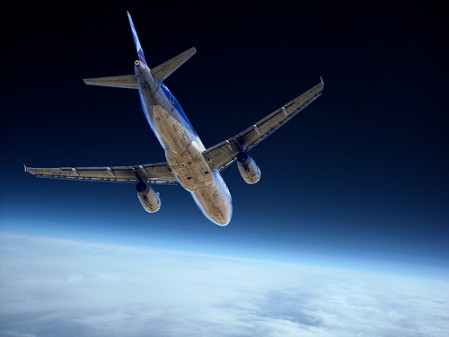
An unintended benefit of having the cellular connection on the plane is that the cell phone doesn’t require a lot of power to connect the call, so your battery will last longer and there will be less electromagnetic radiation in the plane. If you phone was attempting to connect to ground based towers it would have to amplify the signal much more and that consumes more battery power.
So, the technology exists. Why don’t most airlines allow it?
Firstly, there is the myth that cell phones cause interference with navigational equipment. Most people aren’t going to try to test it either, no phone call is important enough to take that risk. But, if you fly a lot then chances are good that you’ve realize mid-flight that you forgot to turn your phone off. It doesn’t appear that there have been any equipment problems. You seem to be flying in the right direction and you haven’t heard any complaints from the cockpit.
I asked an airline insider about this and they checked with some pilots and filled me in on the details. They said that old analog cell phones may have caused problems, but there is no evidence that digital phones cause any problems. Like I said before, Air France has been doing it for two years now without incident and there have been a number of studies that failed to find any incompatibilities between aircraft systems and cell phones. In fact, the problems are more likely with the ground based systems as they scramble to route your call to the nearest tower as you pass a new tower every few seconds in an airplane.
Here’s where it gets really interesting, many planes already have equipment to route in-flight cell phone calls without going to ground based towers (similar to what Air France uses to properly route cell phones through satellites). This equipment is often part of the system that planes use to offer in-flight wifi. Many US carriers currently offer that service and much of that equipment has cellular capability, it’s just not enabled right now.
If it was truly a problem with airplane systems, the FAA (Federal Aviation Administration) would surely support the ban of cell phones. Instead, the FAA blames the FCC (Federal Communications Commission) for the in-flight cell phone ban.
The FCC regulates all electronics that are sold in the United States and they readily admit they’re cautious about changing the rules on this issue. Their main goal is to prevent electronics from interfering and causing problems with each other, especially with emergency and government systems. They say that limited information is available on the safety of using cell phones on airplanes. They also note that consumers don’t want cell phones on planes.
They’re probably right about cell phone calls on the plane, although I’m not sure if that is their decision to make. I could see a war between airlines who adopt the technology and those who promote their flights as cell phone free.
The interesting thing about the technology is that the airlines can control which services the passengers can use. They can disable calls, but allow text messages and emails/data to be transferred. Disabling calls would maintain a flight environment similar to what we have now and that would ensure that screaming babies retain their exclusive right to prevent you from sleeping on red-eye flights.
As more airlines install the equipment for in-flight wifi, they’ll be itching to generate revenue from in-flight cell phone usage too. I wouldn’t be surprised to see the airlines lobbying the FCC for the right to offer these services. When they do, sign me up for the deluxe service package: 1 piece of luggage, cellular usage, 1 meal, 1 life vest during an emergency and 1 bathroom break — not necessarily in that order.
Thanks to Gina for suggesting this secret!
Related: Why Airlines Dim the Lights Before Night Landings
Broken Secrets | By: Chad Upton
Subscribe on: Facebook | Twitter | Kindle
Sources: Live Science, ABC, OnAir
Photo: lrargerich
Stock Market Analysis Began with Rice in 18th Century Japan
The past few years have proven that the world economy lives and dies on the success of major financial markets around the world.
Traders use sophisticated software to analyze trends, make predictions and purchases. There is one legendary trader, who made billions of dollars analyzing market trends.
His name was Munehisa Homma and the only thing he traded was rice. His billions in earnings are in today’s dollars and he may have known more about market analysis in the 1700s than our smartest people do now.

He began trading rice in Osaka, where the rice market was very sophisticated, it even traded rice futures. Coupons were sold that promised the delivery of rice at a specific price in the future. Homma was believed to have created a personal network of 100 men located about 6km apart from each other to move market information between Osaka and Sakata.
He wrote the first book on market psychology in 1755, The fountain of Gold – The Three Monkey Record of Money. I have no idea what the title means, hopefully somebody is working on a movie adaptation and we can see it in 3D. Maybe it could be a prequel to 12 Monkeys?
Seriously though, Homma was a genius. He invented the candlestick chart, which is still used by traders today.
 This handy chart combines four pieces of data into each plot point on a date axis. For example, you can look at a single day of trading of a specific stock and see the open and close price of the stock on that day (the candle body), along with a low and high range of prices at which it traded throughout the day (the candle wick). The candle body is solid when the open price is represented by the top line and the close price is the bottom line. It is hollow when it’s the opposite, indicating whether the price increased or decreased that day.
For a single date, this gives the reader a lot of information. But, it becomes a fountain of gold when you put multiple days together — that’s when patterns can be spotted. The great master could read the chart and predict how the market would behave in the future. Understanding these patterns is how he made his billions.
Charles Dow recognized the value of candlestick charts around 1900 and included them in his studies. You may have heard of him, he’s the guy who co-founded Dow Jones & Company, The Dow Jones Industrial Average and The Wall Street Journal.
He was obviously a brilliant man, but it was the research of Steve Nison in the early 1990s that popularized candlestick charts in North America. If you want to know more about these charts, you should look at his work.
Homma is still recognized as the greatest trader of all time. It is believed that he made more than $100 billion (today’s dollars). He once said, when all are bearish, there is cause for prices to rise.
Broken Secrets | By: Chad Upton
Subscribe on: Facebook | Twitter | Kindle
Sources: Trader’s Log, Candlestick Forum, Wikipedia (Candlestick, Charles Dow, Homma Muneshisa)
Images: Wikipedia (Candlestick Chart, Candlestick Definition)
Coupons You Get at Grocery Stores are Based on Your Purchases
In the United States it is very common for supermarkets to offer discounts to shoppers who present their loyalty card at the checkout. Price tags in the aisles often quote two prices, with and without the discount card.
The loyalty cards are usually provided by the retailer at no charge. However, they’re not free.
Although you don’t pay any money for these cards, you do handover your entire purchase history at that store. Your information is often used immediately at your time of purchase to determine which coupons should be printed out for your next visit.
Marketers frequently target consumers who buy their competitors products. For example, if you frequently buy Uncle Ben’s Rice, you may get a coupon from Rice-A-Roni. The manufacturer is trying to entice you to buy their brand the next time you shop.
Purchase history may also be used to determine the dollar value of the coupons you receive. For example, if you normally buy Dannon yogurt, then Yoplait may offer you $0.50 off your next Yoplait purchase. If you’re already a Yoplait customer, you may only get a $0.10 coupon or none at all.
Obviously, you don’t need a loyalty card for the store to recognize that you’re buying Uncle Ben’s today, but it is important if they want to know if you have bought that brand before or if you typically buy another brand.
When you sign up for a loyalty card, you often fill out a short survey of personal information, including your home address. They say they want your address so they can mail other offers to you, which they may. More importantly, your address allows them to understand a lot about you, including the average income of your neighborhood and even how much you paid for your house. In some cases, these programs are run by outside companies. Your address will help them combine your shopping information from multiple stores, assuming you always use the same name and address.
By comparing your personal information with information about other people’s shopping habits, average income and other demographic information, they can predict which products you’ll most likely try if they provide a coupon a for it.
Many stores will give you their loyalty card and let you use it right away, then they send you home with a survey to fill out and mail in to register for the card. I can tell you from experience that you can use your loyalty card for years without ever mailing the survey in. Although they’re collecting your shopping history, they don’t know much else about you.
There are also studies that show stores with loyalty cards don’t always have the best price, even when you use your frequent shopper card. In fact, one study even showed that sale prices went up after the introduction of a loyalty shopping card. It’s a good idea to keep track of the prices of a few items you commonly purchase to see if the regular price is better at other nearby stores.
I usually shop at a co-op, which does not use a loyalty card but has better prices than any other store around. They even have better prices than Target on items that they both carry, although that is one of the few places I cannot use my credit card to get cash back — they only accept cash or debit, one way they try to keep their costs down.
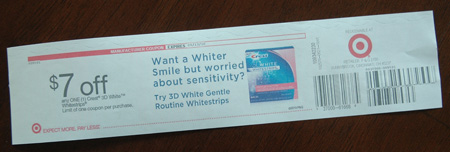
It’s not just grocery stores that provide you with sponsored coupons. I stopped at target yesterday to pick up some envelopes, on my way to the cash I spotted a new iced coffee drink. From other posts, you know I am addicted to coffee, so I couldn’t resist. At the register I was given a $7 off coupon for Crest Whitening strips. I doubt the envelopes triggered that.
Broken Secrets | By: Chad Upton
Subscribe on: Facebook | Twitter | Kindle
Sources: Seattle Press, No Cards, an Industry Insider
The Purpose of Color and Registration Marks on Packaging
I first noticed these marks on cereal boxes as a kid. After pouring a bowl of cereal, I’d read the front panel, then the back and eventually I’d be reading the subscript on the top panels.
The folding panels of many cardboard packages contain colored boxes and cross-hair markings. I always wondered what they were for.

The cross-hairs are called “registration marks” and they may be used for different purposes during the printing and package making process.
In the initial stages of the printing process, they are used to ensure the printing plates are properly aligned in multiple color processes. Technicians use these marks to perform the initial setup and make adjustments during the print run. Advanced printing presses also have sensors to check for alignment and make automatic adjustments.
The registration marks may also be used to align materials in other machines that do cutting, folding and gluing.
The color boxes are used by printing technicians to verify the proper quantity of ink is being laid on the printed material. This allows them to match color samples to ensure consistency from start to finish of the printing run and even across printing facilities that print the same materials around the world.
Thanks to Todd M for suggesting this secret.
Broken Secrets | By: Chad Upton
Subscribe on: Facebook | Twitter | Kindle
Sources: Computer Hope, Wikipedia (Registration), Sensors
What are Truck Weigh Stations for?
There are truck weigh stations scattered along most major highways in the US, Canada, Taiwan and other countries. Obviously they’re there to weigh trucks, but why do trucks need to be constantly weighed?
Vehicles that weigh more than 26,000 pounds or have 3 or more axles have to pay fuel taxes. Motor homes and other private (non-commercial) vehicles are generally exempt. For example, if you see a race-car team drive by, you’ll often see “not for hire” on the side of the cab. That suggests the vehicle is exempt from the fuel tax charges and keeps other trucking companies from soliciting their services.
Truck weigh stations were originally developed for states to collect the fuel taxes they were owed by the commercial trucks using their roadways. It is similar to the licensing concept that I talked about in a previous post, Why U-Hauls Have Arizona License Plates.
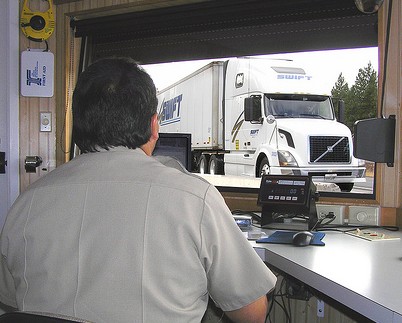
In North America, weight stations aren’t directly used for that purpose anymore. There is now an International Fuel Tax Agreement which allows truckers to file a quarterly tax report. Weigh stations are still used to enforce the tracking and submission of the logs and the payment of the fuel tax.
The scales are still used to enforce weight restrictions. The federal weight restriction is 80,000 pounds. Trucks need a trip permit to transport a load exceeding that weight.
Some weigh stations are pretty high-tech, supporting “weigh-in-motion” technology. This technology can allow truckers to bypass weigh stations entirely. This involves the truck driving over a scale that is built into the right lane of the road, usually about a mile before the weigh station. Depending on the weight of the vehicle, its history and the history of the trucking company, the weigh station operator or an automated system will decide if the truck needs to pull into the weigh station.
Truckers who use these systems have a transponder in their truck, similar to those used for electronic toll collection. If they can skip the weigh station, they will usually get a green light on the transponder. If they need to pull in, they will get a red light.
Weigh stations are also used for safety inspections of vehicles. Truckers often refer to weigh stations as “chicken coops.” Check out my post on trucker signals for more trucker slang.
Broken Secrets | By: Chad Upton
Subscribe on: Facebook | Twitter | Kindle
Sources: Wikipedia (weigh station, IFTA, weigh in motion)
Photo: OregonDOT (cc)
Cats Cannot Taste Sweetness in Food
My favorite classic science fair exhibit is the taste buds booth.
It’s like going to the electronics department in Costco — you eat free food samples while some kid tells you stuff you’ll never remember because all you’re thinking about is how you can get away from the booth without it looking like you just came over for the free food samples.
Taste has been studied for a long time. In 1901, Harvard professor Edwin G. Boring published a paper that stated different taste receptors can be found on different parts of the human tongue. His last name was Boring, but his work was not. In fact, his work is slightly controversial since all areas of the tongue are sensitive to all tastes; however, some areas are more sensitive than others.
Some wine and beer glasses are shaped to encourage the liquid to hit certain parts of your tongue first, this is supposed to deliver the ideal taste sensation for that drink.
 There are five generally accepted taste sensations:
- Sweet
- Bitter
- Savory
- Salty
- Sour
Most mammals can experience all of these sensations. There are some exceptions, particularly with sweetness. New world monkeys do not perceive aspartame as sweet. Humans, apes and old world monkeys do. Cats cannot taste sweetness at all.
Broken Secrets | By: Chad Upton
Subscribe on: Facebook | Twitter | Kindle
Sources: Wikipedia (taste buds, sweetness, wine glass), Scientific American
Why Chocolate is Dangerous for Dogs and Not Humans
Whether it was your idea or not, your dog or cat may swallow chocolate at sometime in their life.
You want to avoid that since there are two toxins in chocolate that can have adverse affects on your pets: caffeine and theobromine.
Both of these drugs are very similar, but chocolate contains a lot more theobromine than caffeine. Theobromine does not affect the human nervous system as much as caffeine, nor is it as addictive as caffeine. But, theobromine is still addictive and believed to be the agent that causes Chocolate addiction. It is also believed to be responsible for chocolate’s notoriety as an aphrodisiac.
 Although theobromine increases heart rate in humans, it also dilates blood vessels, which reduces blood pressure. In fact, it is superior to codeine at suppressing cough and can be helpful in relaxing muscles to alleviate symptoms of asthma.
Humans are able to consume chocolate in moderation because we can breakdown theobromine fairly quickly. In dogs, cats, rats and other species, they cannot digest it efficiently. This leads to a buildup of this toxin and is known as theogromine poisoning. Actually, this can also happen to elderly people who consume large quantities of chocolate.
For animals, a dangerous quantity of chocolate depends on the type of chocolate. Milk chocolate is not as dangerous as semisweet chocolate and it’s not as dangerous as cocoa powder.
Milk chocolate contains approx 44-64 milligrams of theobromine per ounce. Semi-sweet chocolate is about 150-160 mg/oz. Cocoa powder is 800 mg/oz.
A toxic dose for pets is 100-200 mg/kg of body weight (1 kg = 2.2 pounds). That said, problems can still be evident with smaller doses.
Signs of toxicity include:
- Excitement, nervousness, trembling
- Vomiting or diarrhea
- Excessive thirst
- Muscle spasms
- Seizures
- Coma
- Death (usually a result of other problems caused by the toxin)
As much as people like to treat their pets like humans, they are not human and should not be treated like humans when it comes to diet. There are many other human foods that are not recommended and poisonous to pets:
- Alcohol
- Avocado
- Coffee
- Fatty Foods
- Onions
- Raisins and grapes
- Salt
- Yeast dough
- Garlic
- Artificial sweetener
Pet’s digestive systems are very different from humans. Checkout Vetinfo for more details on why some of the above foods should not be fed to your animals.
Thanks to Ryan W for suggesting this secret.
Broken Secrets | By: Chad Upton
Subscribe on: Facebook | Twitter | Kindle
Sources: Wikipedia (Theobromine), About.com, Vetinfo
License Plates and Headlights Increase Visibility to Traffic Radar
I did a previous post about how speed enforcement radar works.
There are two primary types, laser and tradition (Doppler) radar. Even if you have a radar detector, laser is the most difficult type of radar to avoid getting caught by. Laser radar gives officers a near instant reading on your speed, so you don’t have time to slow down before they get a reading on you.
Your best defense is reducing or even preventing the laser beam from bouncing back to the radar gun. The front license plate and your headlights are the most reflective thing on the front of most vehicles. If you’re not required to have a front plate in your area, get rid of it.
The next best thing is laser jamming, although it’s not legal in all places. But, if it is allowed in your area then you can buy laser jamming or scrambling units which prevent the radar gun from receiving a usable laser reading.
If laser jammers are not allowed, you have some other options. You can get plate covers and headlight treatments to help reduce the amount of laser light that is reflected back to the radar gun.
Reflectors on the back of your car are also an ideal reflector for Laser radar guns. For safety and legal requirements in some areas, you should probably keep these reflectors on your car.
I hope that some these tips will help you avoid some speeding tickets.
Broken Secrets | By: Chad Upton
Subscribe on: Facebook | Twitter | Kindle
Source: Wikipedia Laser Lidar
Carousels Were Invented By The Military
Depending on where you come from, you may call carousels by another name, perhaps: “merry-go-rounds”, “flying horses” or “roundabouts.”
They have been popular rides for the past 200 years, but they started off as military training machines. In fact, the word “carousel” comes from the Spanish word, carosella, which mean “little battle.”
This name was fitting because carousels were originally used to train knights to use their swords while riding on a horse that moves up and down. Objects were placed along the outside of the carousel; the knights tried to stab the objects or catch them on their swords.

Jousting competitors also trained on carousels, but, when Catherine de Medicis’ husband was killed in a sudden jousting accident (or “lost” as they called it back then), the carousel quickly became a safer form of entertainment. Crowds would watch as entertainers would catch objects on their swords and travel in circles until they got dizzy.
That sounds more boring than actually going to a mid-evil times restaurant, so spectators naturally wanted a shot at riding the carousel and even catching one of the objects on their sword. This is how it became the popular amusement ride it is today.
In fact, a small number carousels still exist that have an obstacle as part of the ride. On these carousels, riders will try to grab a brass ring as they ride around on the carousel. There are steel rings as well, and those are often thrown at a target to discourage people from keeping them as souvenirs. The brass ring can often be redeemed for a prize, which is usually a free ride on the carousel.
This is also where the term, “catch the brass ring” comes from.
Broken Secrets | By: Chad Upton
Subscribe on: Facebook | Twitter | Kindle
Sources: Wikipedia, Big Site of Amazing Facts
Photo: Swamibu
WD-40 Ingredients and Uses
By Chad Upton | Editor
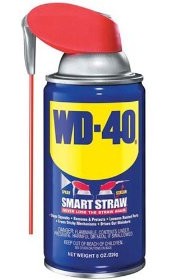
WD-40 was created in 1953 by Norm Larsen. It was originally designed to prevent corrosion caused by water — the WD stands for “water displacement.” Norm’s 40th formula was successful and that’s where the “40” comes from.
The formula is so secretive, they decided not to patent it. This may sound counter intuitive, but filing for a patent would require disclosing the ingredients.
 That strategy was good for a while, but many years later, the Hazardous Communication regulation required that ingredients of potentially hazardous products be made available to emergency responders.
I did some digging and found the material safety data sheet for WD-40 (PDF).
The main ingredient is Stoddard solvent, which is also known by its own brand name, Varsol. CO2 is used as a propellant and mineral oil is another main ingredient.
It was first used to protect the Atlas missile from corrosion and it became available to consumers in 1958. Since then, consumers have found over 2000 uses that the WD-40 Company endorses (and many more it doesn’t).
There is a popular email circulating that you may have seen. It states WD-40 is primarily fish oil, but that’s not true. The email also lists a number of uses, although the WD-40 company only recommends about half of those. Some of the 2000 recommended uses include:
- Stop squeaks (doors, bike chains)
- Remove and prevent rust (lawn mower blades during off season, cookie tins/sheets)
- Remove gum, glue, ink and lipstick from fabrics and other items
- Lubricate metal parts (zippers, tools, machines)
- Loosen nuts and screws
- Cleaning (shower doors, tools, lime stains in toilet bowls)
Check out the full list of 2000 uses (PDF).
PS – The WD-40 company has an affinity for product names with numbers. They also make 2000 flushes, X-14, 3-in-one-oil and a few other products.
Broken Secrets | Facebook | Twitter | Email | Kindle
Sources: Official WD-40 Uses (PDF), MSDS (PDF), Snopes


 Broken Secrets