Archive for October, 2011
Disney Castle Based on Real Castle in Germany
By Chad Upton | Editor
Often inspired by the Disney fairytales of Sleeping Beauty and Cinderella, many young girls dress as princesses for Halloween.
While they are popular fairytales, these theme-park castles are largely based on a real castle in Germany — Neuschwanstein Castle. Look at the resemblance:
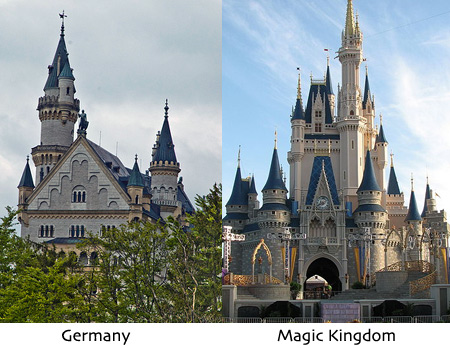
Disney has also noted the inspiration from structures in France too: Notre Dame de Paris and Hospices de Beaune.
Broken Secrets | Facebook | Twitter | Email | Kindle
Sources: wikipedia (Sleeping Beauty’s Castle, Cinderella Castle, Neuschwanstein Castle)
Photos: Katie Rommel-Esham (cc) Jack Versloot (cc)
The QR in QR Code Means Quick Response
By Chad Upton | Editor
Although we typically use QR codes with our mobile phones, they were actually invented by a Japanese company (Denso) for tracking products during manufacturing. Even though they’ve been around since 1994, QR codes have only started to become popular in North America in the past few years. They’re also known as “matrix”, “2d” or “square” barcodes.

Traditional 1 dimensional barcodes are very limited in the amount of information they can store in a small space, generally an 8-24 digit number. The number in a traditional bar code is really only useful if you have a database or table where you can lookup that number to get more meaningful information, such as the price of the item at a grocery store. QR codes can contain a lot more data.
They’re called Quick Response codes because the data is in the code and it doesn’t have to be looked up in a table to be meaningful. For example, the QR code in this article contains a URL to another post on the blog related to bar codes. When you scan it with your phone’s QR app, your phone can decode the image into the URL, no remote lookup is required. QR codes can also be used to get text or send sms text messages and dial phone numbers.
Carrots Do Not Improve Eyesight
By Chad Upton | Editor
Like many kids, I didn’t like vegetables — especially carrots and broccoli. Adults frequently told me that carrots would improve my eyesight, so that seemed like a good reason to try liking them.
There was one person who didn’t tell me this, he actually told me the opposite. My grand father overheard somebody tell me that carrots would improve my eyesight and he let me in on a little secret — it was all a big lie. Carrots do not improve your eyesight.
Sure, carrots and many other foods do contain beta-carotene, which metabolizes into Vitamin A and everyone agrees that is essential for maintaining eye health, but it does not improve it. If you are not consuming enough vitamin A, any number of sources could help restore your vitamin A supply. Carrots themselves are not unique or magical in this way. In fact, carrots have less beta-carotene per 200 calorie serving than red peppers, kale and lettuce.

If lettuce, kale and red pepper have more beta-carotene than carrots, why do carrots get all the eyesight credit?
How Steve Jobs Got His 2009 Liver Transplant So Quickly
By Chad Upton | Editor
When I was about 7 years old, my grade school classroom had an Apple II computer stashed in the corner of the room. I remember the excitement when our teacher said we could use the computer after we finished all of our work, even though I had no idea how to use it. Nobody knew how to use it, except for Woody.
Woody was the only kid who had a computer at home and it too was an Apple II. Since that was the first affordable mass-market computer, if any home or small business had a computer, it was usually an Apple.
Steve Jobs and Steve Wozniak started the personal computer revolution. There’s no doubt it would have happened without them, but who knows when. Steve Wozniak had the drive to build prototypes of computers just for fun while his partner Steve Jobs had the vision and drive to sell them to people who didn’t know how to use them, like some other products Apple has recently been successful with.
When Steve Jobs passed away, his assets were estimated to be around $6 billion. With that kind of wealth, you could buy almost anything. So, when he received a liver transplant in 2009, a lot of people suggested that he bought his way to the top of the waiting list. How else could he have skipped ahead of 16,000 other people?
His wealth did help him, but not in the way that some have implied.

He was on the transplant waiting list. Well, he was actually on more than one waiting list. Some have even speculated that he was on all of the waiting lists.
So, why doesn’t everyone do this? The rule at the time was that you needed to be within 4 hours of the transplant hospital. For most people, that significantly reduces the number of transplant lists you could be on. But, if you’re a billionaire with a private jet on standby, you’re within 4 hours of a lot of places.
Even still, with so many people waiting, how did he get to the top of the list so quickly?
The United Network for Organ Sharing (UNOS) audits the transplant centers to ensure fair treatment. So, he didn’t likely get to the top of the list because of his wealth or social status.
Since his jet gave him access to almost any transplant center in the country, he did what any smart analytical person would do: he figured out which transplant center had the shortest wait and made sure he was on that list. That’s how a guy who lives in Northern California ends up with a liver transplant in Tennessee. It turns out, the median wait time in Tennessee was 85% shorter than the national average.
The technology that Steve brought us will fade, but his approach to everything, including saving his own life, is the real gift he gave us. When Steve rejoined and began to rejuvenate Apple in 1997, the slogan was, “think different” and that sentiment is Steve’s real legacy.
Rest in peace.
Broken Secrets | Facebook | Twitter | Email | Kindle
Sources: digital journal, cnn, slate, the daily beast
Barefoot Running is Better for Joints Than Running in Shoes
By Chad Upton | Editor
Some people think these shoes look weird:

But, they just look like feet. So, maybe it’s our shoe stressed feet that look weird. If you look at your toes, they’re not spread out like your fingers. Most people’s toes are squished together in the shape of a shoe, even when they’re not in shoes.
That’s weird.
I never really thought about it much, until I saw a pair of these shoes. They’re called “Five Fingers” and they’re made by a company called Vibram. They’re a bit pricey, so you may also want to look at Fila’s similar and slightly cheaper version called “Skele-toes.” This style of footwear are to shoes what winter gloves are to mittens.
These shoes and the growing category of “minimalist running shoes” are a hot trend in running circles right now. There are many reasons why, but the ten most convincing reasons are on the floor in front of you.
We’ve been cramming our feet into unnatural shoes since childhood, but what would our feet look like if we had never worn shoes? Probably something like this:

These feet actually look weird too; we’re used to seeing feet that are shaped like shoes.

The difference is glaring. Look at the straight black line in the first photo, it stretches from the big toe, across the ball of the foot to the heel. You can’t draw a straight line on the second photo that aligns these three important parts of your feet.
 Cramping your foot’s style is not cool because that can lead to cramps and strains and lots of heel pains. If you’ve ever had foot pain or discomfort, you may think your shoes don’t have enough cushioning or that your arches have too much or too little support. While there are exceptions, these problems are generally myths perpetuated by the shoe industry that simply wants you to buy new shoes often.
Many of the best runners in the world, who consistently win marathons, run without any shoes at all. Do they have bad feet? No, they have really strong feet. They also have better knees and hips than runners who use thick padded running shoes. One medical study compared running in shoes to barefoot and fount that barefoot running demonstrated 38% lower knee torque and 54% less internal hip rotation torque. This means that running barefoot provides a much more natural motion for your joints. This notion is pretty surprising the first time you hear it, but there are a mountain of medical studies to support it.
Should you throw away your super spongy running shoes and go barefoot tomorrow? Probably not. Just like running in shoes, you need some education to do it the best way possible. Check your area for a local running club where you can learn, or look for some online videos on the subject. I’ve also got some great sources listed below which would make a good starting point.
Also, running on soft shoes might not be a good idea but research shows that running on soft surfaces is better than hard surfaces. Even though grass and dirt may have rocks and pits, these actually work to strengthen your ankles over time. That said, you may also want to consider the type of floors you have at home — you may even want to get something like soft rubber floors.
PS – Neil posted a funny story at 1000awesomethings.com about my first outdoor run earlier this year.
Broken Secrets | Facebook | Twitter | Email | Kindle
Sources: PM&R, Shoe Myths, Nature.com, CMAJ.ca, bjsportmed.com
The Plastic End of a Shoelace is Called an Aglet
By Chad Upton | Editor
Originally and occasionally still, Aglets are made from metal, often copper or brass.
The word Aglet (or Aiglet) comes from an old french word, aguillette and it’s root word is aguille, which means needle. This makes sense since aglets make it easy to thread laces through eyelets in garments and shoes.

Metal aglets can still be found on garments, although usually as decorative accents rather than functional fasteners. Some of these decorative aglets are made from stone or glass and even shaped like small figurines. These go back to at least the fifteenth century, even Shakespeare references an “aglet baby” in The Taming of the Shrew.
Broken Secrets | Facebook | Twitter | Email | Kindle
Sources: wikipedia (aglet), dictionary.com


 Broken Secrets
